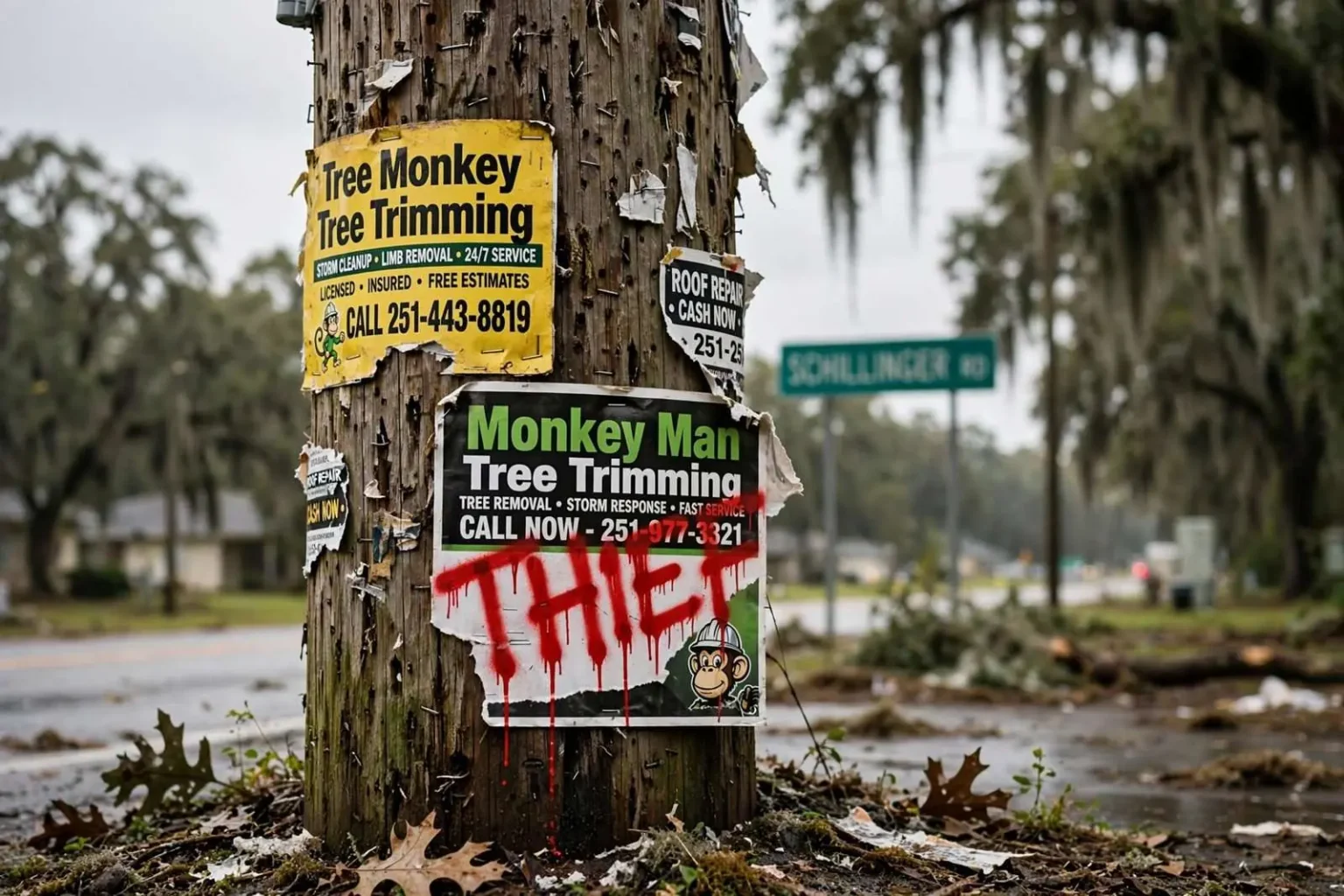
MOBILE COUNTY, Ala. — Two area tree trimming companies are at odds with one another, and the dispute has been playing out in an unusual venue: the utility poles along local roadways. Signs for Tree Monkey Tree Trimming and Monkey Man Tree Trimming have turned up in various parts of the county. In at least one instance in West Mobile, one company’s advertisement appears to have been overlaid with a bold “THIEF” label.
The dueling signage — two similarly named outfits competing for the same storm-driven business, their posters crowding the same poles — has turned the county’s roadside rights of way into a low-stakes billboard war. And in at least one case, the competition has spilled from rivalry into outright accusation, with the “THIEF” label suggesting a dispute over a name, a customer or a job that the poles cannot adjudicate.
Little Recourse for Either Side
One of the owners acknowledged the feud but noted there is little practical recourse available — because tacking posters to poles along public rights of way is prohibited in the first place. That is the essential irony of the situation. Neither party can credibly complain about the defacement of an advertisement that should not be there. A company that reports a competitor for altering its sign is simultaneously reporting the existence of its own unpermitted signage.
The result is a dispute that exists entirely outside the channels that would normally resolve it. There will be no complaint filed, no court date and no citation, because both sides are equally exposed under the same rules. The only enforcer with a free hand is whoever removes the signs, and their remedy applies to both companies without distinction.
The standoff illustrates a broader truth about roadside advertising: the rules against it are widely ignored precisely because the penalties for ignoring them are small. When the worst outcome for an illegal sign is that it gets taken down, a business that posts hundreds of them comes out ahead as long as even a few generate calls before removal crews arrive.
Why Bandit Signs Persist
Signs affixed to utility poles, sometimes called bandit signs, are illegal in most Alabama jurisdictions and create genuine problems beyond aesthetics. Staples and nails driven into wooden poles create hazards for utility line workers who climb them, and the accumulated hardware degrades the pole over time. Utility companies and municipalities remove them routinely, which is precisely why they reappear routinely.
The hazard to climbers is not hypothetical. Line workers scale poles wearing climbing gaffs and rely on the wood itself for footing; a staple or nail buried in the pole can catch a gaff, deflect a boot or tear a glove at the worst possible moment. For the utilities that own the poles, accumulated hardware also shortens the life of an asset that is expensive to replace, which is why crews that encounter signs generally pull them on sight.
The economics explain the persistence. The cost of printing and posting is trivial, enforcement is sporadic, and even a handful of calls can justify the effort. For service businesses competing on immediacy — tree work in particular, where demand spikes after every storm — visibility at the roadside carries real value.
Mobile County offers tree services an unusually active market. The Gulf Coast’s long growing season keeps canopy growth vigorous, and the region’s exposure to hurricanes and severe thunderstorms means every major storm is followed by weeks of cleanup work — broken limbs over driveways, leaning oaks, tangled power drops. Homeowners who wait until a storm is bearing down often find the best companies booked out, which is exactly why firms compete so hard for visibility during the calm between storms.
The local environment also raises the stakes of good tree work. Mature live oaks and southern pines define neighborhoods across Mobile County, and a bad cut or an improper “topping” can permanently damage a tree that took generations to grow. Reputable companies employ crews trained to prune to industry standards, and they carry the equipment to remove a storm-damaged tree without dropping it on the roof it fell toward — differences in skill that a roadside sign cannot convey.
Into that market step firms whose names blur together for the casual driver. Two companies with similar names competing on the same poles makes confusion all but inevitable, and a homeowner who scribbles a number off a pole has no way to know which company — or which version of a company’s reputation — will actually answer the phone.
The Legal Landscape for Roadside Signs
The prohibition on signs in public rights of way is not unique to Mobile County. Cities and counties across Alabama restrict signage on public property, and state law addresses signs on highway rights of way as well, with penalties that can include fines and removal at the sign owner’s expense. Utility poles standing in those rights of way are particularly off-limits, both because of the property interest involved and because of the climbing hazard the hardware creates.
Enforcement, however, depends on staffing and priority. Code enforcement officers and utility crews remove what they find, but the volume of postings — from tree services and roofers to garage sale notices and buy-houses-for-cash placards — guarantees the landscape refreshes faster than it can be cleared. Municipalities that have adopted sign ordinances increasingly pair removal with education campaigns, urging businesses to use permitted channels: yard signs with the owner’s permission, advertising on vehicles, local media and online listings that cost little more than a stack of posters.
For businesses on the receiving end of a rival’s vandalism, the ordinary remedies still exist even when the sign does not. Damaging another company’s property is its own offense regardless of where the property stood, though proving who altered a sign is another matter — as the “THIEF” label in West Mobile demonstrates, the alterations tend to be anonymous.
Advice for Homeowners
The dispute offers a useful reminder for anyone hiring tree work. Homeowners should verify that a contractor carries liability insurance and workers’ compensation coverage before any work begins, ask for a written estimate, and confirm the company’s physical business address before handing over a deposit or letting a crew start cutting.
Those precautions matter most in the aftermath of a storm, when fly-by-night operators follow the damage from county to county. A homeowner whose tree lands on a neighbor’s fence, a passing car or a power line can be liable for the result, and a contractor without insurance leaves the homeowner holding the bill. Asking for a certificate of insurance directly from the insurer — not a photocopy from the truck — takes minutes and screens out most bad actors on the spot.
Payment timing is another protection. Reputable tree companies typically collect a deposit or nothing at all until the work is complete, and they accept that a homeowner may want to see proof of insurance and a written scope before the first cut. Companies that demand full cash payment up front, or that appear door to door immediately after a storm offering an instant discount, present the highest risk profile in the industry.
Homeowners planning significant removals or pruning near a structure should also ask how the work will be done: whether the company will climb or use a bucket truck, how it will protect roofs and fences, and how it handles cleanup and stump grinding afterward. A written estimate that spells out the scope, the price and the cleanup gives both sides the same expectations and provides something concrete if a dispute follows.
The Bottom Line for Mobile County Residents
The pole-pole feud between the two monkey-named tree services is, on one level, a minor curiosity — two competitors skirmishing over signage neither was supposed to post. But it captures something real about how residents find service companies: quickly, visually, and often with too little verification. The sign that catches a driver’s eye on Government Boulevard or Schillinger Road says nothing about insurance, training or how the company treats a customer when a job goes wrong.
The practical takeaway is to treat roadside advertising as a starting point, not a credential. A number from a pole can lead to a competent local business; it can just as easily lead to a crew with a chainsaw and a rented truck. The steps that separate the two outcomes — verifying insurance, getting the estimate in writing, checking the address, asking neighbors for references — cost a homeowner less than an hour and can prevent the kind of dispute that makes it onto the pages of the local news.
As for the two companies at the center of the feud, the poles of Mobile County will keep carrying their signs as long as the economics reward it, and utility crews will keep pulling them down. The rivalry itself may eventually be settled the usual way such feuds are — by whichever firm does the better work when the next storm comes through and the phones start ringing.