Tributaries 2012: New Literary Anthology Celebrates Mobile Bay Area Writers
Tributaries 2012, a new literary anthology edited by Kevin Lee, features prose and poetry from 14 Mobile Bay area writers.
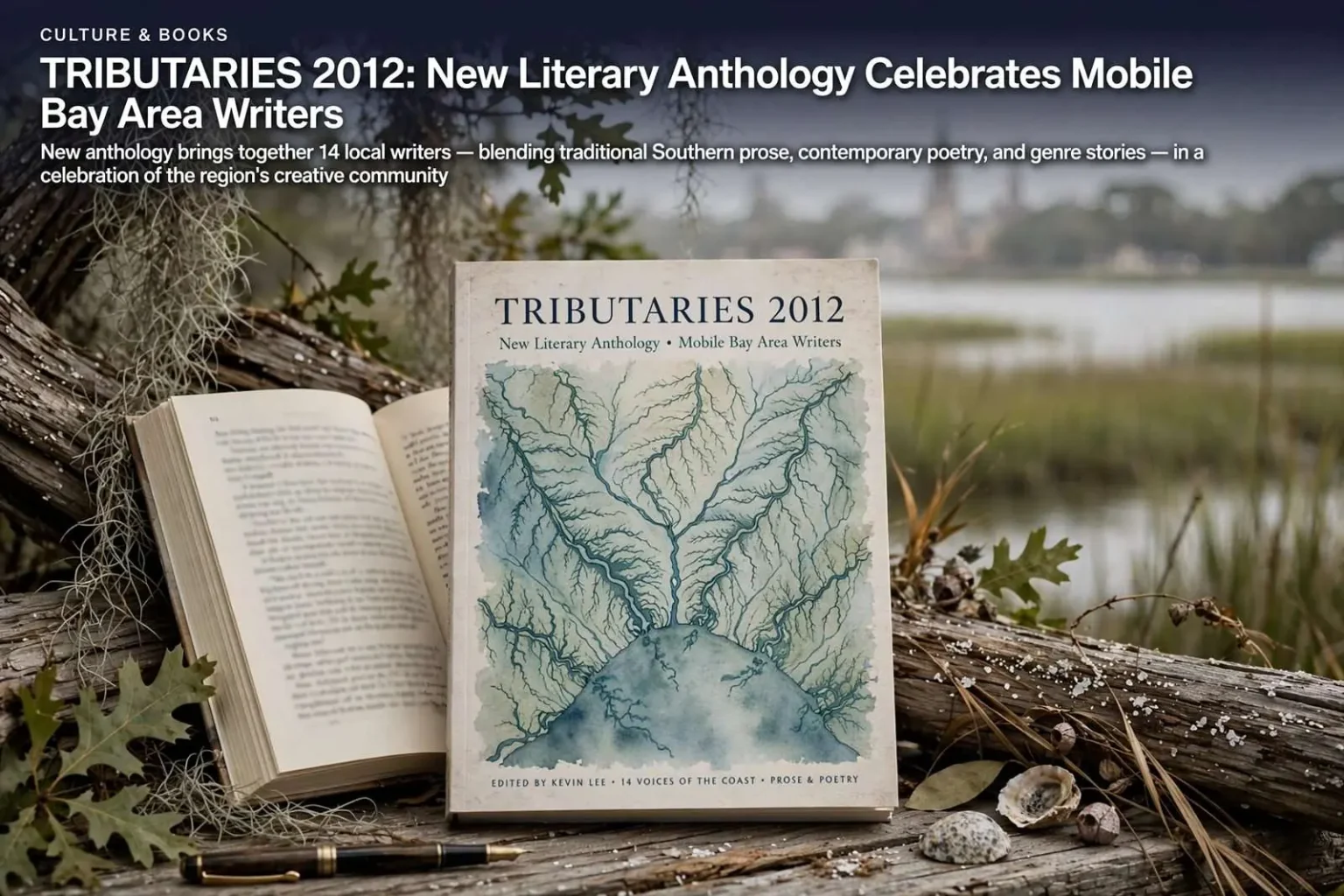
A new literary anthology highlighting the talents of Mobile Bay area writers has arrived, offering readers a diverse collection of prose and poetry that showcases the region’s vibrant creative community. “Tributaries 2012,” edited by Kevin Lee, brings together the work of 14 local literary artists in what the publisher hopes will become an annual tradition. The title itself carries the region’s geography in it — tributaries feeding a bay, voices feeding a shared literary current — and the collection’s editors clearly hope the metaphor holds for years to come.
The collection features a compelling mix of traditional and contemporary styles, demonstrating that the Mobile Bay area’s rich legacy of storytelling remains alive and well. Anthologies of this kind serve a dual purpose: they give established writers a new outlet, and they give emerging voices a first chance at print alongside names readers may already know. For a metro area of Mobile’s size, sustaining a project with 14 contributors is a meaningful statement about the depth of the local writing community.
A Fresh Take on Southern Literature
Far from fitting neatly into any single mold, the anthology spans a wide range of voices and perspectives. Contributors Ronald F. Turner and Thomas Perez offer narratives firmly rooted in the traditions of the twentieth-century South, delivering observations that remain relevant to modern readers. Their work grounds the collection in the region’s literary inheritance — the storytelling cadence, the sense of place and the long memory that have distinguished Southern writing for generations.
Meanwhile, writers Gideon C. Kennedy and Samuel Wilkes bring distinctly contemporary sensibilities to their work, incorporating unexpected twists and inventive styles. The contrast between the traditionalists and the experimentalists is part of what gives the anthology its shape: rather than presenting a single definition of what Mobile Bay writing sounds like, “Tributaries 2012” argues that the region sustains several at once, and that the conversation between them is what keeps a literary community healthy.
The collection also holds genuine surprises. C.J. Petterson ventures into Western territory, an unexpected genre choice from a writer based in the land of bayous and Spanish moss. The move is a reminder that regional writers are not obligated to write about the region — that a storyteller who lives among live oaks and salt marshes can just as credibly ride the range, and that genre fiction has long been one of the places where Gulf Coast writers exercise their range most freely.
Jennifer McDonald contributes a powerful story that balances emotional weight with themes of hope and redemption. Redemption narratives occupy a central place in the Southern canon, and a story that manages emotional weight without tipping into sentiment is among the hardest balances in short fiction. Her contribution anchors the anthology’s prose in the kind of storytelling that lingers with readers after the book is closed.
Poetry That Pushes Boundaries
Interspersed among the prose pieces are poems offering distinctive perspectives. Marjorie Turner blends the spare economy of Hemingway with the ethereal qualities of haiku, a pairing that demands discipline — every word counted, nothing decorative surviving the draft. The result is poetry built on restraint, in which what is left unsaid carries as much weight as what appears on the page.
Elizabeth Herboso explores darker imagery in her examination of love and its complexities. Poetry that refuses to prettify its subject has long been one of the strengths of regional literary journals and anthologies, which can publish work that commercial outlets would find too sharp. Her poems give the collection its shadow side, a necessary counterweight to the gentler pieces around them.
Where to Find It
The anthology is priced at $12.95 and is available at several local retailers, including Ashland Gallery and Bienville Books in Mobile, Lunatix & Co., and Page & Palette in Fairhope. It can also be purchased online through Amazon. The lineup of shops says something about how literary culture circulates on the Eastern Shore and in the Port City: independent bookstores and galleries, rather than big-box chains, are where local titles find their readers.
Page & Palette in Fairhope in particular has spent decades as a gathering place for the town’s famously literary-minded residents, hosting author events and book clubs in a community that has drawn writers and artists since its founding as an experimental utopian colony more than a century ago. Bienville Books has filled a similar role in downtown Mobile, anchoring the city’s independent-bookstore scene and giving local authors a home for signings and launches. Galleries such as Ashland, meanwhile, have long bridged the visual and literary arts in the area, stocking regional titles alongside paintings and prints.
Publishing an anthology through local shops rather than relying solely on online sales keeps the economic loop tight: dollars spent at independent retailers recirculate through the community, and the store events that accompany a local release build audiences for the next volume. For a first-time annual project, that grassroots retail network is often the difference between a one-off publication and a lasting series.
The Region’s Literary Legacy
“Tributaries 2012” arrives in a region with deeper literary roots than outsiders might guess. The Gulf Coast has produced and attracted storytellers for generations — from Mobile’s own rich tradition of memoirists and novelists to the famously literary small towns of south Alabama’s interior, where two of the state’s most celebrated novels put a swath of the region permanently on the national literary map. Writing workshops, reading series and university programs across the area have kept the pipeline fed, and anthologies are where that pipeline becomes visible to the general public.
Kevin Lee, the collection’s editor, is a familiar figure in Mobile’s cultural scene, and the editorial work an anthology demands — selecting, sequencing and shaping a dozen-plus disparate voices into a single reading experience — is considerable. The editor’s hand is also the collection’s argument: that these 14 writers, of these styles, belong together. On the evidence of the contributor list, spanning traditional Southern narrative, contemporary experimentation, genre detours and both spare and dark-edged poetry, the case is persuasive.
The publisher’s hope that “Tributaries” will become an annual tradition reflects a broader trend across the Gulf South, where regional literary anthologies have become a proven vehicle for sustaining local writing communities. An annual cycle gives writers a deadline, gives readers a recurring event to anticipate, and gives bookstores a dependable local title each year. It also builds an archive over time — a decade of annual volumes becomes a portrait of a region’s literary life that no single book could capture.
The effort, as the publisher frames it, is about bridging the gap between experienced writers and emerging voices. That bridge matters because literary communities fail quietly: when emerging writers cannot find publication or audience nearby, they either stop writing or move away, and the local scene thins. An anthology that prints the unproven next to the established is the simplest and most effective countermeasure available, and at $12.95 it is priced for exactly the broad local readership such a project needs.
For readers in Mobile, Baldwin County and beyond, “Tributaries 2012” offers a chance to read their own region through 14 pairs of eyes — to recognize the streets, the weather, the rhythms of Gulf Coast life in fiction and verse, and to discover writers whose next work they can follow from its first appearance. The book is on shelves now at the retailers above, and the reading it invites is, in every sense, local.
Anthologies also serve as a record of a moment in a region’s creative life. In 2012, the Mobile Bay area’s arts community was visibly busy — galleries, theaters and music venues all running regular programming — and a literary collection from that year captures the scene in ink. Years from now, the volume will read as a snapshot of who was writing here and what they were writing about, a function that daily coverage and event listings can never quite perform.
The prose-poetry mix is deliberate in that respect. A collection of only short stories skews toward one kind of reader; a collection that interleaves verse gives browsers a reason to slow down and makes the book work as a survey rather than a showcase. It also mirrors the way local writing communities actually operate, with prose writers and poets sharing workshops, readings and coffeehouse open mics without much regard for the line between the forms.
Supporting the Local Literary Scene
For readers wondering how to use a collection like this, the stores stocking it have already answered the question: start local, then follow through. Attending a reading, recommending a favorite piece to a book club, or asking a librarian whether the anthology is in the catalog are all small acts that determine whether a second volume appears. Writers who see their local anthology sell learn that the community is listening, which is precisely the encouragement that keeps the next story or poem coming.
The mathematics of small-press publishing also explain why the local retail network matters so much. A $12.95 paperback produced in modest print runs earns thin margins, and every copy sold through a consignment arrangement with a hometown shop sustains both the publisher and the store. Readers who buy from the shops listed above are, in effect, underwriting the next edition of the series — a small-scale version of the patronage that has sustained regional literature for generations.
What “Tributaries 2012” ultimately offers is proof of supply and demand meeting in the middle: 14 writers with finished work, a publisher willing to gather it, and a half-dozen local storefronts ready to put it in windows. If the annual tradition takes hold, each edition will add names to the roster and readers to the audience, and the region’s tributaries will keep feeding the bay.