Turkey Fryer Safety: Mobile County Health Officials Urge Caution Before Thanksgiving Day
Before anyone lowers a bird into hot oil on Thursday, the Mobile County Health Department wants cooks to understand how quickly a turkey fryer can tip, boil over or ignite.
MOBILE, Ala. — Families who plan to lower a whole bird into a pot of hot oil this Thursday should go in with their eyes open, the Mobile County Health Department said this week, as it issued a set of turkey fryer safety warnings ahead of Thanksgiving on Nov. 26.
The department said the outdoor fryers that have become a holiday fixture in many backyards come with real hazards. They can tip over, overheat and send scalding oil spilling across the ground, and any one of those mishaps can lead to a fire, a serious burn or some other injury.
Its overall advice is to be wary of using a turkey fryer at all. For households that decide to go ahead with one anyway, the department laid out a list of precautions meant to keep the cook, the guests and the house out of harm’s way.
Why Health Officials Are Sounding the Alarm Now
The county’s health department said fried turkey has steadily gained fans over the years, and more home cooks now treat the fryer as part of the Thanksgiving tradition. That popularity is colliding with a well-known fact about the holiday: no day of the year sees more home cooking fires than Thanksgiving.
The department said it wanted people to think through the risks before the bird ever goes into the bubbling pot, rather than after something has already gone wrong. Thanksgiving falls on Thursday, Nov. 26, which leaves only a few days for families to rethink their plans, gather safety gear or choose a different cooking method.
Fire-safety organizations have raised similar concerns for years. The National Fire Protection Association, a widely cited nonprofit that writes fire codes and safety guidance, has long discouraged the use of outdoor gas-fueled turkey fryers that fully submerge the bird in hot oil.
Five Ways a Fryer Can Turn Dangerous
The health department pointed to several distinct ways a turkey fryer can go wrong. Understanding each one helps explain why the safety steps that follow matter so much.
Oil meets flame
Most backyard fryers sit directly over an open propane burner. The department said it takes only a little oil reaching that burner to start a large fire, and once hot oil is burning, it is very hard to bring under control.
The pot boils over
When a pot holds too much oil, or when the turkey still has ice inside, the oil can surge over the rim the moment the bird is lowered in. That overflow can run straight down onto the flame below.
Hot metal everywhere
The pot’s sides, its lid and its handles can all become hot enough to cause severe burns. Someone who grabs a handle without proper protection, or who brushes against the pot, can be hurt in an instant.
A top-heavy setup
Many fryers stand on narrow legs, and the department warned that the units can tip over with little effort. A spill can spread hot oil across a wide area, reaching feet, legs, pets and anything flammable nearby.
No built-in brakes on the heat
Fryers that lack thermostat controls have nothing to stop the oil from climbing in temperature. The department said that oil in such a fryer can keep heating until it reaches the point where it ignites on its own.
Turkey Fryer Safety Starts With the Setup
Where a fryer is placed may be the single biggest decision a cook makes on Thanksgiving. The health department said fryers belong outside, on firm and level ground, with plenty of distance between the pot and any building or anything that can burn.
The department listed several spots that are off-limits. A fryer should never be used on a wooden deck, beneath a covered patio, inside a garage or in any enclosed area. Each of those places either burns easily, traps heat and fumes or puts a structure directly in the path of a flare-up.
A paved driveway or a flat, open patch of bare ground away from the house is generally a better choice. Cooks should also look up before they light the burner, since tree limbs and roof overhangs can catch fire from rising flames. Keeping a clear path around the fryer makes it easier to step back quickly if something goes wrong.
Getting the Bird and the Oil Ready
The health department said the turkey must be fully thawed before it goes anywhere near the fryer. Ice and hot oil are a dangerous mix, because water turns to steam almost instantly in the pot and can force the oil to bubble up and over the sides. Patting the outside and the cavity of the bird dry with paper towels removes more of that moisture.
The department also warned against overfilling the fryer. A common way to find the right amount of oil, often recommended by food-safety and fire-safety groups, is to do a dry run with water a day ahead. Place the turkey in the empty pot, add water until the bird is just covered, then lift the turkey out and mark the water line. That mark shows roughly how much oil the pot can hold without spilling once the turkey goes in. The pot, and the turkey, should then be dried completely before any oil is added.
The U.S. Department of Agriculture advises against stuffing a turkey that will be deep fried. Cooks should also read and follow the manufacturer’s directions for their fryer, including its limits on turkey size and its guidance on oil temperature.
While the Oil Is Hot: Rules for the Cook
The health department was firm on one point: a fryer should never be left alone. Without thermostat controls, it said, the oil will just keep getting hotter until it catches fire. Anyone running a fryer should plan to stay with it from the moment the burner is lit until the oil has cooled.
Children and pets need to be kept well away from the fryer, both while it is in use and afterward. The department noted that the oil can stay hot for hours after the cooking is finished, so the danger does not end when the turkey comes out of the pot.
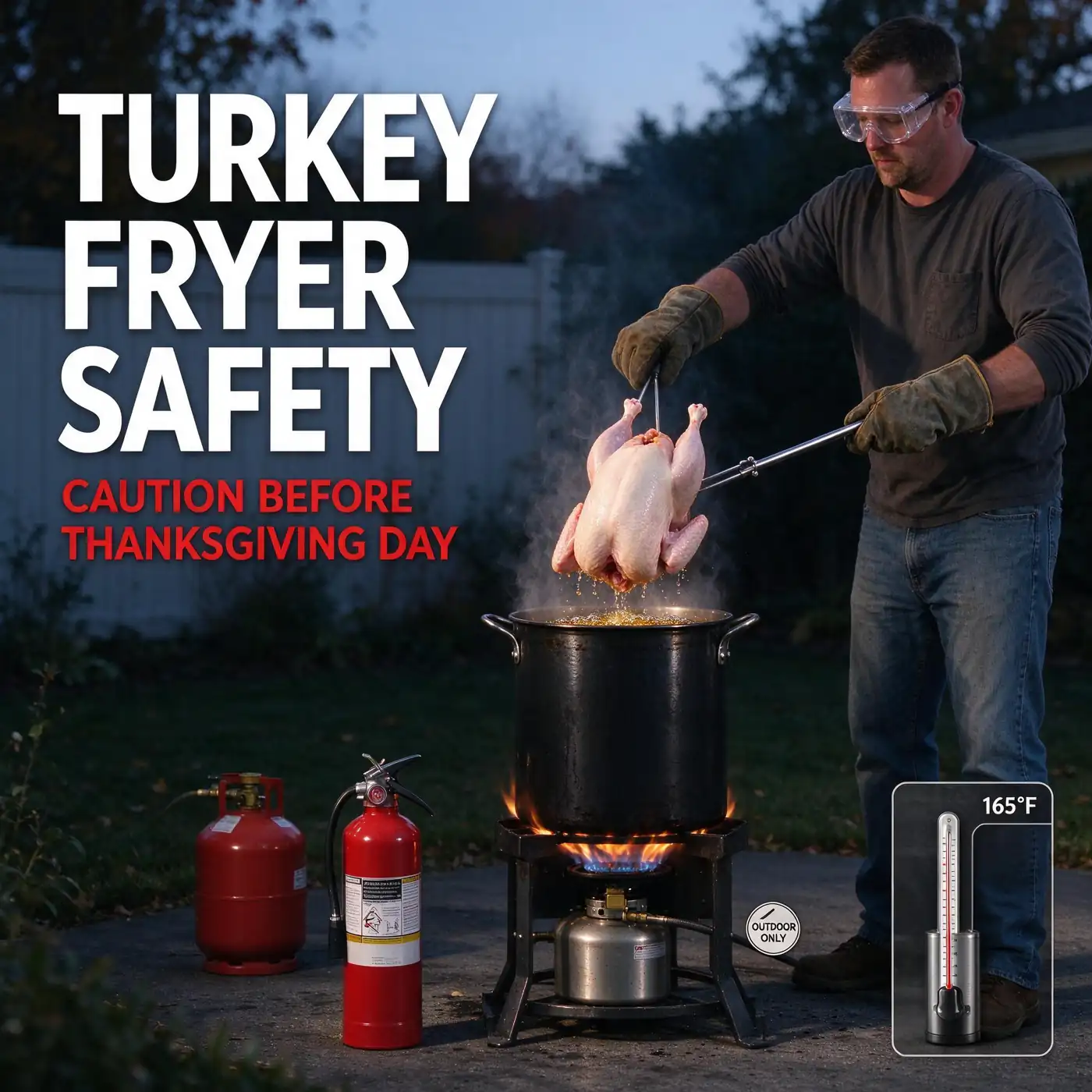
Protective gear is part of the plan as well. The department recommended heavily insulated oven mitts or potholders, plus long-sleeved clothing and eye protection such as safety goggles, to guard against splattering oil. It also urged cooks to have an all-purpose fire extinguisher within easy reach.
Many fire-safety groups add another step: turn off the burner before lowering the turkey into the oil, then lower it slowly. Once the bird is fully in the pot and the oil has settled, the burner can be relit. As with any poultry, the turkey is done when a food thermometer reads 165 degrees Fahrenheit in the thickest parts of the meat.
If a Fire or Burn Happens
Hot oil fires behave differently from ordinary fires. Water should never be thrown on burning oil, because it can cause the oil to erupt and spread the flames. If a fire starts and cannot be put out quickly and safely with an extinguisher, everyone should move away and call 911.
A fryer that is burning or full of hot oil should not be moved or carried, since that is an easy way for oil to splash onto the person trying to help. Turning off the gas supply, if that can be done safely, removes the fuel feeding the flame.
For minor burns, widely accepted first-aid guidance is to cool the skin under cool running water for several minutes. Ice, butter and home remedies should be avoided. Serious burns, burns that cover a large area and burns on the face, hands or groin call for emergency medical care.
Other Ways to Get a Holiday Bird on the Table
For households that want the flavor without the risk, there are alternatives. Roasting the turkey in the oven remains the most familiar option. Some electric fryers designed for indoor countertop use come with built-in thermostats, and oil-free fryers that cook with hot air are also on the market. Anyone considering one of those appliances should check the manufacturer’s instructions and safety listings before buying.
Another choice is to let someone else do the frying. Many grocery stores and restaurants sell fried turkeys during the holiday season, which lets families skip the propane tank and the pot of oil entirely.
What to Know Before Thursday
Here is a quick look at the health department’s advice, grouped by when it matters most:
- Before cooking day: Thaw the turkey completely, measure the right amount of oil so the pot is not overfilled, and pick a firm, level spot outdoors, well away from buildings and anything that can burn.
- Places to avoid: Wooden decks, covered patios, garages and any enclosed space.
- Gear to have ready: An all-purpose fire extinguisher, thick insulated mitts or potholders, eye protection and long-sleeved clothing.
- During cooking: Stay with the fryer the entire time and keep children and pets far away.
- After cooking: Remember the oil can hold its heat for hours, so keep watching the area until it has cooled.
The department’s bottom line is caution. Thanksgiving should be remembered for the meal and the company, and a few minutes of planning can keep a holiday tradition from turning into a trip to the emergency room.