Two Pascagoula drivers killed in wrong-way Highway 63 crash near county line
Two Pascagoula drivers died in a head-on crash on Highway 63 just south of the George-Jackson county line, the Mississippi Highway Patrol said.
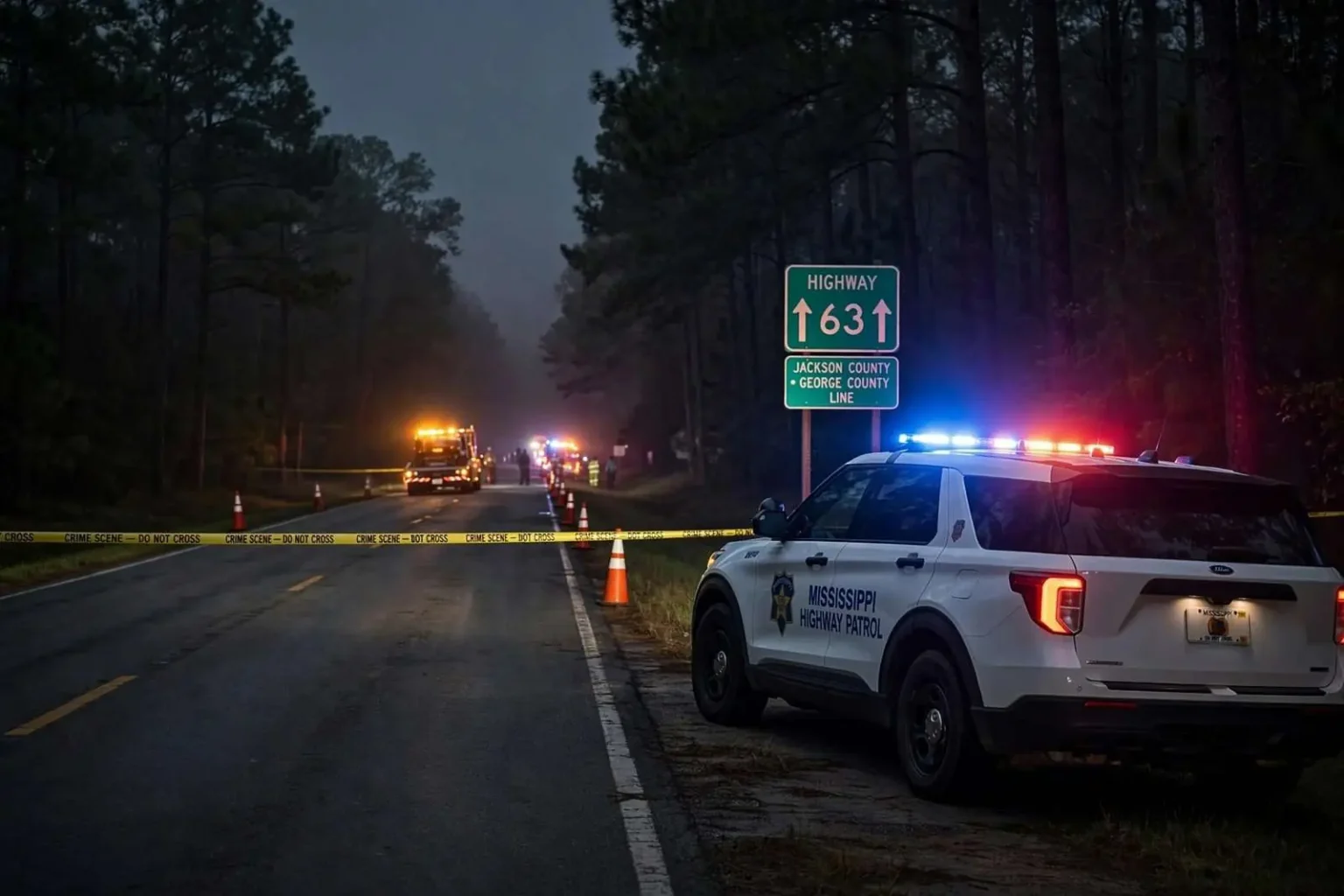
Two men from Pascagoula died in a head-on crash on Highway 63 in Jackson County late Monday night, according to the Mississippi Highway Patrol. Troopers said the collision happened around 9:30 p.m. just south of the George-Jackson county line.
According to the Highway Patrol, a 1999 Ford F-150 pickup driven by 25-year-old Jason Clark of Pascagoula was headed south on Highway 63 when it struck a 2012 Buick passenger car. Troopers said the Buick, driven by 56-year-old Curtis Price of Pascagoula, was traveling north in the southbound lanes at the time of the impact. Both drivers were pronounced dead at the scene.
Troopers did not report any additional occupants in either vehicle. The Mississippi Highway Patrol said the crash remains under investigation. Officials had not released a determination on what led the Buick into the wrong lanes, and no findings on contributing factors were announced.
What investigators examine in wrong-way crashes
Wrong-way collisions present investigators with a specific set of questions, and answering them takes time. Troopers reconstructing a head-on crash work from the physical evidence — skid marks, yaw marks, the point of impact, vehicle damage patterns and debris fields — to establish the position and speed of each vehicle in the moments before the collision. Investigators also examine the roadway itself, checking signage, pavement markings and lighting where the driver entered the opposing lanes.
Determining why a vehicle traveled against traffic can take days or weeks. Investigators typically await toxicology results, review any available video from nearby businesses or intersections, and interview witnesses who may have seen the vehicle before impact. Until those steps are complete, officials generally release no finding on contributing factors, which is why Monday night’s crash remains open with no determination announced.
The location of the crash, just south of the Jackson County line with George County, places it on a stretch of Highway 63 far from the interstate corridors where wrong-way crashes are most often studied. Rural wrong-way events, while less common than their urban interstate counterparts, occur on two-lane and undivided highways where a driver who strays across the center line has no barrier to stop the resulting head-on impact.
A rural corridor with limited separation
Highway 63 is a primary north-south route linking Jackson County and the Pascagoula area to George County and points inland. The highway carries local traffic, commuters and commercial vehicles between the Gulf Coast’s industrial and population centers and the smaller communities that line the route north toward the county seat at Lucedale.
Along much of the stretch near the county line, the roadway carries traffic through rural and lightly developed terrain, with limited lighting after dark and stretches where opposing lanes are not divided by a physical barrier. Pine forests and scattered residences border the road, and businesses grow sparse in the middle reaches between the Moss Point area and the George County line. At night, that combination — high speeds, no median, minimal illumination — leaves little margin for driver error.
Wrong-way crashes are comparatively rare but disproportionately deadly, because the closing speed in a head-on impact combines the speed of both vehicles. A collision between two vehicles each traveling 55 miles per hour delivers the force of an impact at highway speed into an unprotected front end, and rural crash sites are often farther from trauma centers than their urban counterparts, extending emergency response times when minutes matter most.
Highway safety officials in Mississippi have pointed to darkness, unfamiliar interchanges and impairment among the factors most often present in wrong-way collisions, though no such determination was announced in this case. National research on wrong-way driving has found the crashes cluster at night, involve older drivers and impaired drivers at elevated rates, and occur most often when a driver enters the roadway at an interchange or turns onto a divided route in the wrong direction.
The human toll of a late-night crash
Crashes of this kind ripple through small communities in ways that statistical discussions rarely capture. Both men were from Pascagoula, a city of roughly 22,000 people where connections between families run deep, and a fatal collision on a route many residents drive weekly lands close to home for those who knew the victims and for the first responders who worked the scene.
For emergency personnel, a rural nighttime head-on crash is among the most difficult calls they answer. Deputies, volunteer firefighters and ambulance crews from across the region converge on a dark stretch of highway where both vehicles are likely beyond repair and the outcome is often determined before help arrives. Such scenes leave their mark on the responders as well as the families, which is why public safety agencies across the Gulf Coast have invested in training and peer support for the personnel who work fatal crashes.
The families of both drivers will now wait for the investigation to run its course. Final reports in wrong-way crashes, including any conclusions about contributing factors, are typically released only after all evidence has been gathered and reviewed, and in some cases the answers never fully emerge. What investigators can establish is where and how the vehicles met; why one of them was in the wrong lanes may depend on evidence that has not yet been examined.
Driving safely on rural two-lane highways
Safety officials use crashes like Monday night’s to remind drivers of practices that reduce risk on rural corridors. Headlights matter most after dark — not only for seeing the road but for being seen by oncoming drivers across the full distance between vehicles. Staying right of the center line on undivided highways, especially on curves and over hillcrests where sight lines shorten, gives oncoming drivers the split second they need to react to a vehicle that has crossed into their lane.
Fatigue and distraction are recurring themes in nighttime rural crashes, and officials urge drivers who feel drowsy to stop rather than push on. Impairment, too, remains a persistent factor in fatal collisions across Mississippi, and troopers across the Gulf Coast counties conduct regular enforcement operations aimed at impaired and speeding drivers on exactly the kind of rural routes where restraint systems and airbags face the harshest test.
Seat belts remain the single most effective protection in a head-on impact. National safety research has consistently shown that belted occupants of frontal collisions survive at far higher rates than unbelted occupants, a message that carries added weight on rural highways where emergency response times are longer and the nearest trauma care may be half an hour away.
How the investigation proceeds
Anyone with information about the crash was asked to contact the Mississippi Highway Patrol. Witnesses who saw either vehicle before the collision — including anyone who may have observed the Buick traveling against traffic, or either vehicle in the minutes before impact — can provide information that helps investigators establish a timeline.
Once the investigation concludes, the findings typically go into a final crash report that may be used by insurance investigators and, if warranted, by prosecutors. Until then, the Highway Patrol’s public statements will remain limited to the basic facts: two vehicles, two drivers, no other occupants, and a collision that occurred around 9:30 p.m. on a Monday night on a dark stretch of Highway 63 just south of the George County line.
The crash stands as the latest fatal wrong-way event on Gulf Coast rural highways, a category of collision that safety engineers continue to study even as they acknowledge that no roadway design can fully protect against a vehicle traveling the wrong direction at combined highway speeds. For the two Pascagoula families affected, the investigation’s eventual findings will answer questions; they will not change the outcome of a late-night drive that ended where it should not have.
Highway 63 and the region it serves
Highway 63 serves as one of Jackson County’s primary arteries connecting the Pascagoula-Moss Point area with the interior counties. Traffic on the route includes commuters traveling between the industrial corridor along the Pascagoula River and communities to the north, commercial trucks moving between the port facilities and inland destinations, and residents of the small communities that line the highway making everyday trips for work, school and shopping.
The road’s character changes along its length. Near the coast, it passes through developed commercial and residential areas with signalized intersections; farther north, toward the George County line, it narrows into the rural profile typical of south Mississippi — two lanes of asphalt cutting through pine flatwoods, with unpaved side roads branching off toward scattered homesteads. Those rural stretches carry less traffic than the urban segments but account for a disproportionate share of serious crashes, a pattern seen on rural highways across the nation.
The George and Jackson county line area is a familiar boundary marker for Gulf Coast drivers. Jackson County, anchored by Pascagoula and Moss Point, blends heavy industry along the river and sound with rural stretches inland, while neighboring George County remains one of the state’s most rural counties. The highway that crosses between them carries the daily traffic of both worlds — and on a Monday night, it became the site of a collision that took two lives.
Mississippi Highway Patrol’s role
The Mississippi Highway Patrol is the primary investigative agency for serious traffic crashes on state highways outside municipal limits. Troopers handle everything from routine fender-benders to complex fatality reconstructions, and fatal crashes automatically trigger the more intensive investigative process that Monday night’s collision has entered.
In crashes of this severity, the patrol’s response includes securing the scene, documenting physical evidence, interviewing witnesses, coordinating with the county coroner and, where necessary, closing the roadway while the investigation proceeds. Rural closures of that kind can stretch for hours, rerouting overnight traffic while reconstruction specialists measure and photograph the scene.
The patrol has made reducing fatalities on rural Mississippi highways a continuing priority, combining enforcement campaigns targeting speed, impairment and seat belt use with public education aimed at the behaviors most often present in fatal crashes. The state’s traffic fatality count fluctuates year to year, but rural two-lane highways consistently account for a majority of deaths — a pattern that officials attribute to the combination of higher speeds, less forgiving roadsides and delayed emergency response.
For now, the Highway Patrol’s investigation continues, and officials urge anyone with information to come forward. The crash that ended just south of the George-Jackson county line late Monday night joins a long list of reminders that the most ordinary drives — a pickup headed home to Pascagoula, a sedan out on a dark highway — can turn in an instant, and that the margin between a routine trip and a tragedy is often measured in feet of pavement and seconds of attention.