Urology Associates Welcomes Dr. Dustin Whitaker to Foley, Fairhope Offices
Board-certified urologist Dr. Dustin Whitaker has joined Urology Associates' Foley and Fairhope offices in Baldwin County.
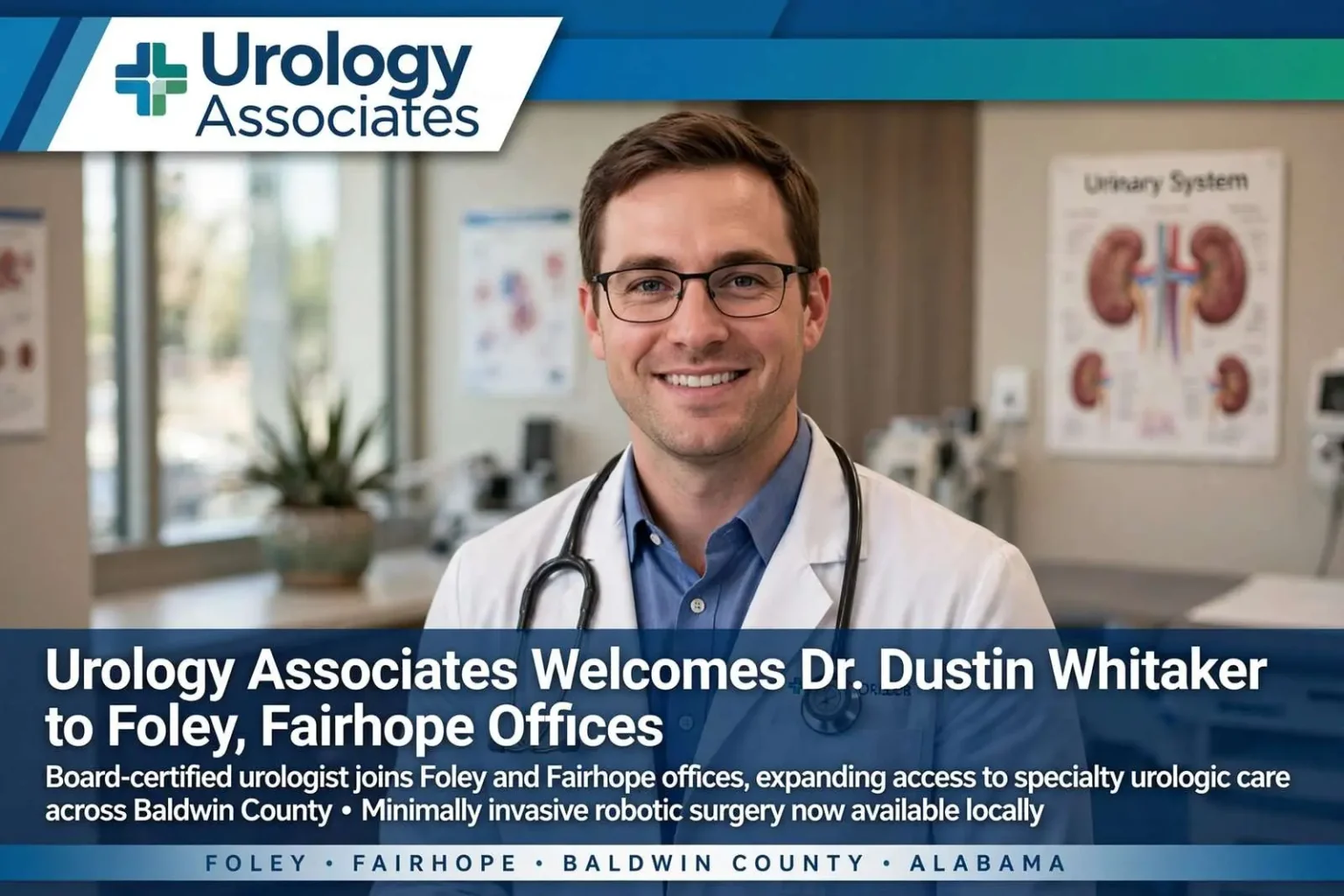
Urology Associates has added board-certified urologist Dr. Dustin Whitaker to its Foley and Fairhope offices, expanding access to specialty urologic care for patients across Baldwin County. Whitaker brings training in minimally invasive robotic surgery along with experience treating a wide range of urologic conditions, from cancers of the prostate and kidney to kidney stones, overactive bladder and other common disorders. His arrival comes as Baldwin County continues to rank among the fastest-growing counties in Alabama, a sustained wave of growth that has increased demand for medical specialists along the Eastern Shore and in south Baldwin County.
The addition of a physician at established offices in Foley and Fairhope reflects a broader pattern on the Alabama Gulf Coast, where physician groups have expanded to keep pace with new residents. For patients in communities such as Foley, Fairhope, Daphne, Spanish Fort, Robertsdale, Gulf Shores and Orange Beach, having urology services available locally can mean shorter drives, earlier appointments and follow-up care that does not require a trip across Mobile Bay.
An Alabama education
Whitaker earned a bachelor’s degree in chemical engineering from the University of Alabama in Tuscaloosa before earning his medical degree from the University of Alabama School of Medicine in Birmingham. The road from an engineering classroom to a hospital ward is one a number of physicians have traveled, and the systematic, analytical habits built in an engineering curriculum pair naturally with the diagnostic work urology demands. The University of Alabama School of Medicine, the state’s flagship public medical school based on the campus of the University of Alabama at Birmingham, trains a large share of the physicians who eventually practice across Alabama and the surrounding Gulf South states.
From Birmingham, Whitaker went on to complete a five-year residency at the University of Tennessee Medical Center. Residency is the period of supervised hospital training that follows medical school, and five years is the standard length for a urology program, reflecting the breadth of the specialty. Urology residents rotate through surgery, oncology, pediatrics, trauma and clinic work, learning to manage everything from routine infections to complex reconstructive procedures.
Training in robotic surgery
During his residency in Tennessee, Whitaker trained extensively in minimally invasive robotic surgery. Robotic-assisted systems allow surgeons to operate through a series of small incisions rather than one large opening, with the surgeon controlling instruments from a console that translates hand movements into precise motions inside the body. In urology, the approach is widely used for procedures such as prostatectomy and partial nephrectomy, where working deep in the pelvis or preserving healthy kidney tissue calls for fine control.
For patients, minimally invasive techniques are generally associated with less blood loss, shorter hospital stays and faster recovery than open surgery, though the right approach always depends on the individual case. Having a surgeon trained in these methods matters for a growing county like Baldwin, where residents otherwise may face longer trips to Mobile or Pensacola for advanced surgical care.
Whitaker practiced in Huntsville for two years before relocating to Baldwin County. Huntsville, anchored by Huntsville Hospital and a growing medical district, is one of North Alabama’s major health care centers, and two years of practice there gave Whitaker experience managing a full patient load on his own after residency. His move south follows the well-worn path of physicians drawn to Baldwin County by its growth, its coastal quality of life and the opportunity to serve communities where specialist supply has lagged behind population gains.
A focus on urologic oncology
Among Whitaker’s clinical interests is urologic oncology, with a particular focus on prostate and kidney cancer. Prostate cancer is among the most commonly diagnosed cancers in American men, and risk rises with age, which makes screening and early detection a routine part of care for men in middle age and beyond. Treatment options range from active surveillance for slow-growing disease to surgery and radiation, and the choice often hinges on the stage of the cancer, the patient’s overall health and personal preference.
Kidney cancer, meanwhile, is frequently discovered incidentally on imaging done for unrelated complaints, which has made early-stage detection more common in recent decades. Surgical removal of the tumor, often through a partial nephrectomy that spares the rest of the kidney, is a mainstay of treatment for many patients. A urologist trained in robotic techniques is well positioned to offer those kidney-sparing procedures when appropriate.
Benign conditions bring patients in too
Not every urology visit involves cancer. Whitaker also manages benign prostatic hyperplasia, commonly called BPH, a non-cancerous enlargement of the prostate that affects a large share of men as they age. An enlarged prostate can press on the urethra and cause weak stream, frequent nighttime urination and a sense of incomplete emptying. Options span medication, office-based procedures and surgery, and a urologist helps patients weigh them.
Overactive bladder is another frequent complaint, producing sudden urges and leakage that can disrupt sleep, work and travel. It is more common in older adults but treatable at any age through behavioral changes, medications and, for stubborn cases, advanced therapies. Kidney stones round out the list of common conditions, and they are an especially familiar problem across the Gulf South, where hot weather and dehydration contribute to rates that run higher than the national average. Stones can cause severe flank pain and, in many cases, can be treated with minimally invasive techniques such as ureteroscopy or shock wave lithotripsy.
Low testosterone is also among Whitaker’s clinical interests. Symptoms can include fatigue, reduced libido and loss of muscle mass, and diagnosis involves blood testing along with a careful look at underlying causes. Treatment is individualized, and follow-up matters, since testosterone therapy requires ongoing monitoring.
What it means for local patients
For Baldwin County residents, the practical significance of the hire is proximity. Urologic problems often require repeated visits, whether for imaging, lab work, procedures or post-operative checks, and a practice with offices in both Foley and Fairhope shortens those trips for patients in south Baldwin and along the Eastern Shore. Foley sits at the heart of south Baldwin County’s growth corridor along Highway 98, while Fairhope serves the rapidly developing bay-front communities of Daphne, Montrose, Point Clear and Spanish Fort.
Whitaker’s move also lines up with the way hospital care has grown in Baldwin County. Thomas Hospital in Fairhope and South Baldwin Regional Medical Center in Foley anchor medical services on their ends of the county, and specialty physicians who hold privileges at those facilities allow many procedures to be completed locally rather than requiring a referral across the bay. The Eastern Shore in particular has added medical offices, imaging centers and outpatient clinics in recent years as retirees and young families alike have settled in communities from Daphne south to Point Clear.
Board certification is the other piece of the credential picture. A board-certified urologist has completed an accredited residency and passed examinations covering the full scope of the specialty, giving patients an added measure of assurance about the standard of care they can expect in the exam room and the operating suite.
Men who have put off a urology visit sometimes do so because they assume their symptoms are simply part of getting older. In many cases, though, the problems that send patients to a urologist respond well to treatment, and an evaluation can rule out more serious causes. Blood in the urine, difficulty urinating, recurring stones and persistent pelvic pain are all reasons to be seen rather than wait. For men approaching the age when prostate screening becomes routine, establishing care with a urologist can make those conversations easier over time.
A first appointment typically involves a review of medical history, a discussion of symptoms and any prior test results, and often simple in-office testing such as a urine sample or a flow study. From there the urologist lays out options, which may range from watchful waiting to medication to a scheduled procedure. Patients who come prepared with questions tend to get the most out of the visit, and family members are usually welcome to take part in the conversation.
Patients in the Foley and Fairhope areas who are dealing with urinary symptoms, kidney stones, concerns about prostate or kidney cancer, questions about testosterone or any other urologic issue can contact Urology Associates to ask about appointments with Dr. Whitaker. As with any new physician joining a practice, early scheduling tends to fill quickly, and primary care doctors across the county now have a new referral destination for their patients.
The addition underscores a broader truth about health care in coastal Alabama: as the population grows, the pipeline of specialists moving into the region grows with it. For the communities around Foley and Fairhope, that means more options, shorter waits and care that stays close to home.