
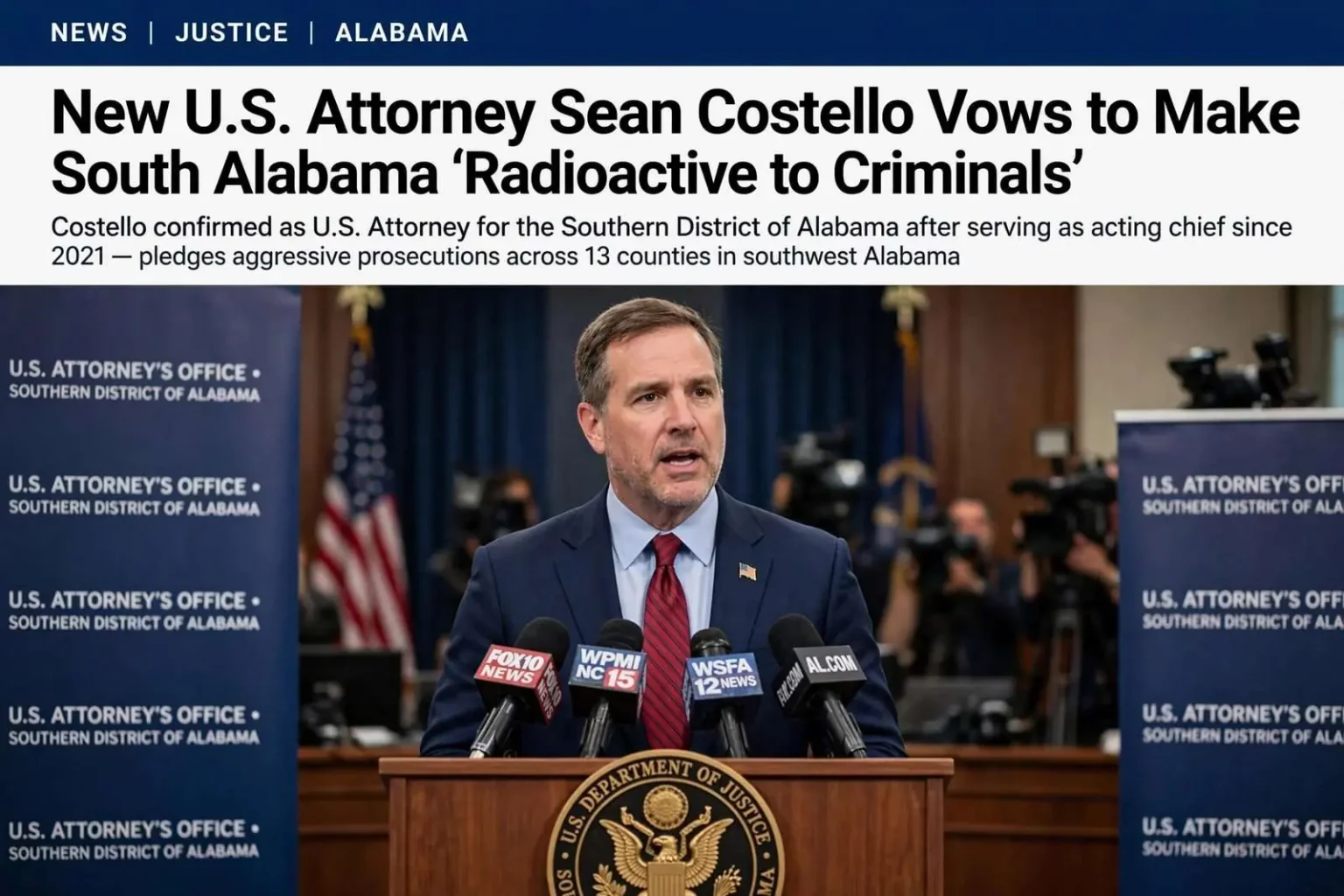
Sean Costello, newly confirmed as the U.S. Attorney for the Southern District of Alabama, is pledging an aggressive approach to federal prosecutions across southwest Alabama following his Senate confirmation on Friday. The confirmation ends a long stretch of uncertainty for the office and gives its leadership the formal mandate that comes with Senate approval.
Costello is a veteran of the office he now leads. He has worked in the U.S. Attorney’s Office since 2003 as an assistant U.S. attorney and has served as acting U.S. attorney since 2021, meaning the region’s federal prosecutor of record for the past several years has finally received the title that matched his responsibilities. In his new confirmed role, he oversees a team of 27 attorneys, 27 support staff members and seven contract employees handling federal cases across 13 counties in southwest Alabama.
Speaking after the confirmation, Costello told FOX10 News: “I’m looking forward to continuing to work with our law enforcement partners and my colleagues in making big cases like this, making South Alabama radioactive to criminals and holding people accountable for the crimes that they commit here.”
A Career Built in the Office
Costello’s path to the top of the district’s federal prosecution apparatus is unusual mainly for how steadily it stayed in one place. Twenty-plus years as an assistant U.S. attorney means he has handled the district’s caseload from the inside — federal drug conspiracies, firearms offenses, fraud prosecutions and the violent crime cases that make up the core of the docket in the Southern District of Alabama. Prosecutors who rise through an office’s ranks carry institutional knowledge that an outside appointee would spend years acquiring: which agencies produce which kinds of cases, how the courts run, and where the region’s recurring criminal patterns lie.
His service as acting U.S. attorney since 2021 placed him in charge of the office through a period when the position itself sat unfilled in a permanent, confirmed sense. Acting leadership keeps an office functioning — the cases move, the staff is paid, the priorities hold — but a confirmed U.S. Attorney carries a four-year mandate and the political weight that comes with it, allowing the office to commit fully to long-term initiatives without the caveat of interim status.
The confirmation fills a U.S. Attorney position that remained vacant through the Biden administration, with Costello transitioning from acting status into the formal, Senate-confirmed role under the current administration. U.S. attorneys serve at the pleasure of the president, and each change of administration historically brings new leadership to the nation’s 93 districts — making continuity like Costello’s the exception rather than the rule.
What the Office Does
The Southern District of Alabama is headquartered in Mobile and covers 13 counties across the southwestern corner of the state, including both the port city and the fast-growing Baldwin County corridor along the coast. Its prosecutors handle every category of federal crime: drug trafficking organizations moving product through the Gulf’s transportation networks, firearms violations, public corruption, financial fraud, immigration matters and the child exploitation cases that federal task forces pursue across jurisdictional lines.
The office’s reach matters because federal prosecution changes the arithmetic of serious crime. Federal sentences run without parole, sentencing guidelines weigh prior records and firearm enhancements heavily, and investigative tools — grand jury subpoenas, wiretaps, multi-agency task forces — allow cases that no single local department could build alone. When a U.S. Attorney pledges to make a region “radioactive to criminals,” the practical meaning is that the coordination between federal and local agencies will be used to push the most serious offenders into the system with the longest reach.
The staff numbers Costello oversees — 27 attorneys, 27 support staff and seven contract employees — reflect the scale of the district’s workload. Spread across 13 counties, those prosecutors work alongside the FBI, DEA, ATF, Homeland Security Investigations, the U.S. Marshals Service and a network of county sheriffs and municipal police departments whose cases feed the federal pipeline.
The Confirmation and Its Politics
A Georgetown University graduate who earned his law degree from the University of Alabama School of Law, Costello acknowledged President Donald Trump and Alabama Sens. Tommy Tuberville and Katie Britt in his remarks following confirmation. U.S. attorney nominations traditionally move through the state’s home-state senators, and the acknowledgments reflected the process that carried his name to the Senate floor.
For southwest Alabama’s law enforcement community, a confirmed U.S. Attorney is a signal of stability. Multi-agency investigations — particularly wiretap-driven drug conspiracies and violent crime initiatives — take months or years to mature, and the office’s leadership continuity from acting to confirmed status under the same prosecutor means the cases built during the interim carry forward under a leader who was there when they started.
Costello’s remarks framed that continuity as the point. The pledge to keep working with law enforcement partners on “big cases” is a statement of direction: the office’s priorities under his leadership will look like its priorities under his acting tenure, now backed by a Senate-confirmed mandate to pursue them.
What It Means for the Region
For residents of Mobile, Baldwin and the other counties in the district, the federal prosecutor’s office touches daily life in ways that are easy to miss. When a drug trafficking network is dismantled, when a corrupt official is indicted, when a fraud scheme that emptied retirees’ accounts is prosecuted, the case almost always came through the U.S. Attorney’s Office in Mobile. The office’s caseload is a measure of how the region’s most serious crime problems get resolved.
The Southern District also plays a central role in the region’s response to violent crime, working with local police departments through task forces that pair federal penalties with local knowledge. Mobile’s position as a Gulf port city gives the district a distinctive profile — maritime cases, smuggling routes and the movement of contraband through one of the nation’s busiest deepwater ports fall within its jurisdiction, alongside the street-level violence that local departments confront every week.
Costello’s emphasis on accountability language echoes the posture of U.S. attorneys across the country, but the phrase about making South Alabama “radioactive to criminals” is aimed squarely at a local audience: offenders considering the region, and residents who want to see the justice system visibly working. The message communicates that the office intends to pursue the cases that deter — the long, coordinated prosecutions that remove entire organizations rather than individual offenders.
The Road Ahead
A four-year confirmed term gives the office a window to see long-term initiatives through. Violent crime reduction programs, drug trafficking prosecutions and fraud cases all run on timelines longer than a news cycle, and confirmation allows Costello to commit the office’s resources without the shadow of interim status that has hovered over the position for years.
The transition also closes out a period of divided leadership for the district’s federal justice system. Through the previous administration, the office operated under acting leadership — a common arrangement, but one that leaves the office’s top position without the permanence that prosecutors, defense attorneys and judges all plan around. With the Senate’s action on Friday, that chapter ends.
For the 27 attorneys and the support staff who handle the district’s docket, the confirmation formalizes what has been true in practice: the lawyer who has led them since 2021, and worked beside them for two decades before that, now holds the job in his own right. The region’s federal prosecution priorities — and the promise to hold people accountable for the crimes committed in South Alabama — now carry the full weight of the office behind them.
The Southern District’s Place in Alabama
Alabama’s federal court system is split into the Northern, Middle and Southern Districts, with the Southern District anchored by Mobile and reaching across the state’s southwestern counties. The district’s judges sit in Mobile and in courthouses serving the region’s other population centers, and its grand juries return the indictments on which the U.S. Attorney’s prosecutions are built.
The office Costello now leads has a history stretching back more than a century, and its alumni have gone on to judgeships, state attorney general posts and private practice leadership across the state. Sitting in one of the nation’s 93 U.S. attorney districts, the position combines prosecutorial power with political visibility — the U.S. Attorney is the president’s chief federal law enforcement officer in the district, and the office’s priorities tend to mirror both national Department of Justice initiatives and local crime patterns.
Costello’s legal roots run deep in the state. After undergraduate studies at Georgetown University in Washington, he returned to Alabama for law school at the University of Alabama School of Law in Tuscaloosa, the state’s flagship law school and a pipeline for Alabama’s bench and federal bar. From there he went straight into federal prosecution in Mobile and never left — a career arc that gave him two decades of familiarity with the district’s courtrooms before he took its top job.
With confirmation behind him, the work ahead is the work he described: the partnerships with state and local law enforcement, the multi-agency cases that define the district’s docket, and the effort to make the consequences of crime in South Alabama severe enough that word travels. For the 13 counties the office serves, the Senate’s vote on Friday set the terms of the next chapter of federal prosecution in the region.


