University of South Alabama Mobile
Infectious Disease Physician Peter Oakes Returns to USA Health, Now Seeing Patients in Mobile
Dr. Peter Oakes, a graduate of the Whiddon College of Medicine with training in antimicrobial stewardship, has joined USA Health's infectious disease division and is accepting new patients in Mobile.
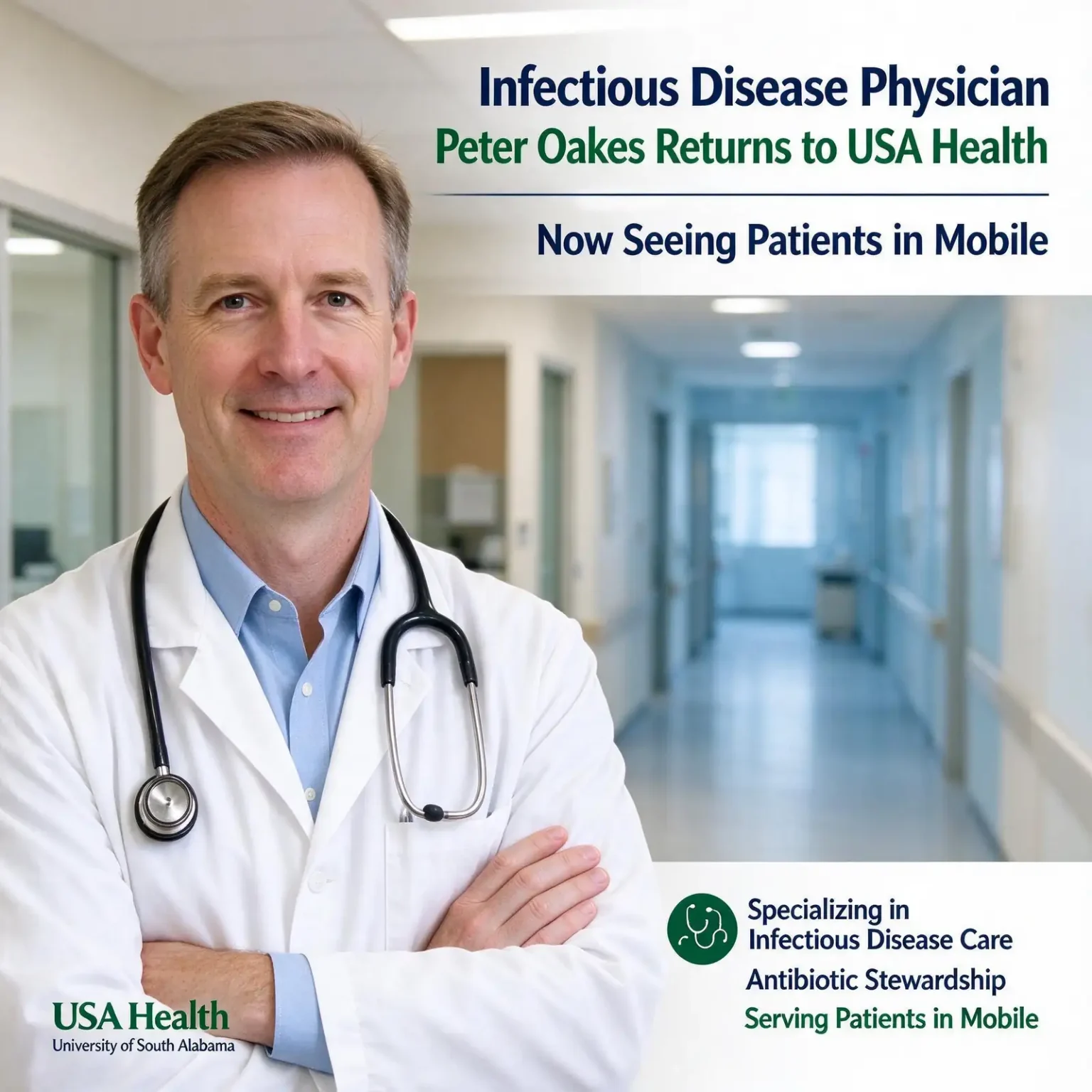
MOBILE, Ala. — USA Health has added Dr. Peter Oakes to its infectious disease division, bringing back to Mobile a physician who earned his medical degree at the University of South Alabama and whose research has focused on using antibiotics more wisely.
Oakes will treat patients with infectious diseases and contribute to the academic health system’s teaching and research missions, according to USA Health. He is accepting new patients at the Mastin Internal Medicine Clinic, 2451 University Hospital Drive, Suite 102, in Mobile.
A return to South Alabama
A native of Birmingham, Oakes earned a bachelor’s degree in French and history from Vanderbilt University before attending medical school at the University of South Alabama’s Frederick P. Whiddon College of Medicine.
After medical school, he completed an internship in general surgery at USA Health. He then completed an internal medicine residency at LSU Health Sciences Center in New Orleans and an infectious disease fellowship at the University of Virginia in Charlottesville.
Infectious disease is a subspecialty of internal medicine. Physicians in the field typically complete three years of internal medicine residency followed by a fellowship of two or more years focused on diagnosing and treating infections, from common bacterial illnesses to complex, drug-resistant and unusual infections.
A focus on antibiotic stewardship
Oakes’ research has centered on antimicrobial stewardship, the practice of making sure patients receive the right antibiotic, at the right dose, for the right length of time, and only when it is needed. His work has looked in particular at optimizing perioperative antibiotic prophylaxis, the antibiotics given to patients around the time of surgery to help prevent surgical site infections.
During his fellowship, Oakes conducted research under the mentorship of Dr. Amy Mathers, associate director of clinical microbiology at the University of Virginia and a longtime leader in antimicrobial stewardship.
He also completed the Society for Healthcare Epidemiology of America’s Antibiotic Stewardship Training Course. At the society’s annual meeting, he presented research on the importance of infusion duration in preoperative antimicrobial prophylaxis, examining how the time over which an antibiotic is delivered before an operation can matter.
Oakes has authored or co-authored numerous publications in anatomy, neuroscience, surgery and other areas of medicine.
Why stewardship matters
Antibiotics are among the most important tools in modern medicine, but every use of them gives bacteria a chance to adapt. Over time, overuse and misuse can help drive the spread of resistant organisms that are harder, and sometimes nearly impossible, to treat.
The Centers for Disease Control and Prevention has identified antimicrobial resistance as one of the most urgent public health threats in the United States, estimating that more than 2.8 million antimicrobial-resistant infections occur in the country each year, and that more than 35,000 people die as a result.
Hospital stewardship programs aim to slow that trend while improving care for individual patients. They review how antibiotics are prescribed, guide doctors toward the most effective choices and help reduce side effects such as C. difficile infections, which can follow antibiotic use. Surgical prophylaxis is a common focus because antibiotics are given to large numbers of surgery patients, and getting the drug, dose and timing right can help prevent infections without adding unnecessary exposure.
Infectious disease care at USA Health
USA Health’s adult infectious disease service treats a wide range of infections in both hospital and outpatient settings, and its physicians also help patients manage their conditions to lower the risk of future infections. According to the health system, conditions treated include:
- HIV/AIDS, hepatitis B and C, and bloodstream infections
- Staph infections and antibiotic-resistant infections such as MRSA
- Respiratory infections including flu, RSV, pneumonia and tuberculosis
- Bone infections and infections related to cancer treatment
- Tick-borne illnesses such as Lyme disease and Rocky Mountain spotted fever
- Tropical and travel-related infections, including malaria, West Nile virus, Zika and dengue fever
Oakes joins a team that includes infectious disease physicians Dr. Carla G.N. Benjamin, Dr. Adriana Betancourth, Dr. Logan Flaxman, Dr. Shannon Tyler and Dr. John A. Vande Waa, along with a physician assistant and a nurse practitioner.
The service sees patients at the Mastin Patient Care Center at 2451 University Hospital Drive, the Strada Patient Care Center at 1601 Center Street and the Stanton Road Clinic at 575 Stanton Road, all in Mobile.
Teaching the next generation
As part of an academic health system, Oakes will also help train future physicians. USA Health is the academic health system of the University of South Alabama, and its physicians teach medical students and residents through the Whiddon College of Medicine, the same school where Oakes earned his medical degree.
How to make an appointment
Oakes is accepting new patients at the Mastin Internal Medicine Clinic, 2451 University Hospital Drive, Suite 102, Mobile. The USA Health adult infectious disease service can be reached at (251) 470-5890, and appointments can also be requested online through the health system’s website, usahealthsystem.com.