

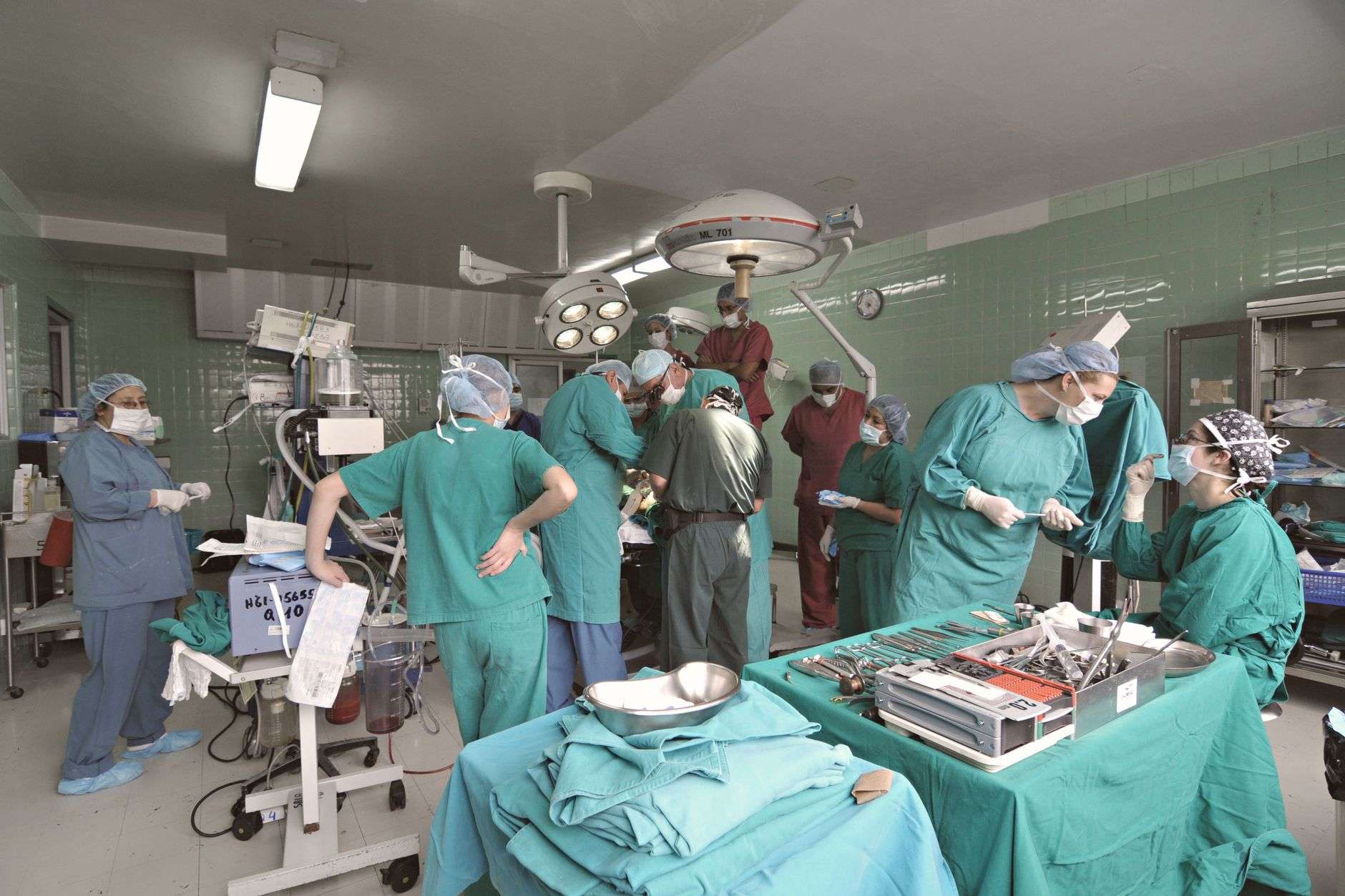
MOBILE, Ala. — USA Health neurosurgeon Dr. Richard Menger, who leads the health system’s spine institute and its complex spine surgery program, has been named one of the nation’s “20 Spine Surgeons to Know,” a national list highlighting surgeons at the forefront of their specialty.
Menger is vice chair of neurosurgery at USA Health, director of the USA Health Spine Institute and chief of complex spine surgery. According to the announcement of this year’s list, the 20 surgeons chosen are leading efforts to improve patient care at a time when minimally invasive surgery, motion preservation, robotics and complex spinal reconstruction are reshaping the field.
‘An Exceptional Surgeon, Researcher and Leader’
Natalie Fox, DNP, PNP-BC, chief executive officer of USA Health, said the recognition reflects what his colleagues see every day.
“I feel fortunate to work alongside Dr. Menger and to witness firsthand the difference he makes every day,” Fox said. “He is an exceptional surgeon, researcher and leader whose dedication strengthens our organization and transforms the lives of patients and families. We are very lucky to have him as such an important part of the USA Health team.”
USA Health is the academic health system of the University of South Alabama, and its physicians also teach and conduct research through the university’s Frederick P. Whiddon College of Medicine.
Complex Deformity in Children and Adults
Menger’s clinical focus is complex spinal reconstruction and spinal deformity in both children and adults, including scoliosis. He also performs minimally invasive spinal procedures.
Spinal deformity surgery is among the more demanding areas of spine care. It involves correcting abnormal curves or alignment of the spine — such as the sideways curvature seen in scoliosis — and often requires long operations that reconstruct and stabilize multiple levels of the spine. Treating children adds another layer, because surgeons must account for a spine that is still growing.
At USA Health, Menger has built a combined neurosurgery and orthopaedic deformity program, bringing together two surgical specialties that both treat the spine. He is also a Fellow of the Scoliosis Research Society, and according to his USA Health profile, he is the only active fellow of the society in the Mobile area.
He started the USA Health Spine Institute with the goal of changing how spine care is delivered, and he serves as its director. He was named vice chair of the Department of Neurosurgery in 2023. At the time, department chair Dr. Anthony Martino noted that Menger “has been recognized nationally for his work in spinal surgery and on the economic concerns in neurosurgery and medicine.”
A New Textbook on Pediatric Deformity
Menger was lead editor of “Mastering Pediatric Spinal Deformity,” a textbook published in 2026. He was also lead editor of an earlier textbook, “The Business, Policy, and Economics of Neurosurgery,” reflecting a career that has spanned both the operating room and the policy questions surrounding how medical care is organized and paid for.
He holds two faculty appointments at the University of South Alabama: associate professor of neurosurgery at the Whiddon College of Medicine and assistant professor of political science in the university’s Department of Political Science and Criminal Justice.
From Cornell Rugby to Harvard Kennedy School
Menger’s path to Mobile included stops at several of the country’s best-known institutions.
- Cornell University: He graduated with honors and played Division I rugby.
- Georgetown University School of Medicine: He earned his medical degree with honors. He was inducted into the Alpha Omega Alpha medical honor society and received the Barbara Bregman PhD Award.
- Harvard Kennedy School: He later earned a master’s degree in public administration, where he was a Hale Champion Public Service Fellow.
- LSU in Shreveport, La.: He completed his neurosurgery residency, which included an enfolded fellowship in pediatric spinal deformity at Shriners Hospital for Children.
- Columbia University Medical Center: As a neurosurgeon, he completed the Advanced Pediatric Spinal Deformity Orthopedic Fellowship in New York.
An enfolded fellowship is additional subspecialty training completed during residency rather than after it. Menger’s two fellowships in pediatric spinal deformity — one during residency and one afterward at Columbia, in an orthopaedic program — are part of what prepared him to lead a program that bridges neurosurgery and orthopaedics.
That mix of clinical, scientific and public policy training continues to shape his work as a surgeon, researcher and educator at USA Health, helping him build new spine care programs, lead teams that span multiple disciplines and expand treatment options for patients.
Service in the Navy Reserve
Beyond medicine and academics, Menger serves as a lieutenant commander in the United States Navy Reserve. During the COVID-19 pandemic, he responded by treating patients in New York City.
A String of National Recognitions
The spine surgeons list is the latest in a series of national honors for Menger.
He twice won the Samuel Hassenbusch Young Neurosurgeon Award from the Congress of Neurological Surgeons, taking the honor in back-to-back years. The award goes to the top socioeconomic abstract selected from the thousands submitted to the organization’s annual meeting. His second winning abstract, “Impact of COVID-19 on Neurosurgical Utilization and Reimbursement,” examined how state-level pandemic restrictions affected neurosurgery case volumes, finding that states with stricter restrictions performed fewer procedures and had more difficulty returning to pre-pandemic levels.
In 2025, Menger was named a Healthcare Research All-Star by Avant-garde Health, a health care research and consulting firm. The annual lists recognize the top 5% of hospitals and physicians publishing high-impact research in their fields, and his recognition was based on peer-reviewed research published in 2021 and 2022. His research has examined operative techniques, clinical outcomes and how policy and economics affect the delivery of spine surgery, including efficient models of care in complex spine surgery.
He was also named to the North American Spine Society’s “20 under 40” list in 2019.
Why the Specialty Is Changing
The areas highlighted by this year’s list — minimally invasive surgery, motion preservation, robotics and complex reconstruction — represent some of the biggest shifts in spine care.
Minimally invasive approaches use smaller incisions and specialized instruments to reduce disruption to surrounding muscle and tissue. Motion preservation refers to techniques and devices intended to keep movement in the spine rather than fusing segments together. Robotic systems are being used to help guide the placement of implants. Complex reconstruction, Menger’s specialty, addresses the most severe deformities and conditions, where the spine’s overall alignment must be corrected.
For patients along the Gulf Coast, having a surgeon with Menger’s training in Mobile means access to complex spine and pediatric deformity care close to home, through an academic medical center that also trains the next generation of physicians.