

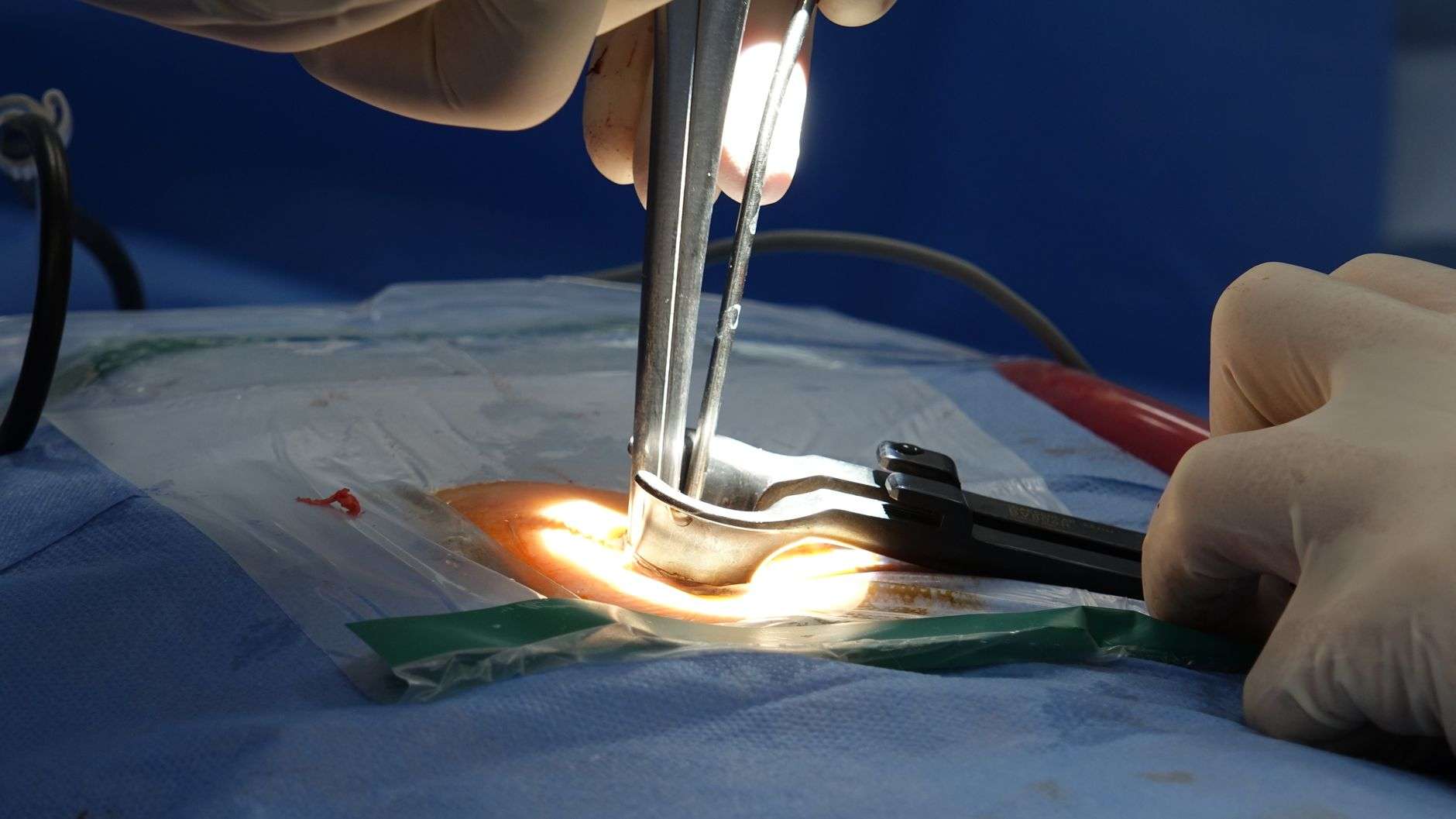
A team of physicians and advanced practice providers from the USA Health Spine Institute traveled to New York City to take part in the 11th Annual Safety in Spine Surgery Summit, where research developed in Mobile earned a spot in the national program. The trip gave the Mobile-based group a chance to compare notes with some of the busiest spine centers in the country and bring fresh ideas back to south Alabama patients.
The summit is an annual gathering devoted to a single question: how to make spine surgery safer. Surgeons, anesthesia teams, nurses, physician assistants and quality researchers from across the country come together to examine complications, protocol changes and systems improvements, and having a Mobile team’s work selected for presentation places the local program among the national centers that set the tone for the field.
The delegation included Richard Menger, M.D., MPA, who directs the Spine Institute and serves as vice chair of neurosurgery at the Frederick P. Whiddon College of Medicine at the University of South Alabama; physician assistant Chelsea Lukenbill, PA-C; and Nikki Chason, CRNP, the lead advanced practice provider for the neurosurgery department. The composition of the group is notable in itself: alongside the surgeon-director were two advanced practice providers whose daily work sits at the center of patient flow, discharge coordination and postoperative care — precisely the territory the team’s research occupies.
Menger described the trip as a chance to compare approaches with other high-volume programs, calling it “a real opportunity to share with other high-performing teams” the strategies USA Health is developing, while also learning what has worked elsewhere. High-volume spine centers operate under the same pressures — more patients, more procedures, tighter resources — and the exchange of practical solutions between such programs is what meetings like the summit exist to produce.
Research Focused on Getting Patients Home Sooner
The USA Health group’s work, titled “Delays from Utopian to Actual Discharge in Spine Surgery Patients: A Quantitative Analysis and Narrative Modeling,” was accepted for presentation at the summit. In plain terms, the project examined the gap between the day a spine surgery patient is medically ready to leave the hospital and the day they actually go home, then tried to pinpoint what causes that gap.
The study’s title names the problem with unusual candor. “Utopian” discharge is the theoretical ideal — the moment every clinical benchmark is met and the patient could walk out the door — while actual discharge is the day the patient physically leaves. Between those two points lies territory that has little to do with surgery itself, and that is where the research looked. The team paired hard numbers on how long the gap runs with narrative modeling that traces how individual delays cascade into longer stays.
Delayed discharges are a well-known challenge in hospital care nationally. Even after a patient clears every medical benchmark for going home, factors such as paperwork, transportation arrangements, physical therapy scheduling, insurance authorizations, or the availability of home health services can add hours or days to a hospital stay. None of those factors reflects on the quality of the operation itself, yet all of them show up in the patient’s length of stay and the hospital’s costs, which is why discharge delays have become a recurring target for quality improvement work across the country.
The causes the Mobile team studied form a familiar list for anyone who has cared for a hospitalized relative. Discharge orders must be written and processed. Medications must be reconciled and prescribed for home. Insurance plans must authorize continued services or equipment. Physical therapists must clear the patient to move safely. Home health agencies must have capacity to begin visits. Rides must exist. When any single link in that chain slips, the patient waits in a hospital bed that is medically unnecessary but practically unavoidable.
For spine surgery patients specifically, extra time in the hospital can raise the risk of complications like blood clots, infections, and deconditioning, while also driving up the cost of care. Patients recovering from spine procedures are encouraged to move early, and every additional day in bed works against that goal; hospital environments concentrate infection risk; and the longer a patient stays immobile, the higher the risk of venous thromboembolism becomes. A delay that looks administratively harmless can therefore carry real clinical weight.
There is also a system-level cost. A hospital bed occupied by a patient who is medically ready for discharge is a bed unavailable to the next patient in the emergency department, and bed shortages ripple into surgery scheduling, staffing decisions and wait times. Hospitals that have reduced their discharge delays have generally done so by treating discharge as a process that starts before the operation, not a formality that starts the morning a patient is cleared.
Why Advanced Practice Providers Are at the Center
The presence of Lukenbill and Chason on the presentation team reflects where discharge work actually happens. Physician assistants and nurse practitioners in a neurosurgery department manage much of the daily clinical flow — rounding on patients, tracking mobility milestones, coordinating with therapy services, and communicating with families and insurers — so they see the causes of a delayed discharge weeks before the data does. A research project on discharge gaps is built from exactly the observations those providers accumulate every day.
Chason’s role as lead advanced practice provider for neurosurgery places her at the junction where clinical readiness meets administrative reality, and Lukenbill’s work as a physician assistant puts her in the same position. Their contributions to the study give it a ground-level accuracy that purely statistical analyses often miss, which is presumably what the narrative modeling component of the title refers to — reconstructing the real, individual paths by which patients slide from ready-to-leave into an extra two or three days of hospitalization.
The USA Health Context
The Spine Institute operates within USA Health, the academic health system affiliated with the Frederick P. Whiddon College of Medicine at the University of South Alabama, Mobile’s home medical school. As the region’s academic medical center, USA Health draws complex spine cases from across south Alabama and the Gulf Coast, and its spine program handles the full range from routine degenerative procedures to complex reconstructions.
That case mix is what makes the Mobile team’s research meaningful to a national audience. Academic spine centers everywhere wrestle with the same discharge-delay problem, but a program that can quantify it in its own patient population and model the causes has something concrete to offer peers at the summit — and something equally concrete to apply at home, where any improvement in discharge flow translates directly into better experience for Mobile-area patients and their families.
The Whiddon College of Medicine connection matters for another reason as well. The college trains the region’s future physicians, and research presented at national meetings feeds directly into that teaching mission. Residents and students rotating through neurosurgery learn from faculty who are not just applying best practices but helping to produce them, a distinction that shapes the quality of care available in Mobile long term.
Safety as a Spine Surgery Specialty
The summit itself represents a shift in how spine surgery has matured over the past two decades. Once a field measured chiefly by operative technique and hardware innovation, spine surgery has increasingly adopted the safety science that aviation and other high-stakes industries use: checklists, standardized protocols, complication reviews, and the systematic study of everything around the operation, not just the operation itself.
Discharge timing fits squarely into that discipline. A surgical complication occurs in the operating room; a discharge delay occurs in the system around the patient, and preventing it requires the same structured attention — measuring the problem, identifying causes, testing changes and measuring again. The fact that the summit’s program includes research of this kind shows the field treating the full patient journey as part of safety, not merely the hours under anesthesia.
For patients, the practical translation is straightforward. Safer spine care means fewer complications, shorter stays, clearer plans for going home, and fewer days spent in a hospital bed waiting for something outside the operating room to fall into place. Research like the USA Health team’s is the mechanism by which those improvements reach patients in south Alabama rather than remaining academic findings.
What the Team Takes Home
The return trip from a national summit typically marks the start of the work rather than the end. Presenting the discharge-delay research puts the Mobile team’s findings before peers who will scrutinize them, compare them to their own data and suggest refinements, and the exchange usually sharpens the next phase of the project — whether that means expanding the dataset, testing a specific intervention, or building the findings into routine discharge planning at the Spine Institute.
The team returned to Mobile with its work validated on a national stage and its own program measured against the country’s busiest spine centers. For a regional academic program, that standing is built exactly this way — one accepted abstract, one invited presentation, one comparison of outcomes at a time — and for the patients the institute serves, the payoff arrives as steadily shorter, safer hospital stays after spine surgery.