University of South Alabama Mobile
South Alabama Students Trade Tobacco for Trivia at Campus Smokeout Event
Nearly 80 University of South Alabama students joined a game-filled Great American Smokeout event on campus aimed at helping young adults quit tobacco and vaping.
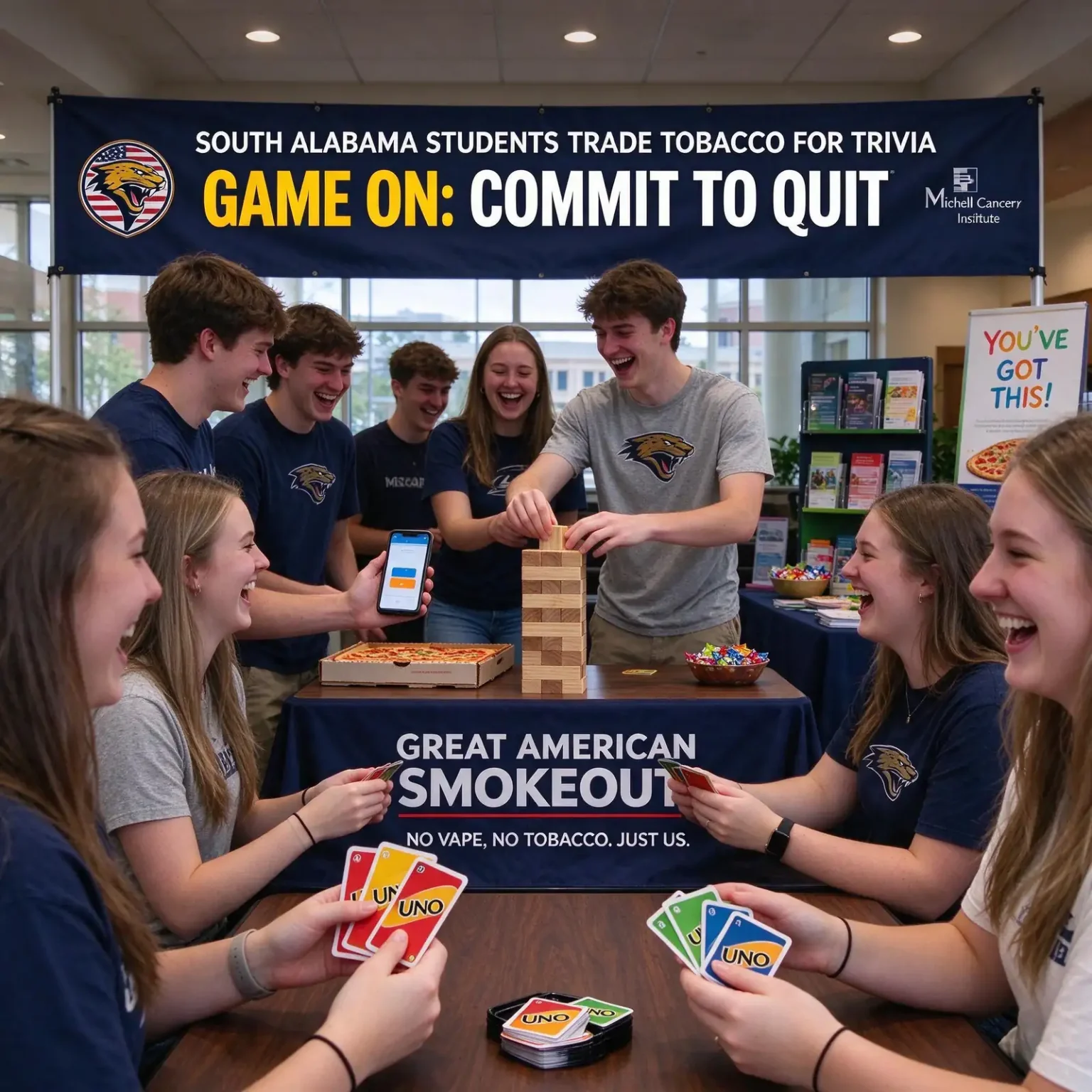
MOBILE, Ala. — Close to 80 University of South Alabama students spent an afternoon earlier this month swapping talk of nicotine for trivia, card games and stacking blocks as the campus marked the Great American Smokeout with an event built around a simple idea: quitting tobacco and vaping is easier with support, and it is worth doing at any age.
The gathering, titled Game On: Commit to Quit, took place Monday, Nov. 16, in the Terrace Room of the university’s Student Center. USA Health Mitchell Cancer Institute sponsored the afternoon, which tied into the nationwide observance led each year by the American Cancer Society. A representative from the Drug Education Council of Mobile County also attended to answer questions and hand out information on the risks of tobacco products.
Prizes, pizza and a break from screens
Rather than a lecture, students got a competition. Participants faced off in Kahoot, the popular app-based quiz game, answering trivia questions for a shot at prizes that included ThinkPad laptops and iPhones. Tables were also set up for Jenga and Uno, giving students a low-pressure way to sit down together between classes.
Organizers with the cancer institute said turnout went beyond what they had hoped for. They described the afternoon as a mix of fun, education and connection, and said one of the most rewarding parts was watching students set aside their phones and spend time talking and laughing with one another face to face.
Food was part of the draw, too. Students were treated to pizza and cupcakes, and the institute thanked its community partners for helping make the event possible. Two local restaurants, Lost Pizza and Marco’s, donated lunch for the crowd, and organizers expressed appreciation to everyone who contributed to the event.
The symbolic exchange at the heart of the event was straightforward: students were encouraged to trade cigarettes, vape devices and chewing tobacco for game pieces and playing cards, a visual reminder that the time and money spent on nicotine can be redirected toward healthier habits and friendships.
Why the Smokeout matters
The Great American Smokeout dates back to the 1970s and has grown into one of the best-known public health observances in the country. The American Cancer Society holds it each November, traditionally on the third Thursday of the month, and uses the day to encourage people who smoke to make a plan to quit, or to stop for at least one day as a first step. In 2026, the national date fell on Thursday, Nov. 19, a few days after the campus event.
The numbers behind the observance remain sobering. Roughly 28.8 million adults in the United States still smoke cigarettes. Smoking continues to be the leading cause of preventable death nationwide and is blamed for an estimated 480,000 deaths each year. That works out to about one of every five deaths in the country.
Those figures do not capture the full toll. Tobacco use is linked to many forms of cancer, including cancers of the lung, mouth, throat, esophagus, bladder and pancreas, as well as heart disease, stroke and chronic lung conditions such as emphysema and chronic bronchitis. The U.S. Surgeon General has also concluded that there is no safe level of exposure to secondhand smoke, meaning the health effects reach family members, roommates and co-workers of people who smoke.
Vaping and the college years
While cigarette smoking among young adults has dropped over the past few decades, electronic cigarettes and other vape products have become a major concern on college campuses and in high schools across the country. Many young people who would never pick up a cigarette are drawn to flavored vapes, which can be easy to hide and are often marketed in ways that make them seem harmless.
Health organizations warn that the risks are real. According to the American Heart Association, the addictive pull of tobacco rivals that of cocaine. Every tobacco product and every vape contains nicotine, and the heart association notes that one JUUL pod may hold a nicotine dose equal to 20 cigarettes.
Age is an important factor. The Centers for Disease Control and Prevention notes that the human brain keeps developing until around age 25. Because of that, using nicotine during the college years can harm the developing brain and lead to addiction, the CDC says. Nicotine exposure at younger ages can affect parts of the brain tied to attention, learning, mood and impulse control.
The CDC has also cautioned that the aerosol produced by e-cigarettes is not harmless water vapor. It can contain substances such as ultrafine particles, flavoring chemicals and heavy metals that users breathe deep into their lungs. Because e-cigarettes are relatively new products, scientists are still studying their long-term effects.
It is never too late to quit
The central message of the Smokeout is an encouraging one. People who stop using tobacco see benefits regardless of how old they are or how long they have used it. Health improvements begin soon after the last cigarette and continue building for years, and giving up tobacco can extend life expectancy by up to a decade.
Public health agencies describe a range of short- and long-term gains. Within minutes to hours of quitting, heart rate and blood pressure begin to come down, and carbon monoxide levels in the blood start to fall. Over the following weeks and months, circulation and lung function tend to improve, and coughing and shortness of breath often ease. Over the longer term, former smokers lower their risk of heart disease, stroke and several cancers compared with people who keep smoking.
Quitting is rarely simple. Nicotine withdrawal can bring cravings, irritability, trouble concentrating and difficulty sleeping, and many people make several attempts before they succeed for good. Health experts say having a clear plan and a support system makes a meaningful difference in the odds of success.
Some practical steps commonly recommended by public health agencies include:
- Choosing a quit date and telling friends and family about it so they can offer encouragement.
- Identifying personal triggers, such as stress, alcohol, coffee or certain social settings, and planning ways to handle them.
- Removing cigarettes, vapes, lighters and related items from home, car and backpack.
- Talking with a health care provider about medications that can ease withdrawal. The U.S. Food and Drug Administration has approved several, including nicotine patches, gum and lozenges, as well as prescription options.
- Using free counseling services by phone, text or app, which can be combined with medication.
Where USA students and others can turn for help
Organizers pointed students toward several resources, some on campus and some available statewide or nationally.
On campus, USA Student Health offers appointments with health care providers who can talk through quitting options, including whether medication might help. Screenings and assessments are available through the University Testing and Counseling Center, which can be useful for students whose nicotine use is tied to stress, anxiety or other concerns.
Beyond campus, Quit Now Alabama connects callers with representatives who can share resources available in the state. Alabama’s quitline can be reached through the national toll-free number, 1-800-QUIT-NOW, which routes callers to free coaching services in their home state.
For students who prefer to get support on their phones, the Truth Initiative offers free help with quitting that can be accessed directly from a mobile device. The nonprofit’s text-based program is designed with young people in mind and focuses heavily on vaping.
Students who are not ready to quit entirely can still benefit from cutting back and learning more about the products they use. Health experts generally encourage people to reach out to a provider or quitline even if they are unsure, since a conversation can help clarify options.
The local partners behind the event
USA Health Mitchell Cancer Institute is the cancer treatment and research center connected to the University of South Alabama and its academic health system in Mobile. In addition to patient care and research, the institute conducts outreach programs aimed at preventing cancer and catching it earlier, and tobacco prevention is a natural fit for that mission because of the strong link between tobacco use and many types of cancer.
The Drug Education Council, based in Mobile, works on substance use prevention and education across the area. Its participation gave students another local contact for information about nicotine and other substances.
The event also reflected a broader trend in campus health promotion: meeting students where they are. Games, food and prizes give students a reason to show up, and organizers can then share health information in a relaxed setting where people feel comfortable asking questions.
What comes next
Although the Great American Smokeout happens on a single day, the American Cancer Society encourages people to treat it as a starting point rather than a finish line. Anyone thinking about quitting can pick a date that works for them, whether during the holiday season, at the start of the new year or right away.
For University of South Alabama students, the campus resources mentioned above remain available throughout the academic year, and statewide and national quit services are free and open to anyone. Family members and friends who want to help someone quit can also call quitlines for advice on how to offer support without adding pressure.
On this Thanksgiving Day, as many families gather together, public health advocates note that the holidays can be both a stressful time and a motivating one for people trying to give up tobacco. Making a plan, leaning on loved ones and using free resources can help turn a single afternoon of games into a lasting change.