Former USS Enterprise Reaches Mobile River Berth as Veterans, Onlookers Watch Tow Past Fort Morgan
The first nuclear-powered aircraft carrier ever built was towed up the Mobile River on Nov. 13 for a dismantling job the Navy expects to finish by September 2030, with a 100-yard Coast Guard security zone now around the ship.
MOBILE, Ala. — The hull of the former USS Enterprise, the first nuclear-powered aircraft carrier ever built, is now moored on the west bank of the Mobile River, where crews will spend roughly the next four years taking it apart. Tugs brought the ship through the mouth of Mobile Bay on the morning of Friday, Nov. 13, and pushed it into its berth south of downtown Mobile that afternoon.
The arrival opens a job the Navy has never undertaken before: the complete dismantlement of a nuclear-powered carrier. Under a $418.5 million Navy contract, NorthStar Marine Dismantlement Services LLC and its partner, Modern American Recycling and Radiological Services, are expected to finish the work by September 2030.
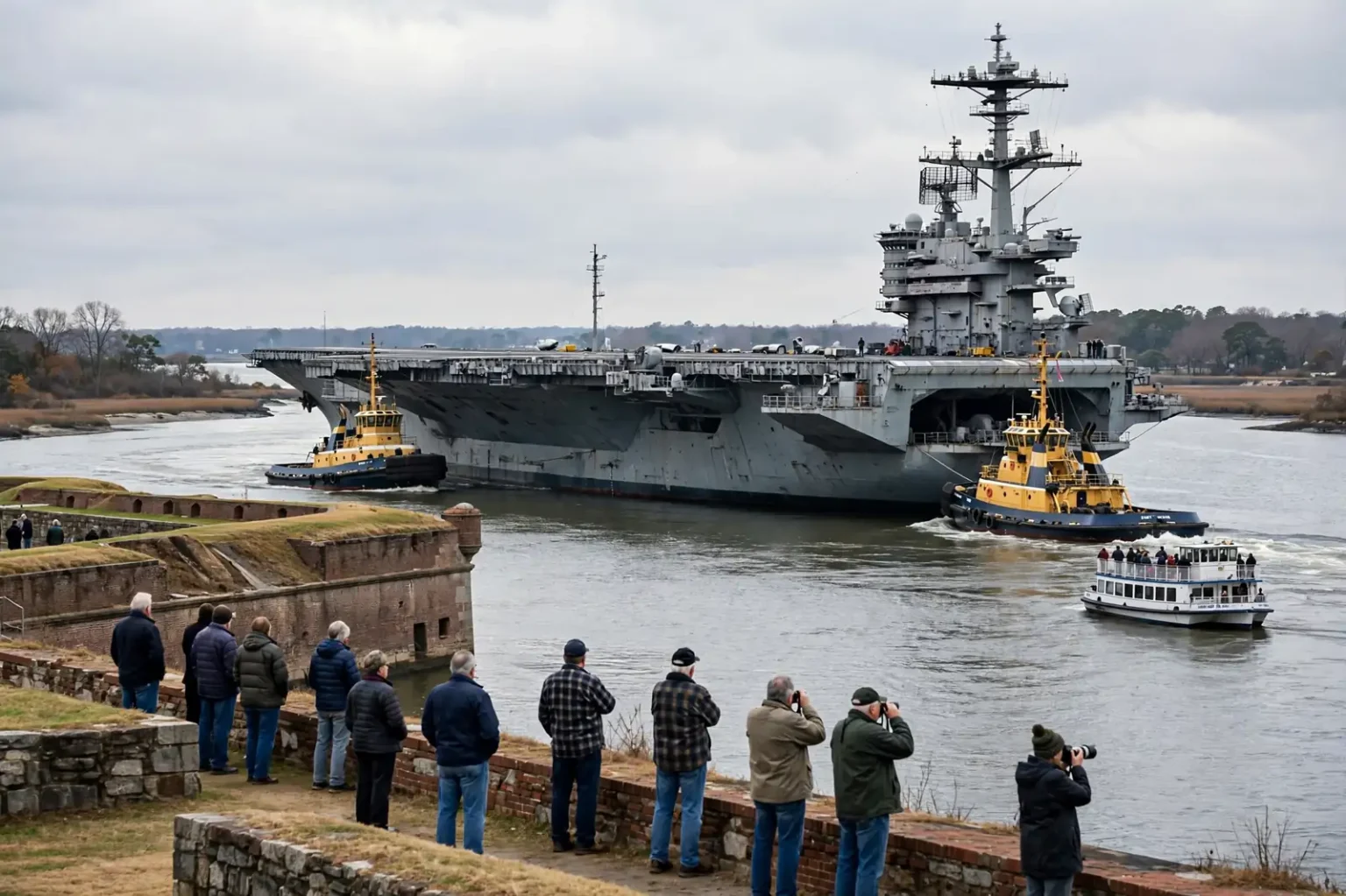
From the beaches of Fort Morgan to the downtown waterfront, the carrier drew photographers, anglers, curious residents and a number of veterans who once lived and worked aboard it. One former Navy pilot even went up in a small plane to greet it before it reached the bay.
A Slow Approach From the Gulf
At first light, the carrier was little more than a low, dark shape on the southern horizon off the Fort Morgan peninsula. Its tall island superstructure was the only real hint that this was a warship and not a tanker. The hull was so large that onlookers could pick it out well before the ocean-going tugs pulling it came into view.
The convoy approached from the east. Around 7 a.m., it swung north toward the bay entrance. Two large tugs, the Ocean Sky and the Ocean Wave, led the way while several smaller tugs helped steer. A Coast Guard vessel followed behind to enforce a moving safety zone around the ship.
Traveling at roughly 5.5 knots, or about 6.3 mph, the carrier took around half an hour to pass Sand Island Light, cross the mouth of the bay and enter the lower bay. A few dozen people watched from the beach at the tip of the peninsula, and others lined the walls of historic Fort Morgan for a better angle.
On the Mobile County side, people also gathered at waterfront spots such as Bayfront Park in south Mobile County to watch the hull move up the bay.
Shipping Paused While the Hull Moved Upriver
A day before the arrival, the Alabama Port Authority announced that traffic in the ship channel would stop while the carrier was moved to its final berth. The closure covered both the Mobile Bar Channel and the Mobile River Channel. It was scheduled to begin with the tow at 6 a.m. Friday, and the full move was expected to take 8 to 10 hours.
By about 1:30 p.m., the Ocean Wave and Ocean Sky were heading up the Mobile River past the Arthur R. Outlaw Mobile Convention Center. They had left the hull in the care of four smaller tugs, which nudged it the last few yards into position.
The ship now sits at a yard just north of the APM Terminals Mobile container terminal. That spot is a short distance south of where the ocean liner SS United States was docked for more than a year and a half before it recently left Mobile to be sunk as an artificial reef.
The carrier became a sightseeing draw almost immediately. That same afternoon, the Perdido Queen riverboat set out downriver on what was expected to be the first of many trips for people wanting a closer look.
A Fairhope Pilot’s Final Flyover
One of the first people to see the ship near the Alabama coast was a Fairhope native who flew F/A-18 jets during his Navy career and landed on the carrier’s flight deck more than 200 times. Shortly before the hull reached the bay entrance, he was circling above it in a single small plane.
He said the carrier was easy to find. From about 10 to 11 miles out, he could see the gray hull on the horizon, the same view he had seen many times before. He recalled many sunrises and sunsets watched from the air just after launching from the ship or just before landing on it.
By the time he deployed on the Enterprise, the carrier was already about 50 years old. He made two deployments aboard it during Operation Enduring Freedom, the military campaign that followed the Sept. 11, 2001, attacks. He also pointed to the ship’s long history, from the Cuban Missile Crisis to the Vietnam War. On Sept. 11, 2001, the carrier was heading home from a deployment, and it turned around and steamed back.
For the flight, he put on his old flight helmet. He admitted it was a bit of a nerdy thing to do, but he said he meant it as a sign of remembrance and respect for a warship that made history.
Veterans Who Once Called the Ship Home
An intelligence officer’s view from the river
Several veterans rode the Perdido Queen to see the carrier. One of them served aboard as an intelligence officer from 1984 to 1986 and again from 1989 to 1991. He took the microphone from the tour guide and told passengers about the ship’s history.
During his years aboard, the carrier made three cruises. The first two went to the Western Pacific and the Indian Ocean, and the second also included time in the Mediterranean. On the third, the ship sailed from Alameda, California, in the San Francisco Bay area, around the world to Norfolk, Virginia.
He said every refueling let the ship run longer before it needed fuel again. To him, that showed the technology behind its reactors kept getting better over time.
Life aboard, he said, was above all busy. Some of his workdays lasted 20 hours as he combined aerial photography, satellite images and other data into strategic analysis. His team briefed aircrews and others on what the enemy had, where it was and what it might do. Intelligence officers attached to the squadrons briefed pilots before their flights on where to go and what to look for, and then debriefed them afterward. He estimated that 200 to 250 people worked directly on intelligence support for the air squadrons.
The last time he was aboard was in 1991, when the carrier was in a shipyard for an overhaul. Looking at it now, he noted that the antennas have been removed and the hull has probably not been painted in about 15 years. Even so, he called the ship a remarkable piece of technology and an example of what the country can do when it sets out to do something and does it right.
A sailor who served through deactivation
At Bayfront Park, a Mobile County man stood alone at sunrise, waiting for the ship. He enlisted in the Navy in 2009, and the Enterprise was his first ship. He served aboard from 2009 to 2013, through its last two deployments and its deactivation in 2012. He had not seen the ship since March 2013.
He described the carrier as the cornerstone of the Navy and said it felt like home. Now that he lives in Mobile County as a civilian, he said, having his old military home arrive in the same place brings his journey full circle. He called his service aboard an honor he will never forget.
A link back to 1961
Another man who came to watch first saw the carrier 65 years ago. In 1961, at age 21, he was in the Army, called up during the Berlin Crisis, and stationed in Newport News, Virginia, where he saw the new carrier. He said he had never seen anything bigger than a fishing boat before, and the ship amazed him. He came Friday because he wanted to see it one more time.
Some spectators were sad to see it go. One woman who came to see a piece of history before it disappears said she wished the carrier could have stayed in Mobile long enough for people to tour it. She said she disliked seeing it arrive only to be taken apart.
More Than Half a Century of Service
The Enterprise, hull number CVN-65, was built at Newport News, Virginia. It was launched in 1960, entered service in 1961 and spent more than 50 years with the fleet. Powered by eight nuclear reactors, it traveled more than 1 million nautical miles. It was the eighth Navy ship named Enterprise.
The carrier served throughout the Cold War, including the Cuban Missile Crisis and the Vietnam War, and later in the conflicts that followed Sept. 11, 2001. It was inactivated in 2012. The Navy finished removing the fuel from its reactor plants in 2017, the same year the ship was formally decommissioned.
Navy officials have said the carrier’s legacy belongs to the sailors and support personnel who kept it ready for its missions throughout its service.
The ship’s final voyage began Monday, Nov. 9, when tugs towed it out of Newport News. The trip south along the Atlantic coast, around Florida and across the Gulf took about four days.
What Dismantling Will Involve
No nuclear-powered aircraft carrier had ever been dismantled before. The fuel has already been removed from the Enterprise, but its reactors still must be taken apart and disposed of.
In its 2026 contract award, the Navy said the entire ship will be dismantled and every material removed from it will be recycled or disposed of properly. Hazardous materials, including low-level radioactive waste, are to be packaged and shipped to authorized, licensed disposal sites.
In general, ship recycling starts with removing fluids and hazardous materials. Workers then cut the structure into pieces small enough to handle, and the scrap metal is sorted and sent off for processing. A carrier more than 1,000 feet long holds a huge amount of steel, which helps explain why the job is expected to take several years.
Steel for the next Enterprise
Part of the old carrier will go back to sea. Some of its steel is to be melted down and recycled to help build a future USS Enterprise. That ship, a Ford-class carrier designated CVN-80, will be the ninth Navy vessel to carry the name.
What Comes Next on the Mobile River
Now that the hull is secured, attention turns to the work itself, which the Navy expects to be finished by September 2030. During that time, the carrier will be taken apart step by step at its riverfront berth until nothing is left.
A 100-yard security zone on the water
The public will not be able to get close to the carrier while it is in Mobile. The Coast Guard has set a 100-yard security zone around the ship, and the Mobile Police Department‘s Marine Unit is helping enforce that perimeter alongside Port Authority vessels. Police said the unit is on the water most days and will patrol the zone as part of its regular work.
Boaters can still see the ship from the water, and police said people outside the zone should be able to take good photographs of it. They also urged boat operators not to let the sight of the huge hull distract them. Police advised boaters to keep track of where they are and to watch for other vessels, warning that someone focused on the carrier could lose sight of their own course and collide with another boat.
For residents who want to see the ship, river tours and public waterfront areas may be the best options for now. Mariners and recreational boaters should stay out of the security zone around the berth, which sits outside the federal navigation channel, and follow directions from patrol boats. People watching from land should stay on public property and keep away from working docks and industrial sites.
For the veterans who watched from the beaches, the river and the sky on Friday, the arrival was a last chance to see a ship that shaped their lives. Over the next few years, its steel will be recycled, and part of it is expected to end up in the next carrier to bear the Enterprise name.