Utility Worker Killed in Mississippi Crash While Headed Home From Hurricane Sally Restoration
Lineman Darrell Holt, 37, died in a Highway 45 crash in Macon, Mississippi while returning from Gulf Coast power restoration after Hurricane Sally.
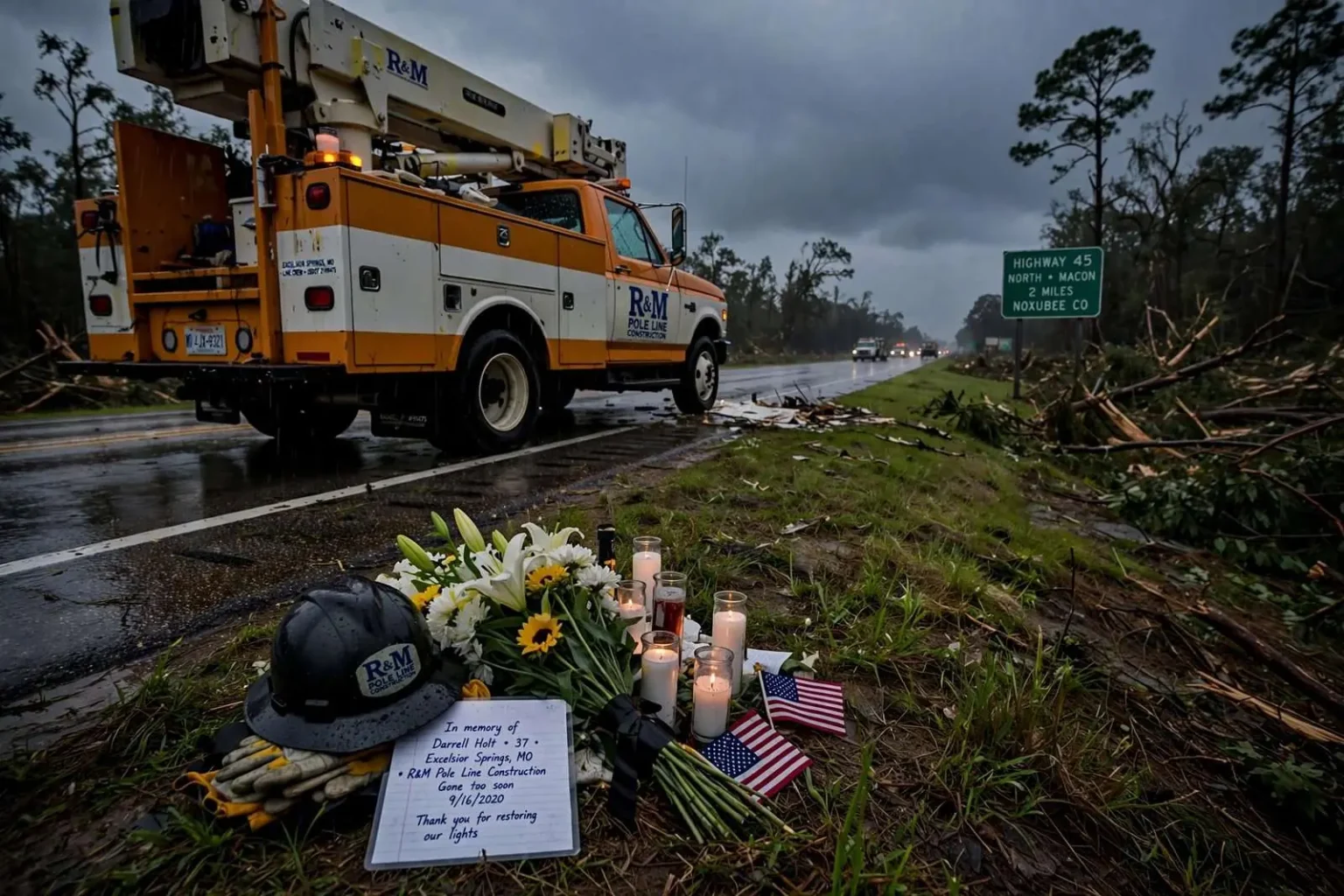
A utility worker who had been helping restore electricity across the storm-battered Gulf Coast was killed in a crash on his way home, according to Mississippi authorities.
The wreck happened Wednesday on Highway 45 in Macon, in Mississippi’s Noxubee County. The man was traveling in a convoy of power trucks when his vehicle struck an 18-wheeler, Assistant Police Chief Douglas Triplett said.
The crash
Noxubee County Coroner R.L. Calhoun identified the victim as 37-year-old Darrell Holt of Excelsior Springs, Missouri.
Holt worked for R&M Pole Line Construction, which had crews in the region assisting with power restoration in the aftermath of Hurricane Sally, the Category 2 hurricane that came ashore near Gulf Shores and left hundreds of thousands of Gulf Coast customers in the dark.
The crash occurred on Highway 45, the four-lane and two-lane corridor that runs north from the Gulf Coast through eastern Mississippi’s small towns — Meridian, Columbus, Aberdeen and Macon among them — and toward Tennessee. In the days after a major Gulf hurricane, the highway becomes one of the main arteries for the migration of utility trucks, bucket trucks, pole trailers and fuel tankers moving between the devastated coastal counties and staging areas inland.
Macon, the Noxubee County seat, sits along that route well north of the storm’s damage path, making it a stretch of highway that storm-response convoys traverse as they rotate crews home or bring fresh ones south. Convoy driving on rural highways carries particular risks: heavy vehicles moving in tight groups, local traffic unaccustomed to the sudden increase in truck volume, and drivers whose long shifts and long drives push against the limits of fatigue.
The storm that brought him south
Hurricane Sally came ashore near Gulf Shores, Alabama, as a Category 2 hurricane with winds around 105 mph, and its slow movement turned the storm into a prolonged rainfall and wind event for the central Gulf Coast. Baldwin County took a direct hit, with Gulf Shores, Orange Beach and Foley suffering severe wind and water damage, and the storm’s effects stretched west across Mobile Bay into Mobile County and southern Mississippi.
The storm left hundreds of thousands of Gulf Coast customers without electricity. Downed transmission lines, snapped distribution poles and debris-choked roads slowed restoration to a neighborhood-by-neighborhood grind that stretched on for days and, in the hardest-hit areas, weeks.
The crews who come after the storm
Restoration at that scale is never a local effort. Utilities along the Gulf Coast call on mutual assistance networks — formal agreements that move line crews, contractors and equipment from across the country toward whichever region takes the storm’s hit. Crews from the Midwest, like Holt’s Missouri-based company, are a standard part of the response, convoying hundreds of miles to work sixteen-hour days restoring power to unfamiliar counties.
R&M Pole Line Construction, Holt’s employer, is one of the contractor firms that utilities bring in to supplement their own crews. Line work is among the most dangerous occupations in the American economy even in routine conditions; storm restoration multiplies the hazards, adding energized lines hidden in downed trees, unstable poles, floodwater and exhausted workers operating heavy equipment in heat and rain.
Not all of the danger comes from the electrical work itself. The transportation piece — convoys of heavy trucks moving thousands of miles on rural highways, often on minimal sleep and shifting schedules — accounts for a significant share of storm-response injuries and deaths. Workers rotate between job sites, drive between staging areas and hotels, and make the long drive home when their tours end, and each of those legs is a highway journey in a vehicle far heavier than an ordinary car.
Holt’s death came on exactly such a leg, as the convoy he was traveling with made its way north through Mississippi. The vehicle he was in struck an 18-wheeler on Highway 45 in Macon, and he was pronounced dead at the scene.
Storm crews faced dangerous roads
The death underscored the hazards faced not only by residents cleaning up after the storm but by the visiting line workers who converged on the region to rebuild its electrical grid, often driving long distances in convoys between job sites.
In the weeks after Sally’s landfall, the roads of Baldwin and Mobile counties carried a traffic mix few locals had ever seen: hundreds of bucket trucks, pole-setting equipment, skid steers and fuel tankers moving through intersections where traffic signals were dark, past piles of storm debris that narrowed lanes and blocked sight lines. Law enforcement agencies along the coast repeatedly urged drivers to be patient with the convoys, whose slow-moving trucks were heading to the same restoration work everyone was waiting on.
The risk ran in both directions. Residents navigating intersections without working signals faced unfamiliar hazards, and the visiting crews — many of whom had never driven the area before — worked long shifts before getting behind the wheel. Federal safety statistics consistently rank transportation incidents among the leading causes of line-worker deaths, ahead of the electrocution hazards that most people associate with the trade.
Excelsior Springs mourns
Holt’s hometown of Excelsior Springs, Missouri, a small community northeast of Kansas City, received the news the way small towns do — through the networks of family, church and workplace that connect a community of roughly 10,000 people. Storm-response workers like Holt are part of a national corps of utility and contract linemen who leave home for weeks at a time whenever a major storm strikes, and their home communities absorb the worry that comes with the work.
The restoration mission Holt was part of had already restored power to vast stretches of the Alabama coast by the time of his death, as crews worked through the backlog of damaged lines and broken poles. The hundreds of thousands of customers initially darkened by the storm had been reduced day by day through that labor, much of it performed by visiting workers who would never meet the families whose lights they turned back on.
The investigation
Authorities did not immediately say whether charges were anticipated in the crash, which remained under investigation.
Crashes involving commercial vehicles are investigated with a thoroughness that ordinary wrecks do not receive. The Mississippi Highway Patrol and local authorities document the vehicles’ mechanical condition, drivers’ hours-of-service records, and the reconstruction of the collision itself — work that can take weeks before any charging decision is made. An 18-wheeler and a utility truck colliding on a rural four-lane involves federal trucking regulations, commercial licensing questions and, in a convoy context, the logistics of a multi-vehicle operation that investigators must untangle.
For R&M Pole Line Construction, the death of a worker on a homebound convoy leg falls under the occupational safety framework as well as the traffic investigation, with the federal Occupational Safety and Health Administration responsible for examining the work-related circumstances of an employee’s death. Companies in the storm-response business face the double obligation of investigating the immediate crash and reviewing the scheduling and convoy practices that shaped it.
Sally’s toll beyond the wind
Holt’s death was one of the storm’s most distant casualties, measured in miles from the landfall point near Gulf Shores but tied directly to the damage Sally inflicted. Storm-related deaths after a major hurricane follow a pattern: a portion come during the storm itself, but a larger share come in the aftermath — from heat, from generators, from cleanup accidents, and from the traffic chaos that follows a disaster.
The utility industry’s mutual assistance system is the reason a Category 2 hurricane does not leave a modern coast dark for a month, and the system runs on the willingness of workers like Holt to travel a thousand miles to restore strangers’ power. Sally’s restoration effort drew crews from across the country to Baldwin and Mobile counties; one of them, a 37-year-old from Excelsior Springs, did not make it home.
The crash remained under investigation by Mississippi authorities, and the storm’s Gulf Coast recovery continued in the weeks that followed — power restored pole by pole, debris cleared street by street, and a Missouri community mourning one of the workers who made that recovery possible.
Life in a storm camp
The restoration economy that visiting crews inhabit has its own geography. Utilities and contractors stage workers in hotel blocks, fairgrounds and parking lots converted into tent cities, where meals, fuel and laundry services are organized around sixteen-hour work rotations. Crews wake before dawn, roll out in convoys to the day’s assigned circuits, and return after dark to do it again — for a week, two weeks, sometimes longer after a storm as damaging as Sally.
The work itself varies by the day’s assignment. Some days are spent rebuilding distribution lines along a single damaged road; other days are devoted to “backfeeding” circuits, rerouting power around broken segments so entire neighborhoods can be energized while repairs continue. Every job ends the same way, with a crew member climbing a pole or bucket to physically close the connection, and with the lights coming on in houses whose owners may never know who did the work.
Wages for storm work run higher than routine line jobs, hazard pay and per diems compensating for the travel and the risk, and the industry’s contractors depend on that circuit — chasing storms from Florida to Texas to the Carolinas — for a significant share of their annual business. The grind takes its toll on the road as much as at the pole, and safety programs across the industry have pushed in recent years to limit consecutive driving hours and formalize convoy procedures after storms.
Remembering the workers behind the lights
Utility crews killed on storm response are memorialized in ways both local and national. The electrical trade honors its fallen through lineworker memorials, and utilities along the affected coast routinely acknowledge the visiting crews who took the region’s restoration as their own assignment. For the host communities, the visiting trucks are a familiar post-storm sight — license plates from Missouri, Indiana, Georgia and beyond parked outside hotels from Foley to Saraland.
Holt’s name joins the list of workers who died not in the storm itself but in the immense logistical effort that follows it, a reminder that the lights coming back on across Baldwin County and the Mississippi coast were each one switched on by a person, a long way from home.