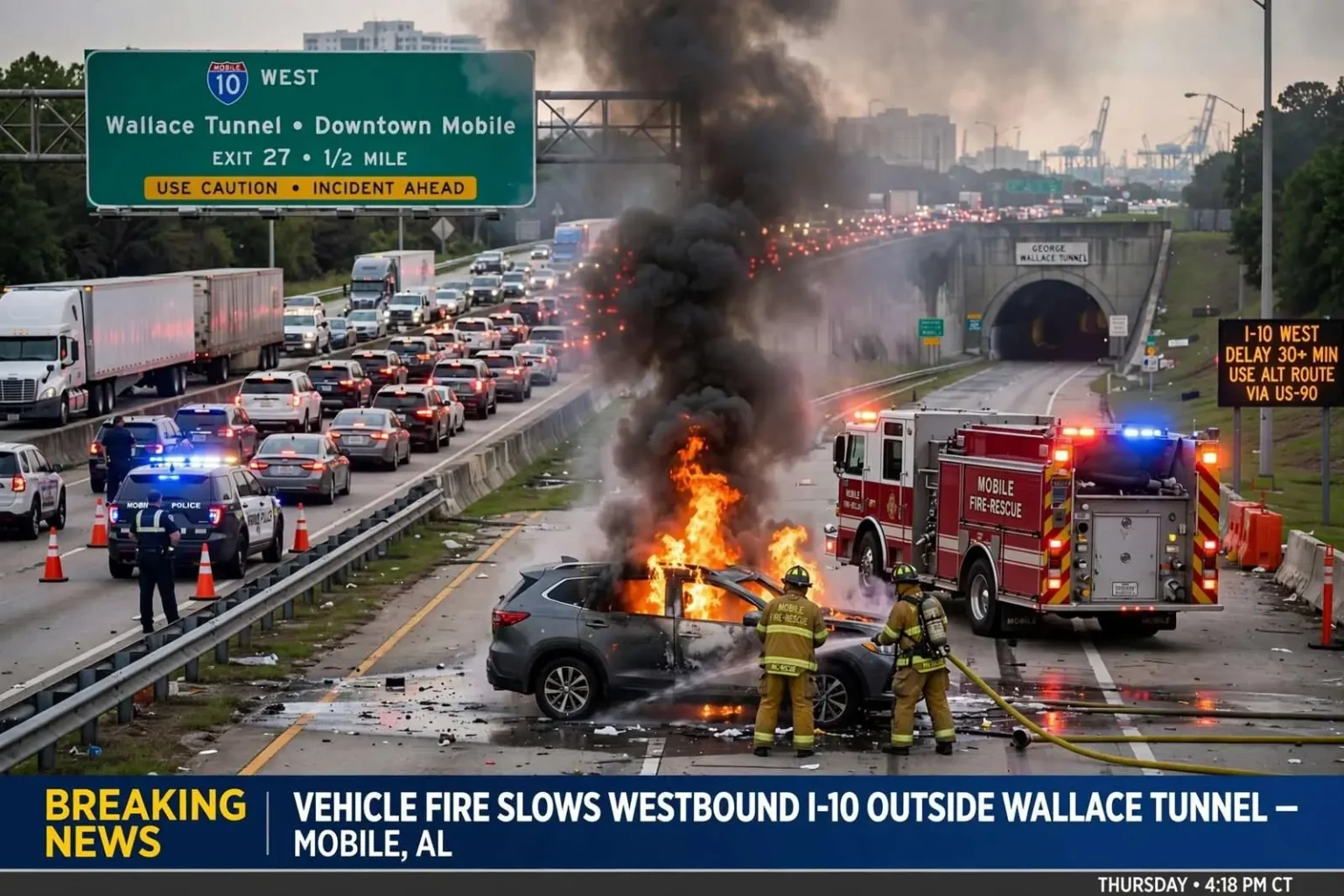
MOBILE, Ala. — Westbound traffic on Interstate 10 is slowing because of a vehicle fire outside the exit of the Wallace Tunnel. Motorists should expect delays while crews work to clear the scene. Drivers are urged to allow extra travel time or consider alternate routes through the Mobile area.
Interstate 10 through Mobile is one of the most congested corridors on the Gulf Coast, and any incident near the Wallace Tunnel compounds the delays the route already carries during normal traffic. A vehicle fire at the tunnel’s westbound exit brought traffic to a crawl as fire crews responded and lanes were restricted, snarling commuters and freight traffic alike. The Wallace Tunnel, which carries I-10 beneath the Mobile River downtown, is the gateway between the city’s eastern and western halves, and the George Wallace Tunnel’s twin bores funnel traffic between the Bankhead Tunnel approaches and the Cochrane-Africatown USA Bridge over the Mobile River.
Vehicle Fires on Urban Interstates
Vehicle fires on highways demand immediate and substantial responses. Mobile Fire-Rescue crews responding to an interstate fire must position apparatus safely, protect the occupants of the burning vehicle, and prevent the fire from spreading to nearby vehicles or grass along the right of way. The department’s downtown stations place engine companies within minutes of the tunnel approaches, but working a fire on an active interstate requires closing lanes, and traffic control becomes as much a part of the operation as extinguishing the flames.
The causes of highway vehicle fires range from mechanical failures and overheated engines to electrical faults and fuel leaks. Trucks climbing the grades that lead into the tunnel approaches run their engines hard, and brake or bearing fires on commercial vehicles are a recurring hazard on urban interstates nationwide. Once a fire starts, the vehicles behind it are trapped until lanes reopen, which is why a single burning car can back up traffic for miles on a corridor that already carries some of the heaviest volumes in Alabama.
The I-10 corridor through Mobile has drawn intense scrutiny for years because of its congestion. The highway funnels Gulf Coast freight traffic — between the Port of Mobile, the interstate’s connections to New Orleans and Florida, and the interior Southeast — through a downtown alignment with two-lane tunnel bores that were built generations ago for far lighter traffic. Any incident near the tunnel, even one cleared quickly, produces ripple delays that extend along the entire corridor and onto the alternate routes drivers turn to.
Alternate Routes Through Mobile
Drivers looking to avoid the delays have a handful of choices, none of them perfect. The Cochrane-Africatown USA Bridge and the Africatown span carry U.S. 90 and U.S. 43 traffic across the Mobile River north of downtown, and the Bankhead Tunnel provides an alternate downtown crossing for smaller vehicles. Motorists with more flexibility can route around the city entirely via U.S. 98 or state highways to the north, though those detours add substantial time for drivers headed east or west on long trips.
Alabama Department of Transportation traffic cameras and message boards advise drivers of incidents like this one in real time, and law enforcement asks motorists to avoid slowing down to watch the scene — a behavior that creates secondary crashes on top of the original incident. Emergency officials also remind drivers to move over for stopped emergency vehicles, as Alabama’s Move Over law requires, giving responders room to work safely on the shoulder or in a closed lane.
Crews worked to clear the burned vehicle and reopen lanes, and traffic returned to normal once the scene was secure. Residue from vehicle fires — fluids, debris and firefighting water — must be cleaned from the pavement before travel lanes are restored, and transportation crews handle that task as soon as the fire department releases the scene. The incident serves as a familiar reminder for Gulf Coast drivers: through Mobile, I-10 is a choke point, and the margin for unexpected events is thin.
For commercial drivers, an incident near the Wallace Tunnel carries costs beyond the delay itself. Federal hours-of-service rules limit how long a driver can remain on duty, and hours spent sitting in traffic count against that clock. Freight carriers routing through Mobile watch the corridor closely and often instruct drivers to time their crossings to avoid peak congestion — a strategy that works until an unplanned incident like a vehicle fire erases the schedule.
The Tunnel and Its History
The George Wallace Tunnel opened in 1973, named for the Alabama governor, and was built using a construction method that lowered prefabricated tunnel sections into a dredged trench beneath the river. Together with the older Bankhead Tunnel, completed in 1941, it forms the below-river crossings of downtown Mobile. The tunnel’s bores are only two lanes wide in each direction, with height and hazardous cargo restrictions that complicate freight routing, and the approaches drop steeply from the surface streets — a design that generations of Mobile drivers have navigated daily and long-distance travelers have found surprising.
Debates over replacing or supplementing the tunnel crossing have run for decades. A proposed new bridge over the Mobile River was studied for years, and tolling plans for I-10 Mobile River Bridge and Bayway projects have been among the most consequential and contested transportation issues in Alabama. Those long-term discussions continue even as day-to-day incidents — a disabled truck, a crash, a vehicle fire — keep demonstrating how sensitive the corridor is to any disruption.
Vehicle fires also pose environmental considerations on a corridor beside a working river. Firefighting runoff and vehicle fluids can wash toward storm drains, and crews work to contain what they can, particularly near waterways. Mobile’s position at the head of Mobile Bay makes its drainage connections to the river system a standing concern in any downtown incident involving spilled fluids.
For drivers who were caught in Thursday’s slowdown, the advice from officials remains the same for any incident on the corridor: check traffic conditions before traveling through downtown Mobile, allow extra time, use alternate crossings when appropriate, and stay alert for emergency workers on the roadway. The I-10 Wallace Tunnel exit is among the busiest stretches of highway in Alabama, and the cooperation of drivers — moving over, keeping speeds down, avoiding rubbernecking — is part of what keeps responders and the traveling public safe when a vehicle fire brings the corridor to a stop.
Emergency response planning for the tunnel corridor is a standing exercise for Mobile agencies. Fire crews train for incidents inside and around the tunnel bores, where ventilation, access and evacuation are more complicated than on open highway. A fire outside the tunnel exit, like the one that slowed westbound traffic, is easier to work than one inside a bore, but it still requires closing the approach lanes and managing the queue of vehicles backing up from the scene — a job that falls to police and transportation crews working alongside firefighters.
The economic stakes of the corridor add weight to every incident. The Port of Mobile has grown into one of the busiest deepwater ports on the Gulf of Mexico, and the freight that moves through it travels largely by truck and rail across the corridor I-10 shares with the city. Distribution centers along the route and across south Alabama depend on reliable travel times, and each significant delay — even one measured in hours — is logged by carriers who factor the Mobile bottleneck into their route planning and pricing.
Staying Safe in Highway Traffic Jams
Stopped traffic on an interstate carries its own risks, and safety officials urge drivers caught in a backup to stay alert for approaching vehicles, keep a following distance even when stopped, and watch for emergency vehicles trying to pass on the shoulder. Motorists should not abandon their vehicles on the roadway unless ordered to, and drivers approaching a slowed scene should reduce speed well before reaching the congestion rather than braking hard at the last moment. Those habits, repeated across thousands of drivers, determine whether an incident stays a single-vehicle event or multiplies into a chain of crashes.
Alabama’s Move Over law, expanded in recent years to cover any stopped vehicle with hazard lights as well as emergency and service vehicles, requires drivers to change lanes away from the incident or slow to a safe speed when they cannot. Enforcement of that law is part of the state’s broader work zone and responder safety effort, and violations carry fines that increase when the stopped vehicle is an emergency responder. Incidents like the vehicle fire near the tunnel exit are precisely the situations the law was written for.
Once the fire was extinguished and the scene cleared, transportation crews inspected the pavement for damage before fully reopening the lanes, and the residual backup drained away over the following hour. State troopers and Mobile police will document the incident in routine reporting, and any findings about the cause of the fire will appear in the vehicle’s insurance and repair process. For the drivers who sat through the delay, the episode ended as most highway vehicle fires do — with a tow truck, a clean-up crew and a return to the endless flow of traffic through one of the Gulf Coast’s busiest and most fragile corridors.