Zombo Combo Follows Fairhope Earth Day Set With Bayfest Slot
Gulf Coast funk quartet Zombo Combo follows its Fairhope Earth Day appearance with a Saturday 8 p.m. slot at Mobile's Bayfest.
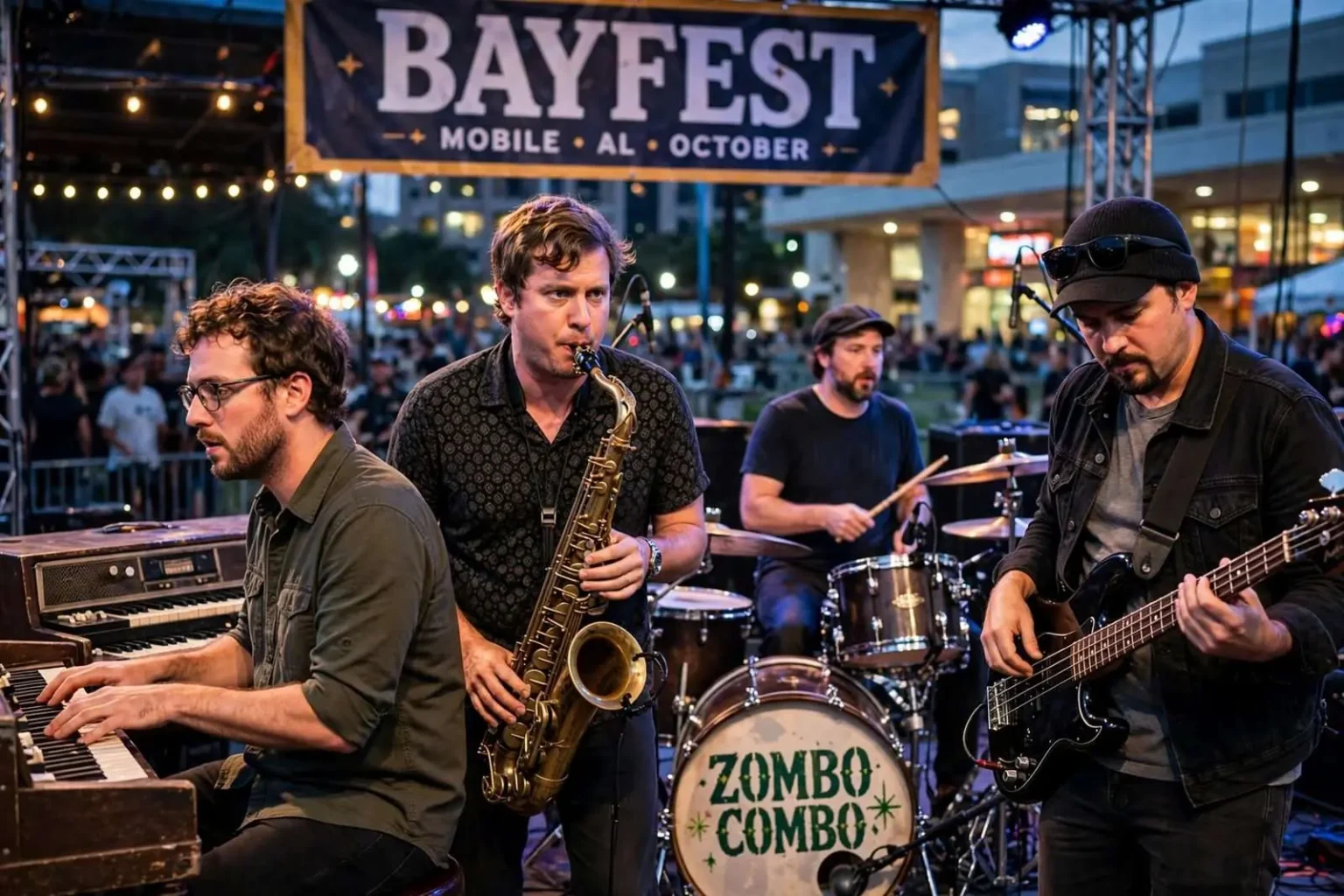
Zombo Combo, the Gulf Coast instrumental funk combo, has had a busy stretch on the lower Alabama festival circuit, and the pace shows no sign of slowing. The four-piece — Chris Spies on keys, Christopher Spies on saxophone, John Milham on drums and JoJo Morris on bass — played the Earth Day celebration in Fairhope earlier in the year and now heads to Mobile for Bayfest, where the band performs Saturday at 8 p.m. For a group that built its reputation at community gatherings and club dates across the bay, a Bayfest slot represents a step up in scale and a chance to play for the biggest audience of the fall.
The band’s sets lean heavily on the deep funk and soul-jazz songbook, a catalog that stretches from the Gulf Coast’s own rhythm-and-blues lineage to the hard-edged organ combos of the 1960s. Recent shows have included renditions of Willie Tee and the Gaturs’ “Gatur Bait,” James Booker’s “African Gumbo” and Fred Wesley’s “Fire Eater,” alongside band originals like “The Weasle.” The song choices tell listeners a lot about where the group’s heart lies: Willie Tee’s New Orleans funk remains one of the deepest wells in Gulf South music, Booker’s piano work bridged jazz and R&B in the Crescent City, and Fred Wesley’s trombone-led funk with the J.B.’s defined the genre’s horn-driven side.
Playing that material without a vocalist puts the weight on instrumental interplay, and Zombo Combo’s lineup is built for it. Two Spieses in the front line — Chris on keyboards and Christopher on saxophone — give the band a two-voice attack on melodies that were often written for full horn sections, while the rhythm section of Milham and Morris keeps the groove deliberately loose and deep. Funk of this school lives or dies on the pocket, and the group’s rotating chemistry has made it a favorite at Fairhope’s community events, where audiences can listen up close and dancers can take over the front of the stage.
A Busy Season on the Lower Alabama Circuit
The route from Fairhope’s Earth Day celebration to Bayfest’s main weekend traces the shape of the lower Alabama festival calendar. Baldwin County’s spring season is anchored by community events in Fairhope, where the city’s parks and downtown streets host arts and music gatherings that draw families from across the Eastern Shore. Mobile’s fall belongs to Bayfest, the downtown music festival that fills the streets around the convention center and Bienville Square with multiple stages and acts spanning rock, R&B, jazz and everything in between. A band that can hold a crowd at both ends of that calendar has proven it can play to listeners who came specifically to hear music as well as passersby who stop because the groove catches their ear.
Instrumental funk is a natural fit for both settings. Without lyric-driven songs to carry the set, the band trades on rhythm, dynamics and the give-and-take between soloists — qualities that work just as well for an afternoon audience spread across a Fairhope park as for a night crowd packed in front of a Bayfest stage. The 8 p.m. Saturday slot puts the band in prime time, when the festival’s audience is at its largest and the downtown streets are full of people moving between stages.
The Musicians Behind the Combo
John Milham is one of the busier drummers on the Mobile Bay scene, and his presence in the band gives it a rhythmic authority that comes from years of club work and festival stages. Drummers who anchor multiple projects bring a particular fluency to a group like Zombo Combo: they know how to shape a set’s energy, when to push a soloist and when to leave space. His partnership with bassist JoJo Morris forms the foundation of the band’s sound, a rhythm section that keeps the deep funk grooves rolling underneath the keyboards and saxophone.
The Spieses’ front line handles the melodic heavy lifting. Organ and electric piano in the left hand and improvisation in the right have been the engine of soul-jazz since the format emerged, and adding a saxophone gives the band a lead voice that can shout like a horn section or whisper through a ballad. Covering material as demanding as James Booker’s requires players who understand the New Orleans tradition, not just its notes, and the band’s choices suggest its members have spent plenty of time listening to the source.
Why the Songbook Matters
The material Zombo Combo selects amounts to a guided tour of Gulf Coast funk history. Willie Tee and the Gaturs recorded in New Orleans in the early 1970s, producinginstrumental funk that stayed local for decades before collectors and deejays rediscovered it; “Gatur Bait” is a prime example of the raw, percussion-heavy sound that made the records prized. James Booker, the piano virtuoso known as the Bronze liberace of the New Orleans keyboards, blended classical technique with R&B feel, and “African Gumbo” captures his rhythmic flair. Fred Wesley, best known as the musical director and trombonist for James Brown’s J.B.’s, wrote and played some of the most sampled horn lines in American music, and “Fire Eater” shows the soloist’s side of his playing.
Drawing on that repertoire does more than fill a set list. It connects Gulf Coast audiences with music created a few hours west along the same corridor of river towns, juke joints and recording studios that shaped the region’s sound. Mobile listeners grew up with the same musical currents — second-line rhythms, swampy guitar tones, horn bands that played school dances and festival stages alike — and hearing them revived by a local combo keeps the tradition in circulation rather than in archives.
The band originals, like “The Weasle,” slot into that catalog comfortably. Writing new material in a vintage style requires knowing the conventions well enough to add something rather than merely imitate, and the group’s willingness to mix its own tunes with the classics suggests confidence in its songwriting. Audiences at the Bayfest set can expect the originals to sit alongside the covers without jarring, bound together by the same bass-forward grooves and organ-sax interplay.
Bigest Stage of the Fall
Bayfest’s Saturday slate gives the band its biggest audience of the fall, and festival slots reward bands that can build energy across a full set. Zombo Combo’s format is well suited to the task: deep-groove instrumentals leave room for extended solos without depending on sing-alongs, and the music’s dance-floor pull fills the space in front of the stage. Festival bookers tend to favor acts with that kind of self-sufficient energy, since a strong instrumental set can hold a crowd between higher-profile headliners.
The Mobile gig also closes a loop on the band’s year. Starting at a community celebration in Fairhope and finishing at one of the region’s largest downtown festivals traces the full range of Gulf Coast live music — from parks and families to street closures and stage production. Bands that work both circuits become fixtures of the scene, familiar faces that audiences greet from Fairhope to Mobile and back again.
For listeners who have never caught the band, the Bayfest date offers a low-cost way in. Festival admission covers all stages, and an 8 p.m. slot leaves the rest of the evening open to explore other acts or settle in for a full night of music downtown. For longtime fans, it is a chance to hear the combo with festival sound and lights behind it, a different experience from the club and park settings where the group usually plays.
The band’s trajectory mirrors the health of the regional scene. A four-piece instrumental funk combo sustained by local musicians, booked at community events and regional festivals, depends on audiences that show up for live music on both sides of Mobile Bay. Every Earth Day set in Fairhope and every Bayfest slot in Mobile supports the venues, bookers and players who keep original music alive along the Gulf Coast, and Zombo Combo’s busy schedule suggests that support is holding steady.
The Venues and Events That Shaped the Band
Fairhope’s community events have long served as a proving ground for Eastern Shore musicians. The city’s Earth Day celebration brings environmental groups, local vendors and regional performers to the waterfront each spring, and its audience includes families, retirees and college students from across Baldwin County. Playing that kind of mixed crowd teaches a band to communicate without pyrotechnics or volume — the groove has to do the work, and instrumental funk rewards exactly that discipline. Zombo Combo’s status as a favorite at Fairhope’s events reflects years of sets that could reach listeners of every age without compromising the music.
Bayfest, by contrast, is a downtown production. Mobile’s fall festival assembles dozens of acts across multiple stages, drawing tens of thousands over a weekend and turning the blocks around the convention center and Bienville Square into a walkable circuit of sound. For a local band, a Saturday slot is both a showcase and a test: festival sound systems expose every weak spot in a rhythm section, and the audience is free to walk away at any moment. The group’s 8 p.m. Saturday performance puts it in front of listeners already primed for a night of music, many of whom will be encountering the band for the first time.
Between those poles sits the club circuit, where the band’s repertoire was built. South Alabama’s venues — from downtown Mobile listening rooms to Eastern Shore bars — have long sustained musicians who play deep cuts and band originals on weeknights. That apprenticeship shows in the group’s arrangements of demanding material like Booker’s and Wesley’s, which require the kind of fluency that only develops over hundreds of sets on small stages.
What the Set Might Hold
Audiences heading to the Bayfest performance can reasonably expect the deep funk and soul-jazz selections that have defined recent shows. “Gatur Bait” brings a percussion-driven swamp groove that translates beautifully to outdoor stages, “African Gumbo” gives the keyboards room to demonstrate New Orleans flourishes, and “Fire Eater” is a natural vehicle for extended saxophone work. Band originals like “The Weasle” keep the set from becoming a history lecture, and the two Spieses can trade leads across any of them.
The instrumental format also invites improvisation, which means no two sets sound quite alike. A festival crowd that catches the band at its peak may hear stretches of group interplay that have never been played the same way before — the essence of combo jazz and funk since the genre’s earliest days. Listeners who appreciate musicianship as much as entertainment will find plenty to hold their attention between the grooves.
For the band members, the fall run caps a year of steady work on the circuit, and it positions the group for whatever comes next — more community events in Fairhope, more club dates around the bay, and possibly larger festival slots if the Bayfest set lands the way the group’s growing reputation suggests it will. Gulf Coast music thrives on bands like this one: working musicians with deep listening habits, a book of classics and originals, and a groove-first approach that fills dance floors from Fairhope’s parks to Mobile’s festival streets.