Zwanze Day Hits the Gulf Coast as Alabama’s Craft Beer Scene Accelerates
Zwanze Day brings rare Cantillon lambic to the Gulf Coast while Fairhope Brewing, Druid City and other Alabama breweries hit new milestones.
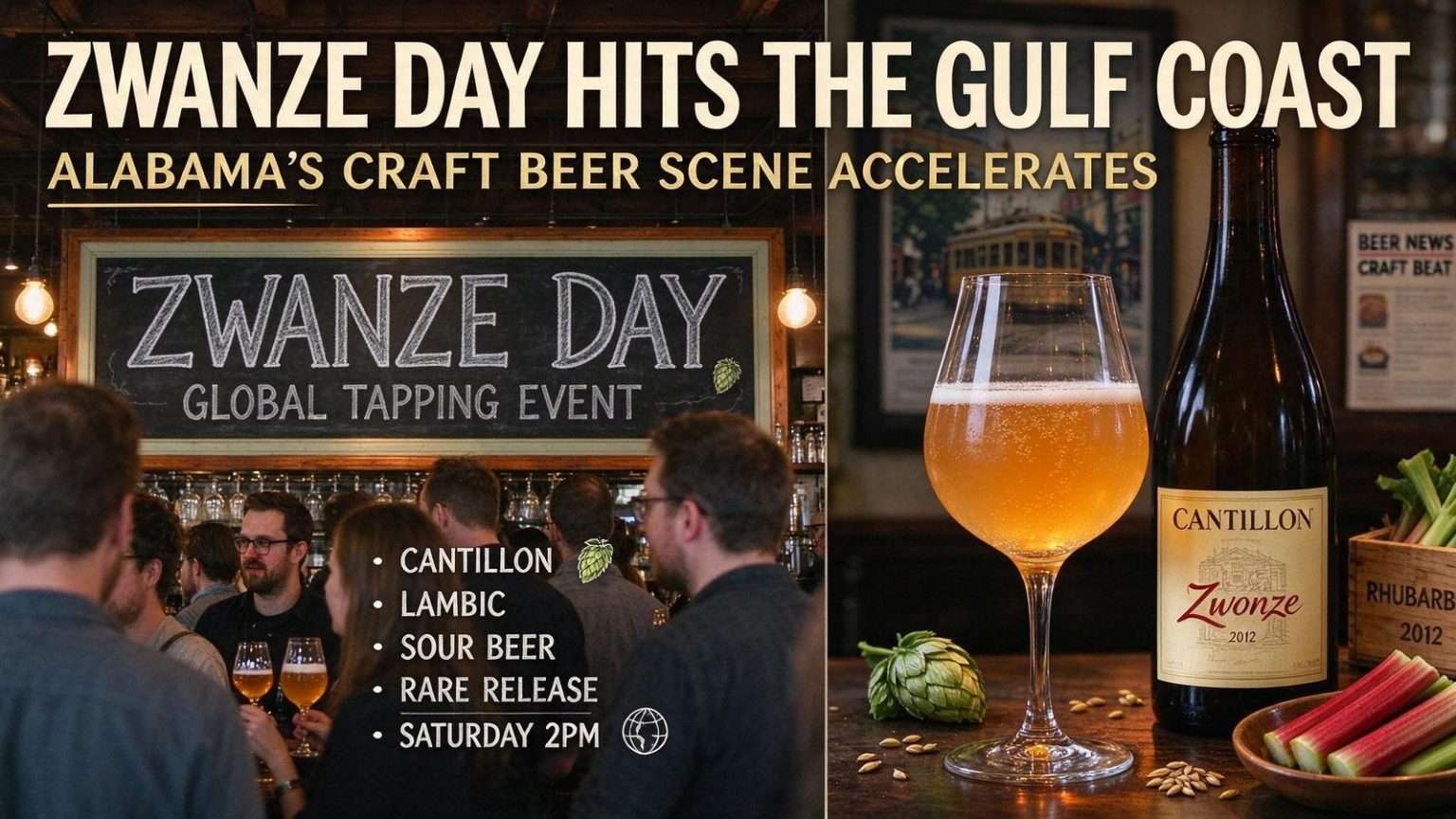
Beer lovers willing to make the drive have a rare appointment this weekend: Zwanze Day, the annual worldwide celebration of Belgian lambic, returns Saturday with the Avenue Pub in New Orleans once again serving as the Gulf Coast’s host venue — one of just 36 bars on the planet pouring this year’s release. For Alabama’s lambic devotees, the short drive west is the only way to taste a beer that appears nowhere else in the region, in a celebration coordinated simultaneously across the globe.
Zwanze Day has become one of the most unusual fixtures of the international beer calendar. Participating bars — selected by the brewery and scattered across continents — tap the same limited-release beer at the same moment, turning a single keg list into a worldwide event. The scarcity is genuine: the release is produced once, in small quantity, and bars that are not on the list simply cannot pour it.
The Avenue Pub on St. Charles Avenue has made itself the Gulf Coast’s home for the event, and its inclusion on the 36-bar list puts New Orleans in the company of a handful of venues worldwide trusted with the pour. For Gulf Coast beer travelers — including a devoted contingent from Mobile and Baldwin County — the pub’s selection spares them a transatlantic trip to taste the year’s release.
A Once-a-Year Lambic
Held annually since 2008, Zwanze Day is the creation of Jean Van Roy, fourth-generation brewer at Brussels’ famed Cantillon brewery, who blends a one-time beer each year meant to capture the self-deprecating humor of his hometown. Cantillon occupies a special place in the beer world: a working family brewery in Anderlecht that has preserved traditional lambic methods — spontaneous fermentation in open cooling vessels, years of aging in oak — while its bottle releases command cult attention across Europe and America.
The name itself carries the joke. “Zwanze” is Brussels slang for a kind of deadpan, self-mocking wit, and Van Roy’s annual releases embrace it — beers built from unexpected fruits and unconventional blends, treated by his brewery with total seriousness and presented with a wink. Each edition exists only once; when the kegs are gone, the beer is history.
The 2012 edition revisits the original 2008 recipe: rhubarb soaked in twenty-month-old lambic, a tart, wine-like beer the brewery describes as delicately balanced between acidity and the fruit’s sharpness. The choice of rhubarb — a vegetable rarely seen in any brewing tradition — is the kind of flourish that defines the series, and its sour brightness over mature lambic promises a pour unlike anything on a standard tap list.
The Avenue Pub on St. Charles Avenue kicks things off Friday night with a list of rare sour beers from around the world, then joins 35 of the 36 participating venues in tapping the 2012 Zwanze simultaneously at 2 p.m. Saturday. The Friday warm-up gives attendees a primer in the sour beer tradition before the main event, and the coordinated Saturday tapping turns the pub’s room into one small node of a global toast.
Understanding Lambic
Lambic stands apart from nearly every other beer tradition on earth. Where most brewing goes to great lengths to control fermentation with cultured yeast, lambic brewers expose their cooling wort to the wild yeasts and bacteria of their own brewery’s air, letting the microbes of the Senne valley — and of the building itself — begin a fermentation that can take years to complete. The result is a dry, sour, complex beer that wine drinkers often find more familiar than beer drinkers do.
Cantillon, founded in 1937, remains one of the benchmark producers, and its tours through the Anderlechet brewery’s copper coolship and cobwebbed barrel rooms have become a pilgrimage for beer travelers. The brewery’s insistence on traditional methods — no artificial carbonation, no flavoring shortcuts — has made its bottles among the most sought-after in the world, and its annual Zwanze release the centerpiece of this international celebration.
That tradition is what Alabama beer drinkers will taste Saturday. A twenty-month lambic soaked with rhubarb carries years of barrel character — the funk, oak, and acidity that only time and wild fermentation produce — brightened by the vegetable’s sharp fruit. For Gulf Coast palates raised on lighter lagers, it can be a revelation; for sour beer veterans, it is the year’s most anticipated single pour.
Alabama Brewing News Closer to Home
Back in Alabama, the craft scene keeps moving — and this is the year it finally reaches every corner of the state. In Tuscaloosa, the state’s newest brewery, Druid City Brewing Company, debuted its beers during last Friday’s surprise Alabama Shakes show at Egan’s Bar — fittingly scrappy beginnings for the smallest brewery in Alabama, which produces just 3.5 barrels per batch.
The pairing could hardly have been better: the Alabama Shakes, the Athens-based band that rocketed from regional clubs to national attention, blasting through an unannounced hometown-adjacent show while Tuscaloosa’s first new brewery poured its first beers to the crowd. Early releases are finding their way onto taps at Egan’s, Wilhagen’s and the Alcove, giving Druid City an immediate foothold in the college town’s bar scene.
The 3.5-barrel batches mean the brewery will stay small and local by necessity — those batches yield a few hundred pints at a time, enough for neighborhood accounts but not wide distribution. That constraint has become part of the identity: a taproom-scale operation born in a college town, growing one small batch at a time.
Tuscaloosa’s entry into brewing reflects the statewide momentum. Within a few short years, Alabama’s breweries have gone from a legal afterthought to a growing industry, as changing state laws allowed higher-gravity beers and on-premises sales, and entrepreneurs in city after city opened operations to serve the demand.
Huntsville Beer Heads South
Closer to Mobile, representatives from Huntsville’s Blue Pants Brewery and Straight to Ale spent the month visiting retailers and distributors, with both breweries hoping to see their beers on local taps and shelves before year’s end — potentially the first wide Huntsville distribution to the lower part of the state.
The push matters for south Alabama drinkers, whose local options have grown even as the state’s breweries cluster in the northern half. Huntsville has emerged as one of Alabama’s strongest brewing markets, seeded by the city’s engineering workforce and a cluster of operations that includes Blue Pants, Straight to Ale, and their peers. Bringing those beers to Mobile and Baldwin County shelves would knit the state’s two brewing regions together for the first time at scale.
Distribution is the make-or-break stage for any small brewery. Brewing the beer is one challenge; trucking it cold, selling it through wholesalers, and keeping it fresh on shelves hundreds of miles away is another. The month of retailer visits signals that both Huntsville operations consider the Gulf Coast market worth the investment — and that Mobile-area beer drinkers should start watching local tap lists.
Montgomery and the Middle of the State
Montgomery’s Railyard Brewing Company has been brewing on-site since November 10, with brewer Kade Miller already having produced an Irish red, oatmeal stout, Scottish wee heavy, honey porter and hazelnut brown — making it, for now, the closest in-state brewery to south Alabama.
That geographic distinction gives Railyard outsized importance for the Gulf Coast. Until the state’s brewing map fills in, Mobile drinkers seeking Alabama-brewed beer must reach north, and Railyard’s downtown Montgomery brewhouse sits at the midpoint — the nearest production facility pouring Alabama-made beer. Its range of styles, from sessionable Irish red to the heavy Scottish wee heavy, shows an operation building depth quickly in its first months.
Miller’s pace — five distinct beers produced since mid-November — reflects the brewery’s strategy of establishing its range early, giving the taproom a rotating lineup while it gauges which styles earn repeat demand. Montgomery’s position on the I-65 corridor also places Railyard directly on the route between Huntsville’s breweries and the coast, positioning the capital city as a link in the chain of Alabama beer.
Fairhope’s Brewery Takes Shape
And in Fairhope, Baldwin County’s own Fairhope Brewing Company received its first equipment shipment this week; the tasting-room bar is built and the brewery remains on track to have beer ready by year’s end at 914 Nichols Ave.
The equipment arrival marks the visible turning point for the Eastern Shore’s first brewery. Fairhope’s project has drawn attention across Baldwin County, where the rapid growth of Daphne, Fairhope, and Spanish Fort has created a substantial market with no local production of its own. A working brewery in downtown Fairhope puts Alabama-made beer within a short drive of the Eastern Shore’s restaurants and bars — and gives the county a fixture its neighbors have watched take shape for months.
The pace of the buildout — tasting-room bar finished, tanks arriving, beer targeted before the new year — suggests an operation determined to join the statewide boom in its current wave. When the first Fairhope batches pour, Baldwin County drinkers will finally have a hometown brewery, and Alabama’s map will have production in the southern tier at last.
A State Map Filling In
Put the weekend’s pieces together and the shape of Alabama’s beer future comes into focus: a new small brewery in Tuscaloosa, Huntsville brands pushing south, Montgomery brewing steadily in the middle, Fairhope’s tanks arriving on the Eastern Shore — and, an hour down the road, a New Orleans pub pouring one of the rarest beers on earth. The state’s drinkers now have more Alabama-made choices than at any point in the modern era, and the geography is finally stretching toward the Gulf.
The momentum traces to a series of legal changes that unshackled the state’s industry. Alabama long ranked among the most restrictive beer states, capping alcohol content in ways that kept most craft styles out entirely. Reforms allowing stronger beers and, later, brewery taprooms changed the economics overnight — and the wave of openings in Huntsville, Birmingham, Tuscaloosa, Montgomery, and now Fairhope is the direct result.
For now, the closest thing to a Gulf Coast celebration of beer culture happens across state lines, at events like Saturday’s Zwanze Day tapping. But the weekend’s news suggests that distance shrinking: Huntsville beer headed for Mobile shelves, Montgomery pouring within a tank’s drive, and Baldwin County’s own brewery on schedule to pour by New Year’s.
The beer travelers driving west on Saturday will toast a Belgian tradition that dates generations. They’ll return to an Alabama scene that, at its current pace, may soon deserve a rare celebration of its own — one small batch, one new tap list, and one opening at a time.