38 Years Ago This Week: Led Zeppelin Played Mobile
38 years after Led Zeppelin played Mobile on May 13, 1973: the full setlist, Plant's stage banter, and J.D. Crowe's head-butting encounter.
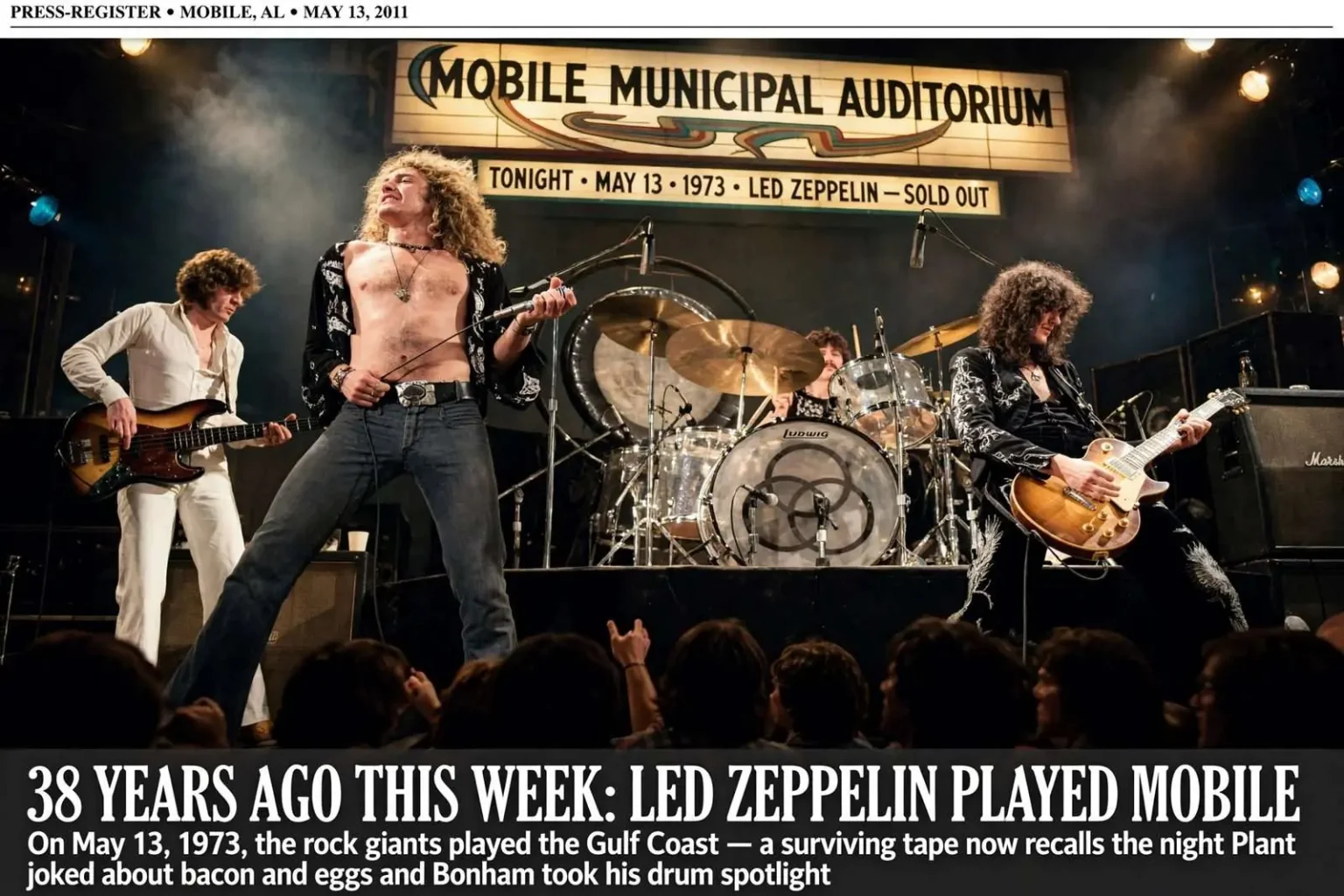
Amid the buzz over Mobile’s current original-music showcase Coastline Chronicles, it is worth pausing on an older anniversary: on May 13, 1973 — 38 years ago this week — Led Zeppelin played Mobile. For one spring night, one of the biggest rock bands on the planet passed through the Gulf Coast on its way across America, and the city briefly shared a stage with a group whose records were selling in the millions.
Led Zeppelin had by 1973 become one of the most successful and least conventional acts in popular music. Formed in London in 1968 around guitarist Jimmy Page, singer Robert Plant, bassist and keyboardist John Paul Jones and drummer John Bonham, the band had built its reputation on loud, blues-rooted rock played with an intensity that few touring acts could match. By the spring of 1973 the group was riding the release of “Houses of the Holy,” its fifth album, and its American tours had become events in their own right — arenas filled, tickets vanished, and cities large and small competed for a date on the itinerary. That Mobile landed one was itself a mark of the band’s touring reach across the South.
What makes the Mobile date stand out more than four decades later is that it was captured. A recording of the show survives, complete with between-song banter, preserving not just the music but the sound of the band members talking to a Gulf Coast audience in their own voices.
On Tape: Plant and Bonham Between Songs
The tape catches Plant in a loose, unguarded mood well before the heaviest music started. Before the band played “The Song Remains the Same,” he told the crowd how close to showtime the musicians had actually gotten moving: “it seems so early really to do a concert, y’know… we only got outta bed about two-thirty… I just finished me bacon and egg and here we are!” The remark drew the kind of laugh reserved for rock stars admitting that the machinery of a giant tour still runs on very ordinary human routines.
Later, after an early rendition of “Stairway to Heaven” — a song the band typically saved for the end of its shows — Plant reflected on how far the group had already traveled in its short life together. “we’ve been together now over five years and we’ve come to America a total of ten times… and the English tax people are quite pleased about this,” he said, a wry nod to the fact that much of the band’s touring income was earned on the road and outside Britain’s tax reach. The joke landed as both a boast and a shrug: five years in, ten American tours behind them, and no sign the schedule was slowing down.
Drummer John Bonham, meanwhile, got his usual rowdy introduction before his featured turn on “Moby Dick,” hailed from the stage as “one of our favorite members of the group, a rather fat, chubby, happy fellow.” The description was affectionate rather than cruel — the standard way Plant introduced his drummer night after night, signaling to the audience that the spotlight was about to shift to the man behind the kit.
The Setlist
The Mobile set ran twelve songs, and it followed the blueprint the band was using across its 1973 tour: an explosive opening, a wide middle stretch, and a long, deliberate build toward the finish. The night opened with “Rock and Roll” and “Celebration Day,” the pair the band trusted to hit full volume within the first minutes of the show.
From there the performance wove through “Black Dog,” “Over the Hills and Far Away,” “Misty Mountain Hop,” “Since I’ve Been Loving You” and “No Quarter,” a run that moved from hard blues to folk-tinged acoustic material to the keyboard-heavy atmospherics that gave the 1973 shows much of their range. Few bands of the era carried that much dynamic territory into a single night, and the Mobile audience heard the band’s catalog in something close to its full breadth.
Then came the main event of the evening’s second half: “The Song Remains the Same,” “The Rain Song,” a sprawling “Dazed and Confused,” “Stairway to Heaven” and “Moby Dick.” The sequence stacked the band’s most ambitious material back to back. “Dazed and Confused” stretched far beyond its studio length as Page worked his bow-and-feedback theatrics, “Stairway” arrived with all the weight of the band’s signature song, and “Moby Dick” gave Bonham his extended drum feature before the night closed out.
A Band at Its Peak on the Road
The Mobile show fell in the middle of one of the most consequential stretches of Led Zeppelin’s touring career. The band’s 1973 American dates were played in support of “Houses of the Holy,” which had just been released and would go on to top charts on both sides of the Atlantic. Concerts from that tour were drawing enormous crowds, and the tour’s final dates in the Northeast would later form the basis of the group’s concert film and soundtrack album, both titled “The Song Remains the Same.” The fact that a Mobile date fell inside that same run gives the surviving recording a significance beyond simple nostalgia: it documents a band working at full stride, not as a museum piece but as a working unit moving from city to city.
For local audiences, the visit also said something about the place of Gulf Coast cities in the national touring map of the early 1970s. Major rock acts routing between New Orleans and the Florida panhandle or the larger Southeastern markets frequently scheduled stops in Mobile, and a band of Led Zeppelin’s stature playing the city put local fans within an evening’s drive of material they might otherwise have only heard on records or late-night radio. Tickets for dates on that tour were famously difficult to come by in the bigger markets, which made a hometown show all the more valuable for the people who filled the hall that May night.
The between-song patter preserved on the recording has become part of the show’s appeal for listeners who have encountered the tape in the decades since. Rather than the polished stage banter of a rehearsed production, the Mobile audience got an unscripted picture of the band: Plant joking about bacon and eggs, acknowledging the tax man, and gently needling his drummer. For a city that had hosted countless touring acts before and since, the tape remains one of the clearest audio snapshots of what a major 1973 rock concert actually sounded like from the floor.
How the Show Fits the Band’s Story
By May 1973 the band members were still in their twenties, yet they were already veterans of a decade’s worth of musical change compressed into five years. “Stairway to Heaven,” played early in the Mobile set rather than at its usual closing spot, had by then become the band’s most requested song, and its placement in the setlist shifted from city to city as the band varied its pacing. Songs like “Since I’ve Been Loving You” stretched back to the group’s first album, while “No Quarter” and “The Song Remains the Same” came from the newest material, giving the Mobile crowd a program that spanned nearly the band’s entire recorded history to that point.
The Mobile setlist also captured the band in transition. The acoustic numbers that had anchored earlier tours were being folded into a more electric, keyboard-driven presentation, and the long instrumental features — Page’s guitar showcase in “Dazed and Confused,” Bonham’s drum spotlight in “Moby Dick” — remained the evening’s showpieces. Within a few years the band’s touring style would change again, but the 1973 dates are widely regarded as the high-water mark of the group’s live presentation, balancing power, variety and stamina in a way later tours rarely matched.
That is part of why the anniversary resonates locally. Mobile audiences that night were not watching a legend in retrospect; they were watching a current, working band on the way up, unaware of how the story would end — with Bonham’s death in 1980 and the group’s decision to disband rather than carry on with a replacement. The recording of the Mobile show preserves the band at the moment when everything still lay ahead.
A Mobile Cartoonist’s Zeppelin Tale
The band’s connection to Mobile journalists did not end in 1973. Fifteen years later, at a 1988 hotel-bar encounter in Milwaukee, editorial cartoonist J.D. Crowe — who now works at the Press-Register in Mobile — teased Robert Plant by pretending to mistake him for David Coverdale of Whitesnake, a band often derided as a Zeppelin derivative. For a singer who had spent a decade deflecting imitators, the gag hit a nerve.
An enraged Plant reportedly head-butted him before the two made peace and posed for a photo with fellow cartoonist Rob Rogers. The dust-up became one of Crowe’s favorite stories, less for the altercation than for the detail that followed it.
“Just as the picture was being snapped,” Crowe recalled, “Plant, who’s a good two or three inches shorter than Rob and I, hoisted himself up to appear taller.” The image — a rock icon caught mid-tiptoe in a hotel-bar photograph — proved as memorable as the head-butt itself, and Crowe has retold the tale in print over the years as a footnote to his own career.
Why the Anniversary Still Matters Locally
Anniversaries like this one do more than mark a date on a calendar. They document the moments when national culture passed through local rooms — when a band at the top of its powers came through a Gulf Coast city and left behind a recording that still circulates among fans. For Mobile, the May 13, 1973 show is one of the clearest examples of the city’s place in the touring history of rock’s biggest acts.
The timing of the anniversary also lands in the middle of a broader conversation about live music in Mobile. Coastline Chronicles, the city’s current original-music showcase, has drawn attention to the local scene and to the venues that host homegrown acts, and the comparison with the 1973 visit is instructive. The Zeppelin show represented the era when touring giants passed through town; the current showcase represents the effort to build a scene that keeps original music on local stages week after week. Both matter to the health of the city’s musical life.
The Setlist, Song by Song
For listeners who want to reconstruct the evening from the surviving recording, the twelve-song program provides a map of the night. “Rock and Roll” and “Celebration Day” opened the show at full speed, the two songs functioning as a double-barreled statement of intent before the band settled into its longer material.
The middle stretch — “Black Dog,” “Over the Hills and Far Away,” “Misty Mountain Hop,” “Since I’ve Been Loving You” and “No Quarter” — carried the audience across the band’s range, from the riff-driven rock of “Black Dog” to the slow blues burn of “Since I’ve Been Loving You” and the eerie keyboard wash of “No Quarter.” By the time “The Song Remains the Same” and “The Rain Song” arrived, the show had shifted into its most ambitious phase, pairing two of the newest songs from “Houses of the Holy” back to back.
The closing run of “Dazed and Confused,” “Stairway to Heaven” and “Moby Dick” delivered the night’s extended features: Page’s bowed-guitar showcase, the band’s signature epic, and Bonham’s drum feature. Twelve songs, but in an era of long sets, twelve songs stretched across an entire evening — with each of the final numbers running well past its studio length.
Thirty-eight years later, the Mobile show survives as a document of that night: a band joking about breakfast, a city filling a hall, and a setlist that ran from “Rock and Roll” to “Moby Dick” without a weak link. Few dates on any 1973 tour were captured this completely, and fewer still landed in cities the size of Mobile. The anniversary is worth the reminder.