5-Year-Old Boy Dies After Being Pulled From Burning Mobile Home on Sharon Drive
A 5-year-old boy has died after Mobile Fire-Rescue crews pulled him from a burning home on Sharon Drive, where he had been trapped while his older brother escaped safely.
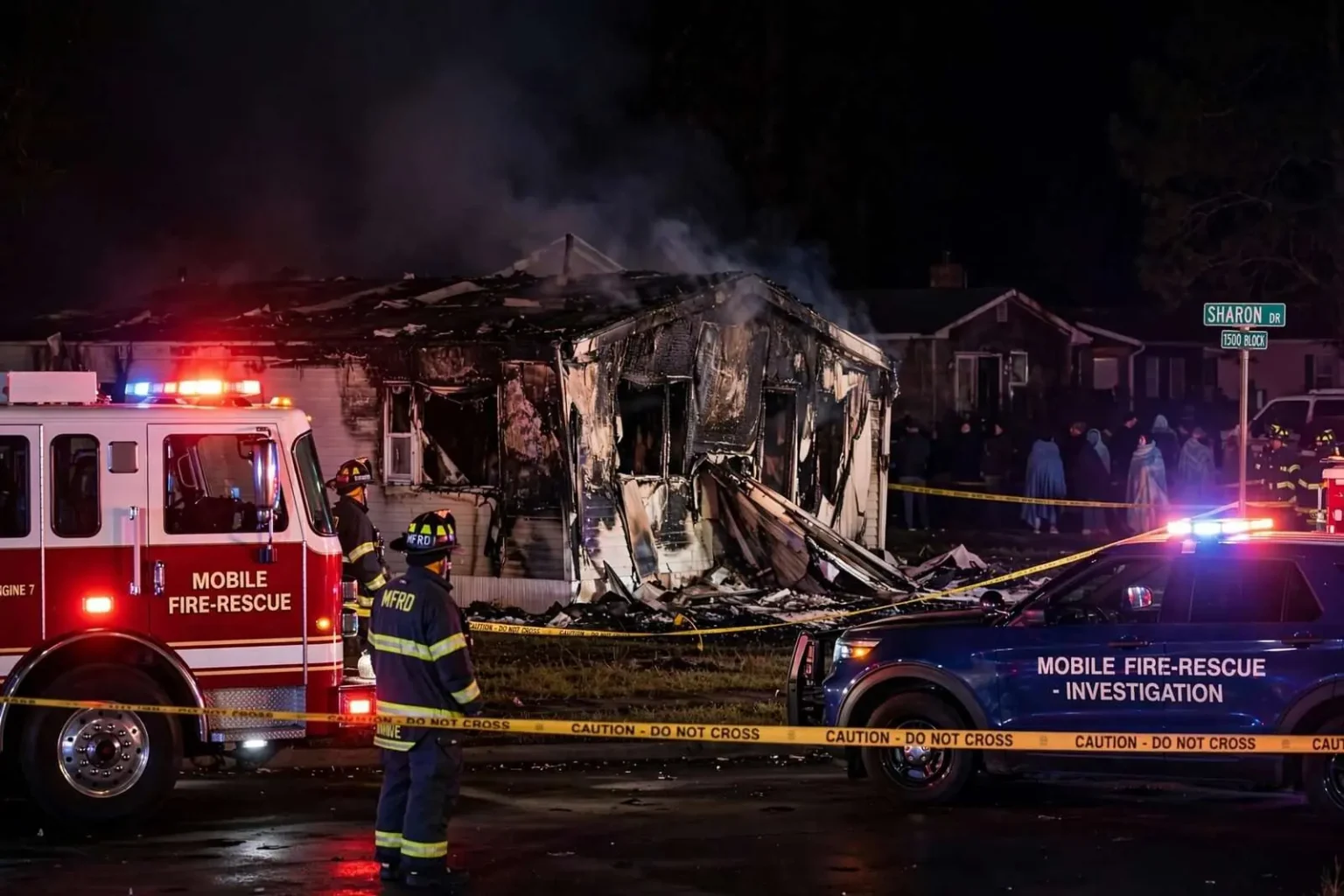
A 5-year-old boy has died after he was pulled from a burning home late Thursday night, according to the Mobile Fire-Rescue Department. Firefighters were called to the fire at a home in the 1500 block of Sharon Drive at about 11:47 p.m., officials said, arriving to find a residential structure fire already burning with force late on a weeknight.
According to the fire department, two children were home alone at the time the fire broke out. A 12-year-old boy was awakened by a smoke alarm and the smell of smoke and managed to escape the home safely. His escape — prompted by the alarm’s sounding — underscored the life-saving role smoke detectors play, and fire officials routinely point to cases like this one in urging residents to maintain working alarms on every level of the home.
The MFRD said the older boy told firefighters that his 5-year-old brother was still trapped inside, but that he was unable to reach him because the fire was spreading too quickly and intensely. The 12-year-old’s account gave arriving crews their first indication that a child remained in the structure, and it directed their initial attack toward the interior of the burning home.
Firefighters entered the home and pulled the younger boy from the blaze. He was rushed to a local hospital, where medical staff attempted ongoing resuscitation efforts. Despite those efforts, the child was pronounced deceased at the hospital, officials said. The delivery of a critically injured child to hospital staff sets in motion a pediatric resuscitation protocol that hospital teams train for, but the severity of smoke inhalation and burn injuries sustained in structure fires leaves even the most rapid response with limited odds.
The investigation
The cause of the fire remains under investigation, according to the Mobile Fire-Rescue Department. Fire investigators approach such scenes with a defined sequence: securing the structure, documenting burn patterns, examining potential ignition sources and interviewing the survivors, neighbors and anyone with knowledge of the home’s condition before the fire.
No further details about the circumstances that left the two children home alone have been released. That question — who was responsible for the children and why they were unattended at nearly midnight — sits alongside the fire’s cause in any such investigation, and authorities typically coordinate among fire investigators, police and the state’s child welfare agency when a child’s death involves an unattended-situation question.
The late hour compounded the dangers the fire presented. Residential fires that begin at night, while occupants sleep, produce the majority of the nation’s fire fatalities precisely because detection comes late. In this case the smoke alarm did its work for the 12-year-old, but the interval between ignition and escape for a sleeping 5-year-old in another room was evidently too long to overcome.
Mobile Fire-Rescue on the scene
Mobile Fire-Rescue Department, the largest fire department in Alabama, operates fire stations distributed across the city precisely so that response times to residential neighborhoods like the Sharon Drive area remain within a few minutes of a dispatch. Nighttime staffing patterns mirror daytime ones for that reason — fire does not keep business hours, and residential fires peak overnight.
The 1500 block of Sharon Drive sits in a residential section of the city where the housing stock includes older single-family homes. Older structures present elevated risks in fires: balloon-style framing can carry fire silently through wall cavities, aging electrical systems are a recurring ignition source, and the time it takes fire to breach doors and windows can be shorter than in newer construction built to modern fire codes.
For the crews who responded, the incident followed one of firefighting’s most difficult scripts: an interior search for a trapped child in a structure already showing intense fire. Search teams work in zero visibility, following walls and room layouts by feel while monitoring their own air supply, all against a clock defined by how much heat the victim’s room has absorbed. The removal of the boy from the home, followed by immediate emergency care and transport, reflected the standard chain of response — but the outcome was determined by circumstances already in place before the first engine arrived.
The toll on the neighborhood
The tragedy has shaken the Sharon Drive neighborhood, and fire officials are continuing to investigate exactly how the blaze started and spread so rapidly through the home. Residential streets register such losses in concrete ways: the yellow tape on the corner house, the neighbors who gathered as the engines ran their pumps past midnight, and the school that will open its doors the next morning with one student fewer.
Victim services typically move in quickly after a fatal residential fire. The American Red Cross of Alabama and the Gulf Coast provides immediate lodging and necessities to displaced household members, and neighborhood churches and civic groups commonly organize assistance. When children are involved, school crisis counselors become part of the response, particularly for the surviving brother, a 12-year-old who escaped the same fire that killed his sibling.
The psychological weight on the surviving child draws particular attention from professionals. Children who escape a fire that kills a sibling frequently carry trauma that requires sustained support, and the adults around them — relatives, school staff, counselors — are advised to seek trauma-focused care early rather than waiting for visible distress.
Smoke alarms and the margin they buy
The one unambiguous life-saving fact in the incident is that a smoke alarm awakened the 12-year-old. National fire data consistently attributes hundreds of lives each year to working smoke alarms, and the fire service’s core prevention message — an alarm in every bedroom, outside each sleeping area and on every level, tested monthly — exists because early detection is the single greatest variable a family controls.
Fire departments across the region, MFRD included, distribute free or low-cost alarms and will install them for residents who cannot do so themselves. Officials stress two recurring failure modes: alarms with dead or missing batteries, and alarms more than ten years old whose sensors have degraded. Both failure modes are invisible until the night they matter.
Escape planning is the companion message. A family that has practiced a fire escape plan — two ways out of every room, a designated meeting place outside, an understanding that children should not re-enter for pets or belongings — responds to a midnight alarm with rehearsed movements rather than confusion. The 12-year-old’s escape and his attempt to reach his brother reflect both the value of the alarm and the limits of what a child can do against a fast-moving fire.
How fire investigations proceed after a child’s death
When a fire fatality occurs, the investigation widens beyond origin and cause. Mobile Fire-Rescue investigators document the scene photographically before anything is disturbed, map the burn and smoke patterns that indicate where the fire started and how it traveled, and collect physical evidence from the area of origin for laboratory analysis. Electrical panels, appliances, heating equipment and potential smoking materials are all examined in turn.
Findings typically fall into categories — accidental, incendiary, natural or undetermined — and the undetermined finding is common in fires that destroy the physical evidence investigators depend on. Whatever classification results, it will factor into decisions by police and prosecutors about whether any legal follow-up is warranted, and by the state Department of Human Resources regarding the circumstances in which the children were left alone.
Alabama law sets out the standards governing when a child may be left without supervision, and agencies weigh factors including the children’s ages, the duration, the time of day and the availability of caretakers. Outcomes in such cases are not automatic; investigators gather the facts first, and determinations follow the evidence. Authorities had released no such determination in this case as the investigation continued.
The science of fast-moving house fires
The speed described in this fire — a blaze intense enough to defeat a 12-year-old’s attempt to reach his brother — is consistent with modern fire behavior research. Synthetic furnishings and building contents burn hotter and faster than the natural materials of decades past, and a residential fire can reach flashover, the point at which an entire room ignites, in as little as three to five minutes from ignition.
Smoke inhalation, rather than burns, kills most fire victims. Carbon monoxide and the toxic chemistry of modern materials render occupants unconscious within minutes in the rooms fire has not yet reached, which is why victims found by search teams so often show no visible injury despite fatal exposure. The 5-year-old’s condition upon rescue and the hospital resuscitation efforts that followed fit that pattern.
For the firefighters involved, an unsuccessful rescue of a child is among the profession’s heaviest burdens, and departments operate peer support and counseling programs for exactly these incidents. Crews that carry out a removal and resuscitation attempt that ends in a pronouncement at the hospital typically receive follow-up contact from department wellness resources in the days and weeks after.
Community response and what comes next
As of the department’s most recent statements, the cause of the fire remained under investigation, and officials asked anyone with information about the circumstances to come forward. The 1500 block of Sharon Drive, meanwhile, began the ordinary work of absorbing an extraordinary loss — the practical questions of a family’s displacement and a child’s funeral, and the harder questions that follow a tragedy of this kind.
Fire officials used the occasion to renew the department’s standing prevention appeal: working smoke alarms on every level, in every sleeping area; batteries tested monthly; alarms replaced every ten years; and a practiced escape plan that every member of the household, including the children, knows by heart. Those measures cost nothing compared to what a single night without them can take away.
The investigation into the Sharon Drive fire remains open, and any additional findings will be released by Mobile Fire-Rescue as they are confirmed. Until then, the neighborhood, the school and the surviving brother are left with the memory of a late-Thursday-night blaze that a smoke alarm could not entirely outrun.