75-Year-Old Man Killed in Single-Vehicle Crash at I-10/I-65 Interchange
A 75-year-old man died after his vehicle struck a guardrail while he was attempting to exit from eastbound I-10 onto northbound I-65 in Mobile on Tuesday evening.
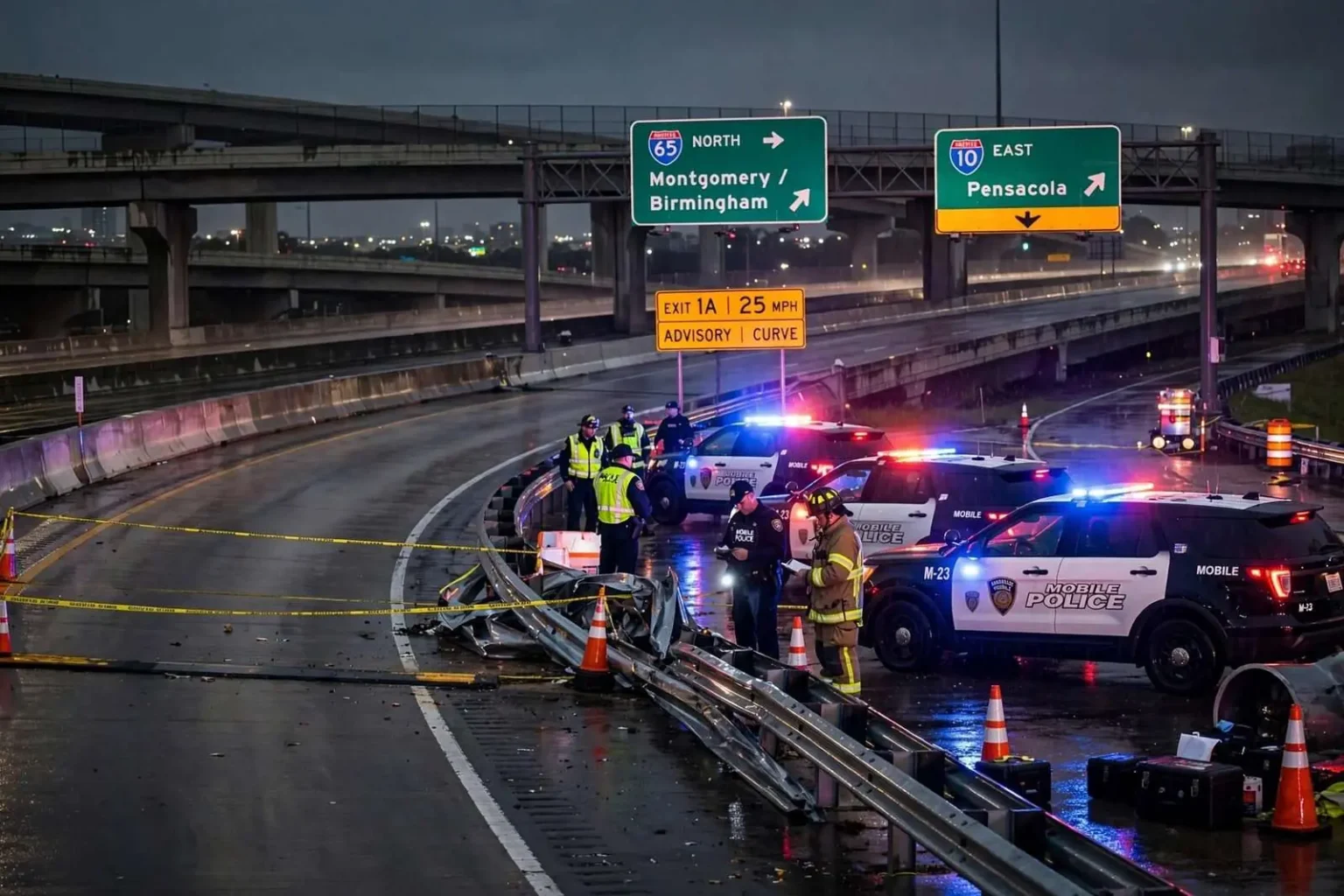
A single-vehicle crash at the interchange of Interstate 10 and Interstate 65 claimed the life of a 75-year-old man Tuesday evening, according to authorities. Officers with the Mobile Police Department responded to the interchange around 8 p.m. Tuesday after reports of the crash, arriving to find the aftermath of a violent collision at one of the region’s most heavily traveled highway junctions. The death added another entry to the toll of serious crashes that have accumulated over the years at the confluence of the two interstates that frame Mobile’s traffic patterns.
According to a preliminary investigation, the driver, identified as Raymond Callaway, was traveling eastbound on I-10 when he attempted to exit onto northbound I-65 and struck the guardrail. The impact occurred along one of the sweeping connector ramps that carry traffic between the two highways, curves where vehicles moving at interstate speed must shed much of that speed to navigate the transition. Callaway was transported to a local hospital following the crash, where he was later pronounced dead, police said.
Details about what led the vehicle off the roadway remained limited while investigators continued their work. Police had not released information about the condition of the roadway at the time, whether other vehicles may have contributed to the maneuver, or the extent of the damage to the car. What began as an evening drive through a familiar corridor ended with emergency crews blocking access long enough to document the scene and clear the wreckage, a sequence familiar to anyone who regularly travels the interchange.
A junction built for another era’s traffic
The interchange where the crash occurred is one of the busiest and most complex sections of highway in the Mobile area, where high-speed traffic merges and diverges across multiple lanes as drivers navigate between the east-west and north-south interstates. I-10 carries through traffic between Florida and the Mississippi line, including a heavy mix of commercial trucks moving goods to and from the Port of Alabama, while I-65 funnels drivers between Mobile and points north toward Montgomery, Birmingham and beyond. Every vehicle moving between the two corridors must thread through the interchange’s series of ramps and merges.
That geometry places constant demands on drivers. Motorists entering from one highway must find gaps in traffic that may be traveling significantly faster or slower than the ramp speed, while those exiting must decelerate across limited distance. The connector ramps between I-10 and I-65 are marked with advisory speeds, but at night, in rain, or amid the region’s frequent summer thunderstorms, the margin for error narrows considerably. Local drivers know the interchange as a place where lane discipline matters, and where a momentary lapse, a missed exit or a misjudged curve can produce serious consequences.
Generations of Mobile-area drivers have learned to navigate the interchange’s quirks, and transportation planners have studied the junction for years as regional traffic volumes grew. The corridors it connects serve not just commuter traffic but the commercial arteries that link the Port of Alabama, the aerospace and manufacturing operations along I-10, and the communities spread across west Mobile County. When a crash closes lanes there, the ripple effects reach commuters, freight haulers and emergency responders alike, which is one reason incidents at the junction tend to draw prompt attention from authorities.
How investigators work a fatal crash
When a crash involves a fatality, the police response extends well beyond treating the injured and clearing the roadway. Investigators document skid marks and final vehicle positions, examine the guardrail and roadway for impact evidence, and work to reconstruct the sequence of events that put the car where it came to rest. Physical evidence from the scene, combined with the vehicle itself, helps answer the questions a preliminary report cannot: how fast the car was traveling, when the driver lost control, and whether mechanical factors played a role.
Single-vehicle crashes involving guardrails at highway interchanges are frequently linked to factors such as speed, visibility, or a driver’s unfamiliarity with an exit, though authorities noted the investigation into this crash remains preliminary. Guardrails exist precisely to redirect errant vehicles away from greater hazards, but a collision with one at highway speed transmits enormous force into the passenger compartment, and older drivers can face particular challenges when high-speed maneuvering is required. Investigators will consider the full range of possibilities before reaching conclusions about what happened on the ramp that evening.
The preliminary nature of the findings means the picture could change as more evidence is analyzed. Police may consult vehicle inspection results, medical examiner findings and any available witness accounts before finalizing their reconstruction. Mobile police have not indicated whether any additional factors contributed to the crash, leaving open the questions that most concern drivers who use the interchange daily: whether the roadway itself contributed, whether conditions played a role, or whether the crash was the result of driver error alone.
Older drivers on high-speed roadways
The victim’s age, 75, is a detail investigators and safety researchers weigh carefully in crashes of this type. Older drivers as a group maintain strong safety records in many respects, including a tendency to avoid late-night driving, impairment and aggressive maneuvers. But the physical changes that come with age, including slower reaction times and reduced night vision, can matter most in exactly the situations an interchange ramp presents: a curve approached at speed, merging traffic, a decision that must be made in seconds. Many older drivers manage those changes well by planning routes, avoiding difficult interchanges or traveling at off-peak hours.
Alabama has no age-based restriction on license renewal that would keep experienced drivers off the road, and the state’s licensing framework treats senior drivers as individuals rather than a category, relying on medical review and family vigilance where concerns arise. Transportation safety advocates emphasize that the alternative, taking away mobility from older adults, carries its own risks, and that the better path is engineering roadways to be more forgiving. Guardrails, brighter signage, clearer lane markings and improved ramp geometry are all tools agencies use to make interchanges survivable for drivers of every age.
The human cost behind the statistics
Every fatal crash sends waves through a family and a community that no traffic count can measure. A 75-year-old driver is often a husband, father, grandfather and neighbor, someone whose daily routines, errands and relationships shaped the lives of people around him. The news that a familiar relative did not come home from an evening drive is the kind of call no family expects, and it arrives with questions that the earliest police reports cannot answer. In the days that follow, relatives typically must navigate hospital procedures, investigators’ questions and arrangements, all while grieving a loss that arrived without warning.
For the officers, paramedics and firefighters who responded to the interchange that night, fatal crashes are among the most difficult calls they handle. Emergency crews train extensively for highway incidents, but the work of extrication, treatment and scene management, performed alongside speeding traffic a few feet away, takes a toll even on veterans. The response around 8 p.m. Tuesday would have involved coordination between police, fire and medical units, each with a role in securing the scene, aiding the driver and documenting what they found for the investigation that follows.
Fellow drivers who passed the scene in the minutes and hours after the crash also carry away impressions that linger. A blocked ramp, flashing lights and a draped guardrail are reminders that the routine trip home can change in an instant. Traffic incidents tend to fade from public attention quickly, resolved into a line in a daily report, but for those directly involved, the evening’s events become a permanent dividing line in their lives.
Safety at the interchange going forward
Crashes like this one feed into the broader conversation about highway safety in the Mobile area, where the I-10/I-65 junction has long been a focus of attention for planners and residents alike. Each serious incident becomes part of the data that engineers and policy makers use when they evaluate ramp designs, signage, lighting and speed limits. Guardrail placement and condition, in particular, are reviewed after collisions, since a barrier’s ability to absorb and redirect impact is central to its purpose of preventing worse outcomes.
Drivers who travel the interchange can take practical lessons from any single-vehicle crash on a connector ramp. Reducing speed to match the advisory signs rather than the traffic on the main line, maintaining safe following distances through merges, checking mirrors and blind spots before lane changes, and allowing extra time in rain or darkness all reduce the demands on a driver at the moment the margin for error is thinnest. For those unfamiliar with the interchange, planning the exit in advance, or staying in the lane that leads to it well before the decision point, removes the sudden maneuver that so often precedes a loss of control.
The investigation into the crash remains preliminary, and authorities have said the findings could evolve as evidence is reviewed. As with any fatal collision, the final determination of cause will rest on the physical evidence and analysis completed by investigators in the days ahead. This story may be updated as more information becomes available from the Mobile Police Department.