Gulf Shores Weighs Rental Agreement Rule Ahead of Airbnb Changes as Orange Beach Puts Ordinance on Nov. 17 Agenda
Gulf Shores council members discussed a written rental agreement requirement at a non-voting work session, while Orange Beach scheduled its own ordinance for Nov. 17, days before Airbnb policy changes take effect Nov. 20.
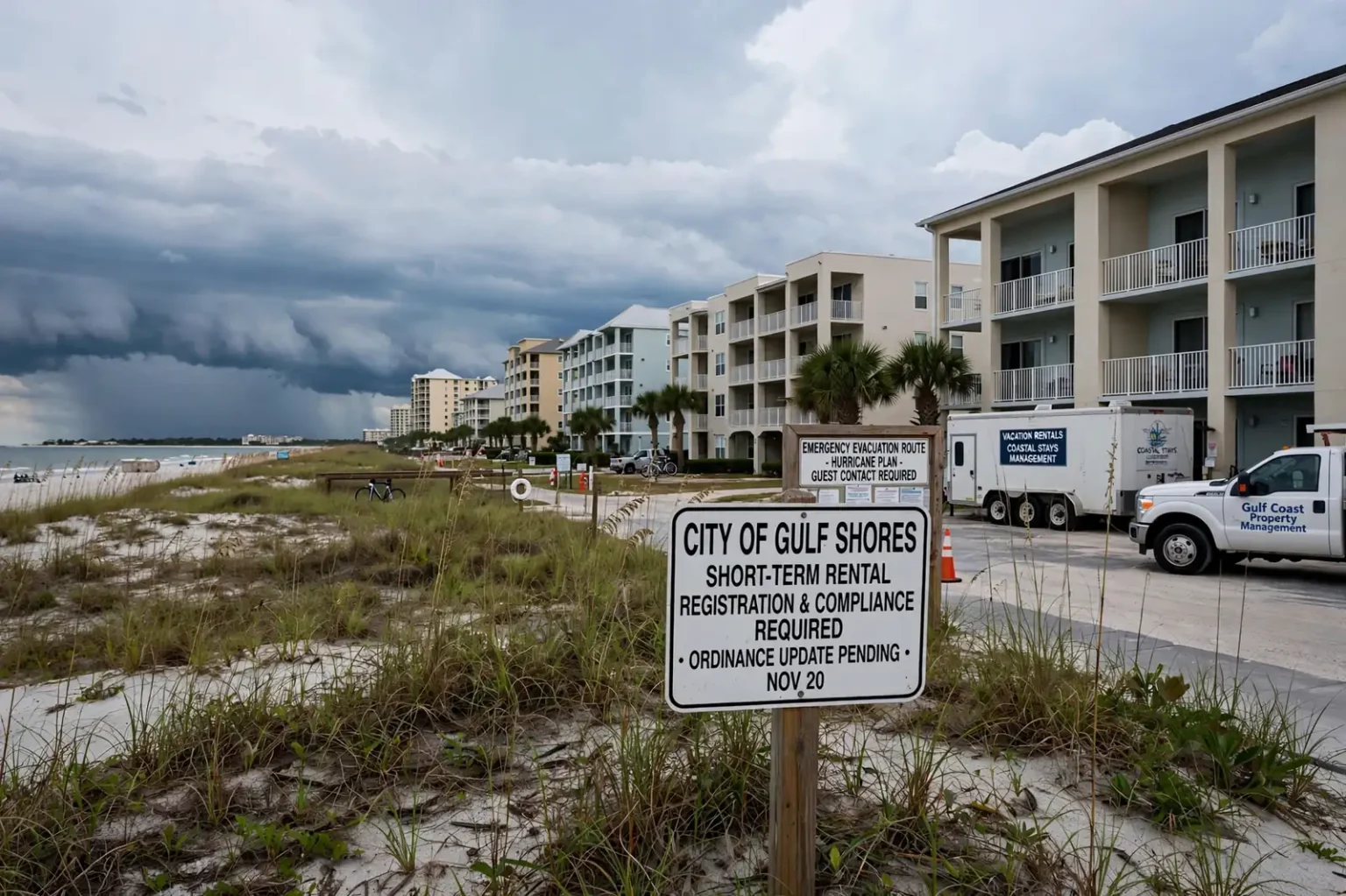
GULF SHORES, Ala. — Vacation rental operators in Gulf Shores are asking city leaders for a local safety net before Airbnb policy changes take effect on Nov. 20. During a recent Gulf Shores City Council meeting, property managers and homeowners association representatives warned that the platform’s new rules will limit their ability to verify who is staying in local units, keep in touch with guests during emergencies and back up removals with a signed contract.
Their request to the council was straightforward: adopt a city ordinance that requires every short-term vacation rental in Gulf Shores to collect a verified guest ID, direct contact information and a signed rental agreement before anyone checks in, no matter which booking website was used to reserve the stay.
Latest: Gulf Shores Work Session Cannot Produce a Vote; Orange Beach Ordinance Set for Nov. 17
The rental managers’ request was set to come before the Gulf Shores City Council at its Monday, Nov. 16, work session, where an amendment to the city’s Vacation Rental Ordinance was on the agenda with a staff recommendation for approval. Work sessions in Gulf Shores are not voting meetings, however. City staff said any decision to write the new requirements into the ordinance would have to come at a regular council meeting, and as of the afternoon of Friday, Nov. 13, no special meeting had been called to act on the measure before the platform’s Nov. 20 start date. Staff said it would be up to the council to discuss the issue and decide how it wants to proceed.
Neighboring Orange Beach has scheduled formal action sooner. An ordinance responding to the same booking platform changes is on the agenda for the Orange Beach City Council’s regular meeting on Tuesday, Nov. 17. Both cities are weighing the measures at the urging of Gulf Coast vacation rental companies, which argue that the new platform rules would sidestep local safety requirements that licensed local operators must follow.
At the Gulf Shores council’s Nov. 9 meeting, a representative of a local vacation rental company asked members to adopt guidelines similar to those being drafted in Orange Beach, so that the same protections would apply across the island the two cities share. The representative said the industry’s aims are guest safety, protection for property owners and accountability for damage, unauthorized occupants and guests who refuse to follow the rules, and said local companies were already meeting resistance from the platform over the issue.
In Orange Beach, a member of the city council who formerly worked in the local vacation rental business said the central objection is that a third-party platform would allow guests to remain anonymous while licensed real estate companies are held to strict operating standards. The council member also said it is unacceptable for rental managers and property owners associations to be kept from knowing who a guest is or from having the guest’s address, phone number and email address.
What the Gulf Shores amendment would require
The proposal would make a signed, written rental agreement between the operator and the renter a condition of holding a short-term rental license in Gulf Shores. Every licensed vacation rental operator would have to have one in place for each renter occupying a property. The amendment also sets minimum contents for those agreements:
- The name and age of the responsible renter
- A way to reach the responsible renter directly during the stay
- The renter’s acknowledgement of the property’s maximum occupancy
- The renter’s acknowledgement and acceptance of the rental’s terms and conditions
- Any other information needed to comply with local rules and support enforcement
Why the city says it is needed
According to the agenda summary, the amendment responds to concerns raised by local vacation rental owners and management companies. City staff noted that online booking platforms have adopted policies limiting the ability of owners and managers to require separate written rental agreements unless local law specifically calls for them. Writing the requirement into city code is meant to close that gap.
The stakes are tied to an existing provision in Chapter 11 of the city’s Code of Ordinances, which governs removing undesirable guests from vacation rental units. Under that ordinance, the authority of property owners and police to remove a short-term guest who engages in prohibited conduct or refuses to leave depends on the existence of a written vacation rental agreement that meets specific legal requirements and disclosures. Without such an agreement, those enforcement tools may not be available. City staff wrote that approving the amendment would help owners, managers and law enforcement keep the means to deal with nuisance behavior, protect public safety and preserve quality of life for residents and visitors as booking platform rules change.
Occupancy and Spring Break worries
Rental managers have raised additional concerns before the council. A local real estate representative told members at their meeting last week that the platform’s occupancy limits apply to how many people sleep at a property but do not account for additional people who may gather there during the day, a gap managers fear could open the door to large gatherings during Spring Break and other peak periods. That concern carries particular weight in Gulf Shores, which adopted strict limits on drinking alcohol on its public beaches during Spring Break after a wave of rowdy parties and large crowds roughly a decade ago.
Managers who have addressed the councils in both cities have said their goal is not to fight the platform’s fees or business model but to protect public safety and accountability by knowing who is staying in the properties they manage. They say the new platform rules, which take effect Nov. 20, bar hosts from collecting a guest’s phone number, email address or home address, prohibit background checks and signed rental agreements, prevent copying identification and stop hosts from requiring checkout chores such as washing dishes or stripping beds.
Airbnb’s response
Airbnb has not sent representatives to either city’s council meetings, but in a written statement the company said its existing policies already address the issues raised. It said it works closely with hosts and elected officials to answer questions so hosts feel comfortable on the platform.
The company’s position includes several points:
- Personal information: Its policies already bar hosts from collecting identification or personal information unless required by law or by homeowners association rules. Hosts may check identification at check-in, much like a hotel, as long as that requirement is disclosed before booking.
- Contracts: Every guest already agrees to Airbnb’s Terms of Service and to the host’s house rules before booking, and the company argues that requiring a separate contract for each stay duplicates those protections and could confuse guests about which terms apply. Contracts will be allowed only in certain situations, such as when required by law or homeowners association rules.
- Small hosts: Nearly 80% of its Alabama hosts occasionally rent out a single home, and the company says the proposals would force those hosts to draft legal contracts and collect, safeguard and store sensitive personal data for just one property.
- House rules: Hosts will be able to choose from seven standard rules and add their own, with rules shown more prominently on listings, in a guest’s Trips tab and in reservation reminders. Airbnb will flag rules that conflict with company policy and let hosts appeal. Host-imposed fines will not be permitted.
- Verification and screening: Every host and booking guest goes through identity verification, and the company says it runs criminal background checks on them. Its reservation-screening technology is designed to flag higher-risk bookings and guests who repeatedly break house rules, who can be suspended or removed.
- Support lines: The company cites a Neighborhood Support Line, a 24-hour safety line, around-the-clock customer service and a dedicated channel for law enforcement. Some coastal managers counter that the hotline, which is run from outside Alabama, is too slow for urgent local complaints.
- Coverage: Its AirCover program provides hosts up to $3 million in damage protection and up to $1 million in liability insurance.
The company also said in its statement that any council member with a conflict of interest should recuse from considering the proposal. The statement did not name any official.
Because Airbnb’s own policies allow contracts and identification requirements when local law calls for them, a city ordinance requiring written rental agreements would likely become a key test of how the platform’s rules and local regulations fit together on the Alabama coast.
What the Gulf Shores Airbnb Policy Changes Would Do
According to the rental managers who addressed the council, the nationwide Airbnb update scheduled for Nov. 20 restricts hosts in three key ways:
- Signed agreements: Hosts will no longer be allowed to require guests to sign a separate rental agreement of their own.
- Identification: Hosts will not be permitted to collect government-issued identification from guests.
- Contact details: Hosts will not be able to keep a guest’s permanent phone number or email address on file.
Instead of a guest’s real phone number, managers said, the platform supplies a temporary relay number that stops working two days after checkout. Operators described these as fine-print changes, but they told the council the practical effects would reach well beyond paperwork.
Why Local Rental Managers Say Safety Is at Stake
The concerns raised at the meeting fell into three broad areas, each tied to the realities of running rentals on the Alabama Gulf Coast.
Storms and evacuations
Gulf Shores sits on a barrier island coastline that is regularly in the path of tropical storms and hurricanes. When officials call for evacuations, rental managers are often the ones responsible for making sure guests get the word and leave in time. Speakers said that depending on a short-lived relay number, rather than a guest’s own phone or email, could leave them unable to reach visitors when it matters most, which they characterized as a direct public safety risk.
Removing problem guests
Managers also told the council that, under local police practice and Alabama law, officers need a legally binding, signed rental agreement before they will help an owner remove a disruptive or noncompliant guest from a property. Without the ability to require that document, operators said, they could find themselves with no clear way to enforce house rules or end a stay that has gotten out of hand.
Fraud, parties and property damage
The third concern centered on accountability. Speakers said that limits on identity checks and signed contracts would leave owners and neighborhood associations more exposed to unauthorized occupants, party houses, occupancy violations and damage that may go unpaid. Representatives of local property owners associations agreed, noting that the effects would not stop at a single unit but could spill over to neighbors and shared amenities in condominium and residential communities.
A Major Piece of the South Baldwin Economy
The stakes are significant for a city whose economy leans heavily on visitors. Market estimates put the number of active Airbnb listings that identify Gulf Shores as their location at more than 5,300, with average annual revenue of $49,721 per unit. Taken together, those estimates suggest the listings generate well over $260 million a year in rental income.
Those figures cover only one booking platform and only listings tied to the Gulf Shores name, so they offer a partial picture of a short-term rental market that stretches across much of south Baldwin County. Still, they help explain why operators pushed the council to act quickly. Rental income supports cleaning crews, maintenance contractors, management companies and the restaurants and attractions that guests visit, and it feeds the lodging taxes that help pay for public services in coastal communities.
Orange Beach Facing the Same Questions
Homeowners association representatives pointed out that Gulf Shores is not alone. Neighboring Orange Beach is wrestling with similar concerns as the same platform rules approach, and local operators have raised the issue there as well. South Alabama News covered that discussion earlier this month in a separate report on Orange Beach rental operators and the Airbnb changes.
Because the two cities share a stretch of coastline, a guest base and many of the same management companies, rental operators have an interest in rules that line up across city limits. A patchwork of requirements could make compliance harder for companies that manage units in both places.
How a Local Ordinance Could Work
The proposal presented to the council would shift the requirement from the booking platform to the property itself. Under the approach operators described, a short-term rental in Gulf Shores would have to obtain three things before occupancy:
- a verified identification for the guest,
- direct contact details for the guest, and
- a signed rental agreement.
The idea is that a city rule applying to every rental, regardless of how it was booked, would give managers a clear legal basis to collect that information even if a platform’s own policies discourage it. Cities in Alabama generally regulate short-term rentals through local ordinances that address issues such as registration, occupancy, parking and noise, and the request would add guest verification standards to that local toolbox.
Whether such an ordinance can be written to operate alongside a private company’s terms of service is the kind of question that typically requires legal review, and the council signaled it intends to get that review.
What Happens Next for Gulf Shores
Council members asked the rental industry representatives for complete documentation of the platform changes so the city can see exactly what the new rules say. Members also said they are committed to reviewing possible ordinance adjustments with the city’s legal counsel before the Nov. 20 deadline arrives.
Any change to city code would need to go through the council’s regular process, including formal consideration at a public meeting. Residents, owners and managers who want to follow the discussion can find council agendas and meeting information on the City of Gulf Shores website. For more coverage of the city, visit our Gulf Shores news page, and for broader coverage of the visitor economy, see our tourism section.
What Rental Owners and Guests Should Watch For
For now, owners who list properties on the platform may want to review their listing settings, house rules and emergency communication plans ahead of Nov. 20, and to stay in touch with their management companies about how they plan to handle guest verification. Guests booking stays on the coast this winter may notice differences in what information hosts request and when.
The outcome of the council’s legal review will determine whether Gulf Shores becomes one of the first coastal cities in the region to set its own guest verification standard for vacation rentals.