Elliott Drafts Toll Tax Credit to Refund Mobile River Bridge Tolls; Daphne Mayor Signals Support
State Sen. Chris Elliott's draft bill would give Alabama residents a refundable, dollar-for-dollar income tax credit for Mobile River Bridge and Bayway tolls paid with an ALGO Pass. Daphne Mayor Robin LeJeune backs the idea.
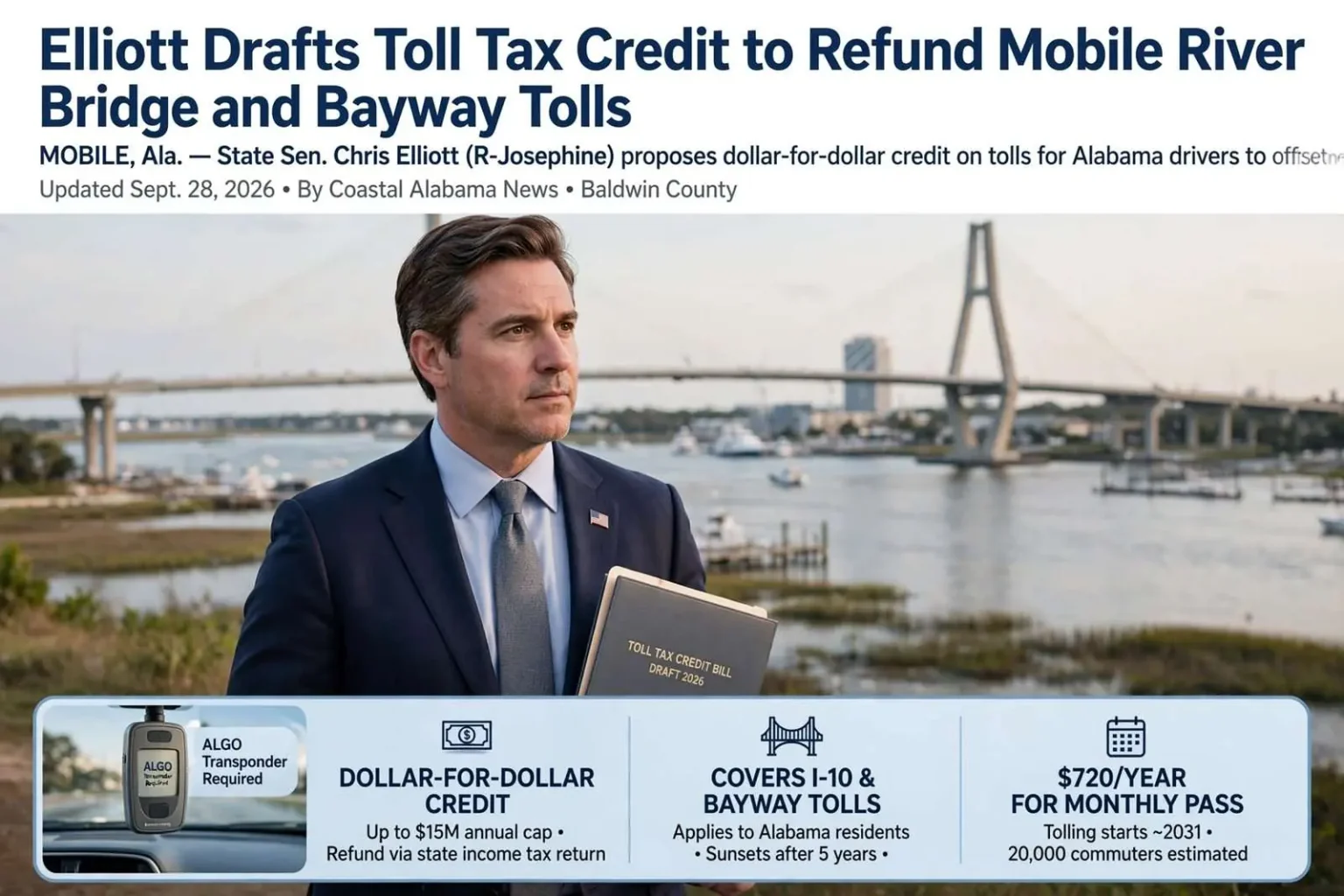
MOBILE, Ala. — State lawmakers have no power to stop the tolls coming to the new Mobile River Bridge and the reconfigured Interstate 10 Bayway. But a Baldwin County senator thinks the Legislature can do the next best thing: create a toll tax credit that gives Alabama drivers their money back at tax time.
Update, Oct. 5, 2026: With construction now underway after Friday’s groundbreaking, Elliott says he is drafting the toll tax credit bill, and Daphne Mayor Robin LeJeune says he supports the effort. See “Latest developments” below.
State Sen. Chris Elliott (R-Josephine) has drafted legislation that would put that credit on state income tax returns. Alabama residents and most businesses could claim a dollar-for-dollar credit equal to what they spent on tolls on I-10 and the Bayway during the previous year, and they would get the full amount back even if their toll bill was larger than their state income tax bill.
“I think it’s the least we can do for the residents of coastal Alabama,” Elliott said.
How the credit would work
Under the draft bill, a driver would need to meet three conditions to qualify:
- Live in Alabama
- File a state income tax return
- Have an ALGO transponder
A dollar-for-dollar credit is more generous than a deduction. A deduction lowers the amount of income that is taxed, so it returns only a fraction of the money spent. A credit comes straight off the tax owed. Because Elliott’s version would pay out the full toll amount even when it exceeds a filer’s tax liability, it would function as a refund of tolls paid through the state tax system.
Taxpayers who cross only a few times a year could still claim what they paid, but Elliott said he expects regular commuters to be the ones most likely to use it. He estimated that about 20,000 people will buy monthly passes. Using that number, he projects the credit would cost the state about $15 million a year, money that would come out of the Education Trust Fund budget. Elliott said that is a tiny share of the budget.
The draft includes a five-year sunset. Elliott said that is required by a state law mandating sunset clauses on tax breaks, though he said his goal is to find a way to make the credit permanent. The law also requires a cap on what a tax break can cost the state. The draft sets that cap at $15 million a year, and Elliott said he hopes to get more precise numbers from the Alabama Department of Transportation.
The toll plan that prompted the bill
For years, local transportation planners said toll rates on the new crossing would stay fixed, first at $2.50 per trip for passenger vehicles with ALGO transponders and later at $3. Last week, it was reported that ALDOT had agreed to automatic annual rate increases as a condition of borrowing billions of dollars to build the project.
Bond documents show the increases would take effect every Jan. 1. For the first 10 years after tolling begins, rates would rise by 5% or by the inflation rate for Southern urban consumers, whichever is higher. After that, the base adjustment drops to 2.5%, with the inflation rate applying if it is higher. ALDOT has defended the approach, saying a multibillion-dollar project financed over decades could not realistically be paid for on the assumption that toll rates would stay frozen.
For a standard passenger vehicle, ALDOT has listed these opening rates:
- ALGOpass monthly unlimited plan: $60 per month
- ALGOpass per trip: $3
- Compatible transponder from another toll agency: $7.70
- Pay-by-plate, with no transponder: $15.40
The $60 monthly pass, which grants unlimited use of the bridge and Bayway, is the one rate that will not change for 10 years. Tolling is not expected to start until the new bridge opens, around 2031. The Causeway, the Wallace Tunnel, the Bankhead Tunnel and the Africatown Bridge will remain toll-free.
‘Just to go to work’
Even with the monthly price frozen, Elliott said the pass will cost a commuter $720 a year, and that is a significant expense for a Baldwin County resident earning the median income.
“That’s almost a 25 percent increase in their total income tax liability – just to go to work,” he said. “And so, my goal here is to is to say, you know, for residents that are utilizing this on a day-in and day-out basis and are paying that $720 a year, let’s put that money back in their pocket, so we’re not double-taxing them.”
Elliott said most of the bridge’s cost should be borne by the drivers least affected by tolls.
“Our visitors that are coming to the beaches, those who are just passing through, I have no problem putting the cost on them,” he said. “I just – it’s my job to protect my constituents and those folks that I represent that are just trying to get back and forth to work.”
Not his first try
The idea is not new for Elliott. He offered a similar proposal in 2019, when an earlier plan to build a bridge was on the table. That plan collapsed that year amid a public revolt over tolls, after the local metropolitan planning organizations voted to remove the project from their plans.
Elliott, who was first elected to the state Senate in 2018 and represents District 32, previously chaired the Baldwin County Commission and the Eastern Shore Metropolitan Planning Organization. He has been one of the most vocal voices on the corridor for years. Earlier this month, he backed ALDOT’s plan to restripe the existing Bayway to carry six lanes, calling an entirely new elevated span something the state could not afford.
The current project, with a design and construction cost of $3.2 billion and a Phase One budget ALDOT now puts at about $4.15 billion, includes a six-lane cable-stayed bridge over the Mobile River and restriping of the 7.5-mile Bayway. It is financed in part by a federal Transportation Infrastructure Finance and Innovation Act loan of up to $2.52 billion, which tolls will help repay. State, federal and local officials broke ground on the project Oct. 2 at Cooper Riverside Park in Mobile, and construction is expected to take about five years.
Local reaction and the House race
Many residents of Mobile and Baldwin counties still oppose tolling the new bridge at all.
“(People) pay enough in tax and gas prices, food prices, so just another added expense to families barely getting by these days,” said Pat Sanchez, who was filling up his tank in Mobile on Wednesday.
Sanchez was not fully convinced by the tax credit, either, questioning the wait between paying tolls and getting the money back.
“So they’re gonna hold your money 12 months?” he said.
Elliott already has a potential partner in the House. Danielle Duggar, the Republican nominee for the Eastern Shore’s House District 96 seat, has agreed to carry the bill in the lower chamber if she wins in November. “In a perfect world,” she said, local residents should be exempt from tolls, but she said a tax credit would “put money back into the people’s pockets.”
Her Democratic opponent, Terri Osborne, said she supports the idea as well. Osborne said “local residents should get an exemption.” The general election is Nov. 3.
An uncertain path in Montgomery
The bill’s prospects are unclear. A tax break that would mostly benefit residents of Alabama’s two southernmost counties, paid for out of the statewide education budget, could be a hard sell to lawmakers from the rest of the state. Elliott said he is hopeful anyway, and he argued the measure could have value beyond the Gulf Coast.
“If you end up running into a similar type of funding mechanism for a road project in the Huntsville area or Birmingham area or something like that, then this legislation could be used to offset that cost, as well,” he said.
The bill is still a draft and would have to be filed and passed during a future legislative session. Because tolls are not expected to be charged until the bridge opens around 2031, drivers would see no effect from the credit until tolling begins.
Update: Elliott says toll increase left a ‘bad taste,’ questions long-term commitments
Updated Sept. 28, 2026
In a recent radio interview, Sen. Chris Elliott (R-Josephine) expanded on his proposed toll tax credit and on the frustration many Baldwin County commuters have expressed since learning the bridge’s base toll will rise every year.
Elliott said he appreciates that state and federal officials have made the project a priority but does not want his constituents to foot the bill. “For the mom and dad who are waking up in Daphne or Spanish Fort every day and driving across to go work in Mobile somewhere, let’s give them a little bit of a tax credit,” he said. “And so what we’ve come up with is essentially a dollar-for-dollar credit for those folks that have the ALGO Pass.” The draft legislation caps the credit at $15 million, to be paid from the state’s General Fund and Education Trust Fund.
The base toll for ALGO Pass account holders will start at $3 and rise each year. Elliott said the Alabama Department of Transportation communicated an earlier increase in the base toll, from $2.50 to $3, but not the automatic annual increases. “They just conspicuously left this part out, that it was going to increase and it was going to increase automatically,” Elliott said. “And so my take on that is that’s an unfortunate either purposeful or, you know, just a lapse in communication and it leaves a bit of a bad taste, especially given this project’s history from a communication standpoint.”
‘A part-time legislature’
Elliott said the project is a done deal, with federal documents signed for a loan of roughly $2.5 billion. Asked whether lawmakers could do anything to ensure future projects are handled with more transparency and accountability, he said Gov. Kay Ivey has done her job as an executive administrator by following the process set up by the Alabama Toll Road, Bridge and Tunnel Authority, which the Legislature created.
“We’re not a full-time legislature, we’re a part-time legislature,” Elliott said. “We’re there three-and-a-half months a year to appropriate and then the governor goes and budgets and spends. But you’ve got to at some point have a governor that is accountable and responsible for these actions and you’ve got to, for this to work properly, you’ve got to trust that to some extent that the governor’s going to do what’s right and in the best interest of Alabamians.”
Pressed on other Ivey-era projects that will carry costs for generations, including new mega prisons and the West Alabama Corridor, Elliott said lawmakers may need to take a closer look. “She has chosen to make decisions that will cost the state and the people of the State of Alabama for decades into the future and has obligated future gas tax revenues, future toll revenues, future general obligation warrants for prisons and other things well beyond her tenure, the tenure of the next governor and the tenure of the governor after that,” he said. “And so, is this something that the legislature needs to look at? Maybe. Some of it is a constitutional power, where the constitution itself would have to be changed. So it gets into a separation of powers issue. We’re just seeing a governor here that has decided to make use of it more than others in the past have.”
Latest Developments: Daphne Mayor Backs Toll Credit as Bridge Breaks Ground
While many Alabama political leaders have spent weeks criticizing the planned tolls, Elliott has said the Legislature already has a tool to respond. “I’ve got a bill for that,” he said.
LeJeune: free routes were part of the deal
Daphne Mayor Robin LeJeune said the toll-free alternatives — the Wallace Tunnel, Bankhead Tunnel, Africatown Bridge and Causeway — were an important part of the compromise local officials reached to move the long-delayed bridge into construction.
“No one wants a toll. I don’t want a toll,” LeJeune said. “But when you’re in a situation where this is the only way this project gets done, you make absolutely sure there are free routes for people to use and that’s what we did.”
He said leaders also worked to keep the opening toll as low as possible while still making the financing work. “We’re happy we were able to do that, to keep the toll low at $3 and make certain there were free routes for our citizens,” he said. “It got us to where we were able to celebrate this groundbreaking.”
LeJeune said he also supports Elliott’s push to offset toll costs for Alabama residents. “I’m supportive of anything that will put money back in our pockets,” he said.
Elliott: ‘The best of both worlds’
Elliott said the proposal is aimed mostly at people who will cross Mobile Bay regularly just to get to work. He estimated that for someone earning about $65,000 a year, the $720 annual cost of a monthly pass would amount to roughly a 25 percent increase over that person’s state income tax liability.
“We give tax credits to big corporations all the time in the name of economic development,” Elliott said. “This toll tax credit would literally drive economic development because we’re talking about people who are literally driving to their jobs to go to work.”
The bill would not change the toll itself or the financing structure behind the bridge. The state would keep collecting toll revenue while reimbursing qualifying Alabama taxpayers through the tax code. Elliott said the $15 million annual cap in his draft is a placeholder while he waits for more detailed figures on expected use of the commuter pass.
“We’d get the best of both worlds,” Elliott said. “We get people passing through Alabama to pay for the bridge and Alabama residents get a break.”
Earlier bills stalled in committee
Elliott has filed versions of the idea before. In 2020, he sponsored legislation that would have created a state income tax credit equal to tolls paid on qualifying projects of the Alabama Toll Road, Bridge and Tunnel Authority, with refunds when the credit exceeded the tax owed. That bill was referred to the Senate Finance and Taxation Education Committee but did not advance.
He tried again in 2022 with similar legislation co-sponsored with Mobile County Sens. David Sessions and Jack Williams. That bill also died in the same committee.
Tolling on the new crossing is not expected to begin until the bridge opens, currently projected for late 2031.