Alabama State Government Daphne
Mobile River Bridge Groundbreaking Launches Long-Awaited I-10 Bayway Project After Decades of Delay
Leaders including Gov. Kay Ivey and Transportation Secretary Sean Duffy broke ground Friday on the Mobile River Bridge and Bayway, an I-10 crossing projected to open in late 2031 with tolls for drivers who use it.
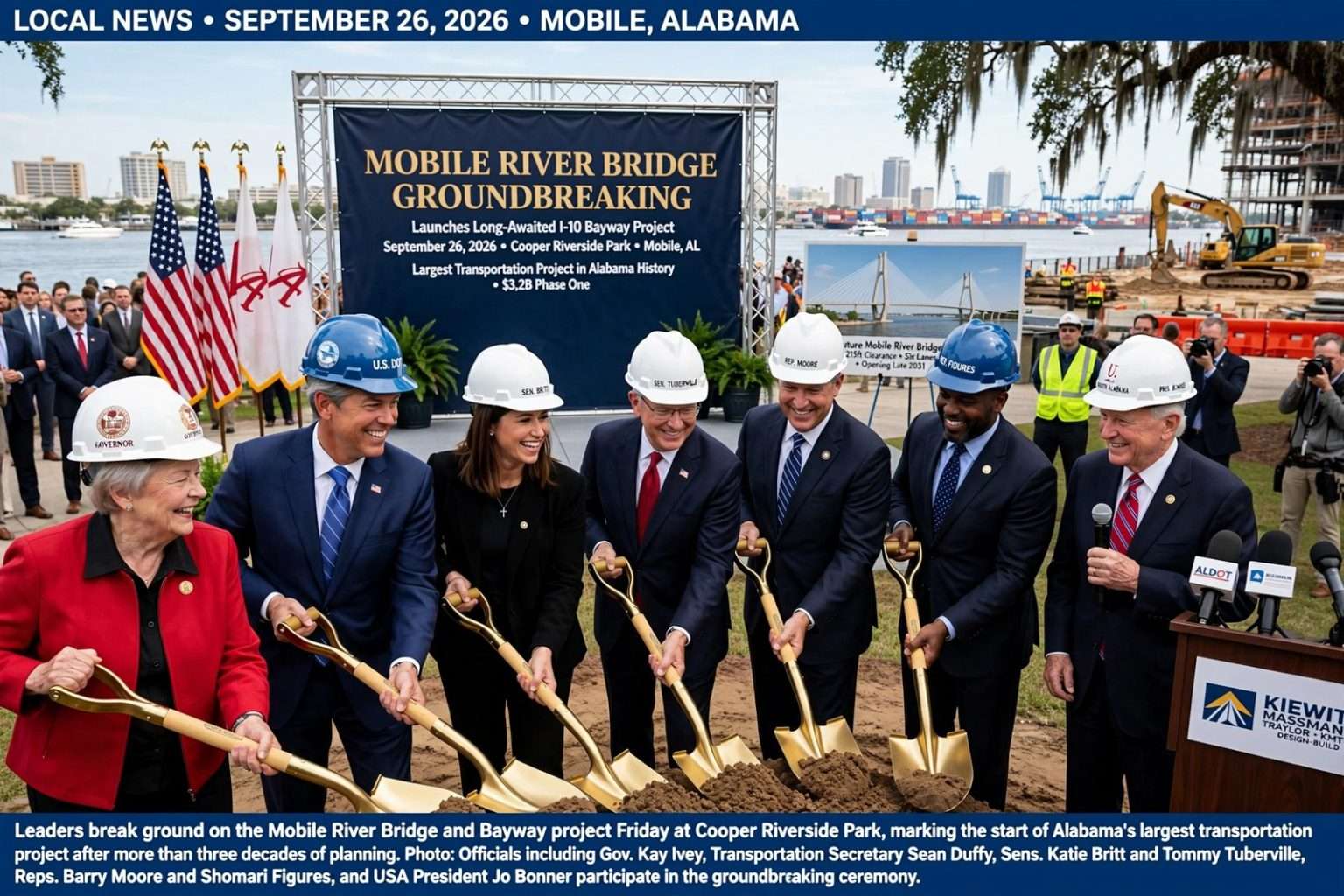
MOBILE, Ala. — The Mobile River Bridge is no longer just a line on a planning map. Federal, state and local leaders gathered Friday at Cooper Riverside Park in downtown Mobile to ceremonially break ground on the Mobile River Bridge and Bayway project, an Interstate 10 crossing that has been studied, debated, shelved and revived for more than three decades.
Gov. Kay Ivey, U.S. Transportation Secretary Sean Duffy, U.S. Sens. Katie Britt and Tommy Tuberville, and U.S. Reps. Barry Moore and Shomari Figures turned the first ceremonial shovels of sand along the Mobile riverfront. Leaders from the Eastern Shore and Mobile metropolitan planning organizations and other state and local officials joined them, along with representatives of the project’s design-build team. University of South Alabama President Jo Bonner served as master of ceremonies.
The project is widely described as the largest transportation undertaking in Alabama history. State officials have put the price of the first phase at $3.2 billion, while other estimates of the overall first-phase cost run to $4.15 billion.
Mobile Mayor Spiro Cheriogotis said it will change the area forever, changing Mobile’s skyline and the reality of passenger and commerce flow.
From Notice to Proceed to Shovels in the Sand
Friday’s ceremony followed a busy stretch of paperwork. The Alabama Department of Transportation issued a notice to proceed to the Kiewit Massman Traylor design-build team, known as KMT, on Sept. 25. That step came after the project’s bond sale closed and the federal government finalized a $2.52 billion loan under the Transportation Infrastructure Finance and Innovation Act, commonly called TIFIA.
KMT is a joint venture of Kiewit, Massman Construction Co. and Traylor Bros. Inc. Since the notice to proceed, the team has been mobilizing crews and equipment, and work actually started Thursday, a day before the public celebration.
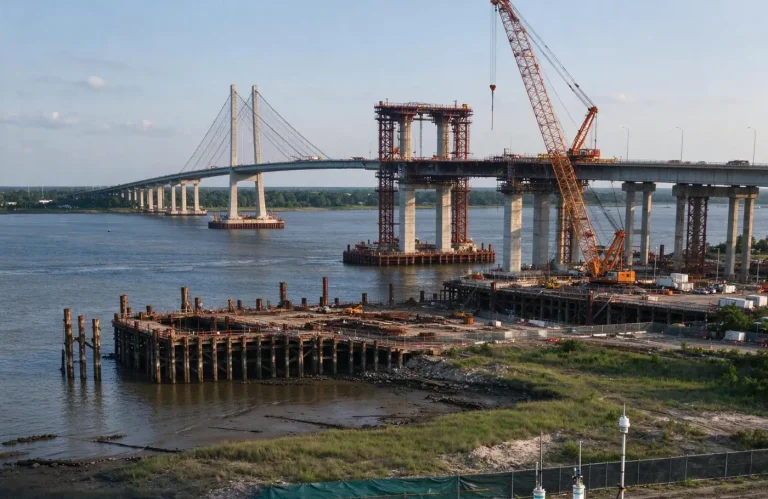
Construction is expected to take about five years, with the new six-lane, cable-stayed bridge projected to open in late 2031.
Doug Glaser, executive vice president of Omaha-based Kiewit, said Coach put pressure on him, but they are confident in the schedule, acknowledging hard work for locals and Alabamians but looking forward to the challenge.
What Phase One Will Build
The project has been split into two phases under an arrangement announced in July. The first phase, which officials say is fully financed and backed by a toll plan, includes:
- A new six-lane, cable-stayed bridge over the Mobile River, rising 215 feet above the water, with an overall structure height of more than 500 feet, according to Cheriogotis.
- A connection from the new river bridge to the existing Bayway across Mobile Bay.
- Restriping of the existing Bayway to carry three lanes in each direction between Mobile and the U.S. 98 interchange in Daphne.
- Improvements to key interchanges and traffic flow, with state officials also planning to extend the widened interstate east to the State Route 181 interchange in Malbis.
A second phase would tear down the existing Bayway and replace it with a new, higher elevated interstate across Mobile Bay. No funding source, construction timeline or cost estimate has been announced for that phase.
Standing on the riverbank, Cheriogotis pointed out where the span will go.
He said it will come right through, cutting next to them and joining the Bayway, standing 215 feet from the water and over 500 feet total, and he can’t wait to see it grow over five years.
How the Bridge Is Being Paid For
The financing package for phase one relies on several pieces, according to officials:
- A $2.52 billion federal TIFIA loan through the U.S. Department of Transportation.
- $675 million in federal grants, which includes a $550 million grant awarded during the Biden administration.
- At least $250 million from the state of Alabama.
- Bonds issued through the Alabama Toll Road, Bridge and Tunnel Authority. The Mobile project is the first ever built under that authority, which will receive the TIFIA loan.
Toll Rates Drivers Can Expect
Tolls will begin when the new bridge opens and will be collected electronically, without toll booths. The rate structure is designed to steer drivers toward the state’s ALGO Pass transponder account. Rates announced for the project are:
- $3 per trip for drivers using an ALGO Pass.
- $60 per month for unlimited trips with an ALGO Pass monthly plan.
- $7.70 per trip for drivers with an out-of-state toll transponder.
- $15.40 per trip for drivers with no transponder. Those drivers can later open an ALGO Pass account and pay the lower rates.
- Up to $121.10 per trip for commercial vehicles without a transponder.
Toll rates are expected to rise over time. The Causeway, the tunnels and the existing bridges will remain free, giving drivers a toll-free option.
Ivey: ‘This New Bridge Is Simply a Must’
Ivey said they are finally breaking ground on the Mobile River Bridge and Bayway Project, noting a new I-10 crossing has been discussed since 1990, and she prefers action over talk.
The governor said the current crossing was built to handle 35,000 vehicles a day but now sees as many as 95,000 at its peak. Other figures put the Bayway’s typical daily traffic at roughly 80,000 vehicles.
She said the bridge is a must, thanking Secretary Duffy and President Trump for a wise investment in Alabama, urging to build the bridge and let the good times roll.
Duffy Recounts a Call From the President
Duffy drew laughs with a brief impression of President Donald Trump, mimicking the president’s voice and hand gestures as he described the phone call that pushed the project forward.
Duffy said when the president calls, he says he loves Alabama, it’s amazing, good people, and they need to build the I-10 bridge, to which Duffy responds okay.
He turned to commuter stakes, saying they will save over 30 minutes travel time, time for family.
Duffy said there was a time people wanted bike paths, but bridges have bigger impact, and with limited money the administration invests in roads and bridges that move people and products.
In July, the administration removed federal requirements for a pedestrian and bicycle path and an observation overlook. Britt and Tuberville wrote those features added cost without solving the central problem.
Duffy credited the Alabama delegation, along with Federal Highway Administration Administrator Sean McMaster, for helping craft the two-phase plan and its financing, saying the effort “wasn’t easy.”
Britt and Tuberville Describe the Washington Push
Tuberville said he and Britt met Duffy a year ago, but Duffy was reluctant, saying they didn’t have the money. Tuberville described Duffy predicting the senators would lobby the president until Trump called, saying that’s how D.C. works.
Britt said the president’s involvement was decisive, stating it wouldn’t have happened without Trump, Susie Wiles, and herself.
Britt has pushed the project since taking office, writing Duffy in January calling it the largest shovel-ready infrastructure project in the country, meeting with him and Tuberville in March for the TIFIA loan, and serving on the Senate Appropriations Committee which writes the Transportation budget.
She called the day a “full circle moment” and described the corridor’s reach.
Britt said the corridor will be a lifeline for Alabama, the region, and the nation, connecting the port of Mobile, shipbuilders, military assets, Alabamians, and visitors, mitigating safety concerns and strengthening hurricane evacuation routes.
Tuberville described the bridge as a matter of national security and contrasted Alabama’s progress with projects elsewhere.
Tuberville said bridges approved in Cincinnati and Baltimore aren’t being built, but this one was approved by the best president ever, Donald Trump, who figured out a way with the best transportation secretary, Duffy, and got it done.
A Football Connection and a Five-Year Clock
Tuberville, who is running for governor in the Nov. 3 election, singled out Glaser. Glaser played offensive line for Nebraska in the late 1980s, while Tuberville was an assistant on Jimmy Johnson’s Miami Hurricanes staff that beat Nebraska in the 1988 Orange Bowl.
Tuberville said they are counting on Doug, and if he wins the governor’s race they’ll be good friends, with Governor Ivey and himself holding him accountable for five years.
Moore and Figures Weigh In
Moore, a Republican from Enterprise and his party’s nominee for U.S. Senate, called the bridge a conservative infrastructure investment.
Moore said generations will benefit from economic impact, emergency services, and beach access.
Figures, a Democrat whose district includes Mobile, thanked both the current and previous administrations.
Figures thanked the Trump administration for their role, but also thanked the Biden administration for a $550 million investment.
Mayor: ‘Like a Kid … on Christmas Morning’
Cheriogotis said the bridge will boost commerce by easing the chokepoint at the George Wallace Tunnel, improve hurricane evacuations and expand traffic capacity between Mobile and Baldwin counties.
He said he benefits from the hard work of predecessors, feeling like a kid on Christmas who got everything without writing many letters to Santa.
Cheriogotis thanked leaders at every level for sticking with the effort, thankful none threw in the towel.
Decades in the Making
Bonner has a long personal history with the crossing. He was on the staff of then-U.S. Rep. Sonny Callahan in 1997, when Alabama secured its first $10 million to study a new I-10 river crossing.
Bonner said he wishes they had built it earlier when it would have been cheaper.
Trump Visit Caps the Day
The groundbreaking came hours before Trump’s scheduled 6 p.m. rally at the University of South Alabama’s Mitchell Center.
Duffy said at the ceremony Trump will come tonight, and it’s meaningful to him, Duffy, and the delegation, urging to build the bridge.
What It Means for Residents and What Comes Next
The existing crossings stay open and toll-free during construction; tolls apply only to the new bridge once it opens. Frequent users will pay far less with an ALGO Pass than without a transponder, and the Causeway, the tunnels and the existing bridges remain toll-free alternatives.
Expect construction activity along the riverfront, the Bayway and connecting interchanges over the next five years. The second phase, a full Bayway replacement, awaits funding that has not been identified.
Update: Toll-Free Routes and the Tolling Pilot Program
Once the new bridge opens, tolls will help the Alabama Toll Road, Bridge and Tunnel Authority repay the federal Transportation Infrastructure Finance and Innovation Act loan. In July, the Trump administration allowed Alabama to become the first state to use the Interstate System Reconstruction and Rehabilitation Pilot Program, which permits tolling on an interstate for reconstruction and rehabilitation purposes. Tolling has been a controversial issue for decades and derailed earlier attempts to build the bridge.
Passenger vehicles with an ALGO Pass will pay $3 per trip, while those using interoperable transponders will pay $7.70. The Causeway, the Wallace Tunnel, the Bankhead Tunnel and the Africatown Bridge will remain toll-free alternatives.
Gov. Kay Ivey noted that the existing infrastructure was designed to carry 35,000 vehicles a day but handles about 95,000 in peak season. U.S. Transportation Secretary Sean Duffy said the project will save drivers an average of more than 30 minutes in travel time.
Update: More on the Financing and the Road to Construction
Gov. Kay Ivey framed the project as a statewide gain when authorizing it, saying it will transform travel through Baldwin and Mobile counties, strengthen a vital interstate corridor, and benefit Alabama for generations, a win for citizens, the state, and the Gulf Coast.
The Alabama Department of Transportation issued the notice to proceed to the Kiewit Massman Traylor design-build team on behalf of the Alabama Toll Road, Bridge and Tunnel Authority. The project has been in the planning process for nearly three decades.
Two federal milestones made the start of construction possible:
- 2024: The state received a $550 million grant through the U.S. Department of Transportation’s Bridge Investment Program.
- Sept. 18, 2026: Transportation Secretary Sean Duffy announced that the toll authority would receive a Transportation Infrastructure Finance and Innovation Act loan of up to $2.52 billion from the Build America Bureau, the authority’s first TIFIA loan.
Duffy said the Mobile River Bridge and Bayway project will ease traffic congestion, boost freight flow, and enhance driver safety.
When the loan was announced, Build America Bureau Executive Director Morteza Farajian said the Bureau is proud to help usher in the Golden Age of Transportation and partner with ALDOT and the Authority for their first TIFIA loan, noting the TIFIA program saves taxpayer dollars and gets projects built faster.
A TIFIA loan is federal credit, not a grant: the toll authority must repay it, which is why toll revenue from the new bridge is central to the financing plan. Construction is expected to take up to five years.
Related coverage from South AL News
- I-10 Bridge Tolls and Trump Naming Push Left Out of Speeches at Mobile Groundbreaking
- $2.52 Billion Federal Loan Closes the Financing Gap on the Mobile River Bridge; Construction Expected to Begin Next Month
- Shovels Go In Friday: Ivey Clears Mobile River Bridge Construction as Baldwin Commuters Count Down to Relief
- Mobile River Bridge Push: Tuberville, Britt Say Duffy First Said No Before Trump Stepped In