Affordable Care Act Insurance Exchange Opens for Alabama Shoppers
Alabama's federal health insurance exchange opened Oct. 1, 2013. Here's what ACA plans cost here, who is selling them and the Jan. 1 enrollment deadline.
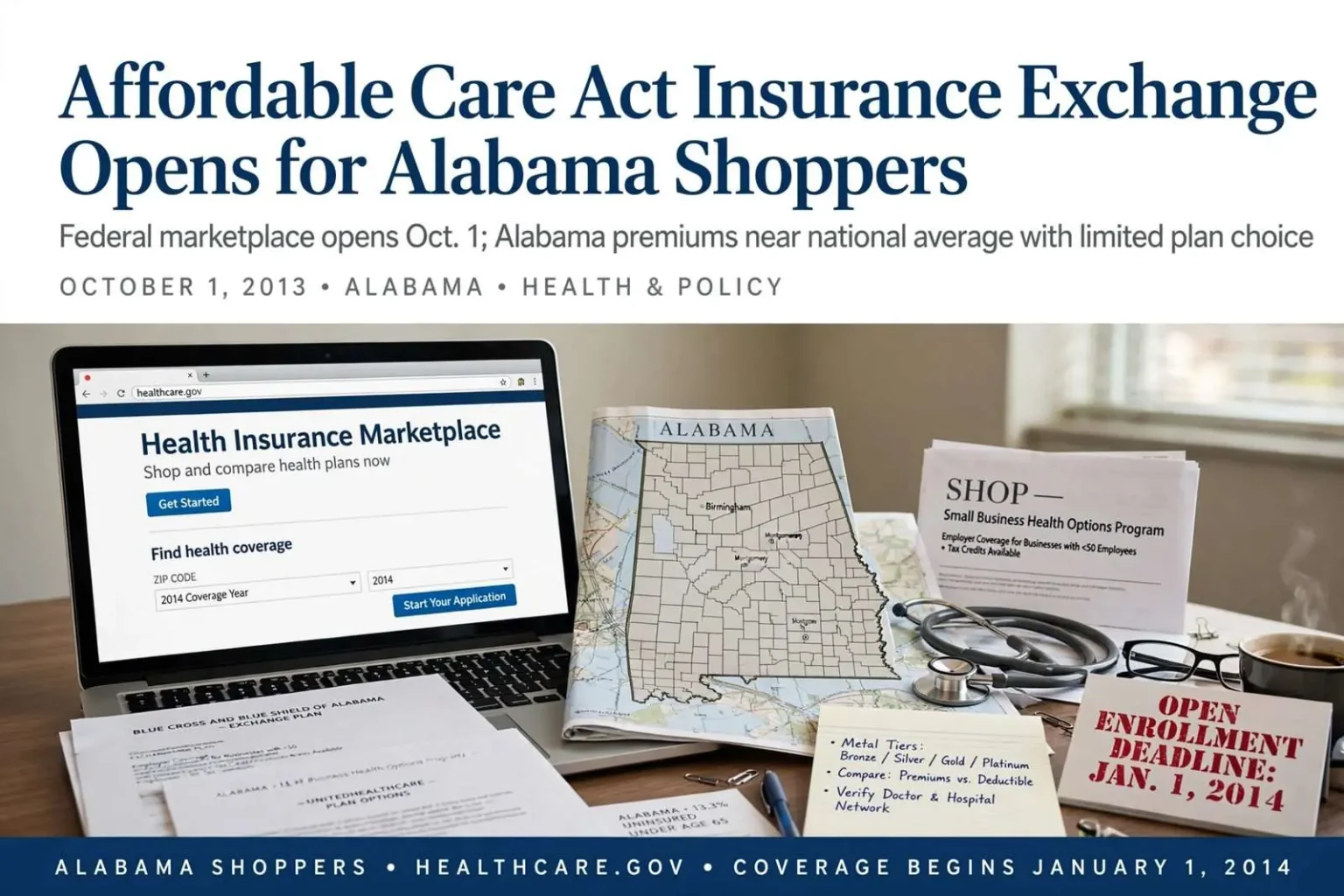
Alabamians looking for health coverage can now shop online: the federal Affordable Care Act marketplace opened for business Oct. 1, and early federal figures suggest plans in Alabama will cost close to the national average — or slightly below it.
The numbers, released by the Obama administration and reported by Bloomberg BusinessWeek, also put Alabama’s pricing roughly in line with neighboring Georgia and Florida. Tennessee residents are seeing lower premiums on average, and they have far more choice: the number of qualified plans being offered there is seven times greater than what is available in Alabama.
The comparison matters because premium levels were the central political question surrounding the rollout. Opponents predicted the law’s requirements would drive costs sharply upward; supporters pointed to regional averages as evidence that competition among insurers would keep pricing in check. Alabama’s early figures landed somewhere in between — affordable by the projections’ standards, but with far less selection than neighboring states.
Alabama shoppers will use the federally run exchange at healthcare.gov because Gov. Robert Bentley opposed the health care law and declined to build a state-run marketplace. States that built their own exchanges control more of the enrollment experience; states that declined, as Alabama did, default to the federal site for both shopping and subsidy applications.
In theory, the marketplace is aimed at the 13.3 percent of Alabamians under age 65 who have no health coverage at all — a rate that has ranked among the higher uninsured shares in the country, reflecting the state’s economy and its history of employer coverage gaps.
Who Is Selling Plans
Blue Cross and Blue Shield of Alabama, the state’s largest health insurer, is offering plans that cover all 67 counties. UnitedHealthcare applied to do the same, while Humana proposed covering parts of the state.
The lineup gives Alabama shoppers a smaller competitive field than consumers in many states. In markets where a dozen insurers compete, premiums and networks vary widely; in a market dominated by one incumbent insurer with one or two national entrants, the shopping experience is simpler but the options are fewer.
Plans are sold in metal-tier levels and vary by area, so consumers are encouraged to compare network details before choosing. The tiers — bronze, silver, gold and platinum — trade monthly premium against out-of-pocket cost, and two plans with identical premiums can cover very different sets of doctors and hospitals.
Network checking is especially important in Alabama, where hospital systems and physician groups negotiate separately with each insurer. A plan’s price tells a shopper nothing about whether their existing doctor accepts it, and coverage experts have urged consumers to verify providers before enrolling rather than after the first claim.
Open Questions for Consumers and Brokers
Dennis Mayfield, CEO of benefits consulting firm Mayfield & Associates, said the launch leaves many open questions even for people who follow the industry closely.
“There remain many doubts, concerns and challenges for millions of Americans to learn and appreciate,” Mayfield said. “Now that the public exchange is open for business, what’s not clear is how coverages will actually work — if networks will change and which providers will accept exchange-based coverage.”
Mayfield added that he believes the industry will adapt as the law phases in, noting that small companies stand to gain from the SHOP exchange options designed to help them cover more workers.
The Small Business Health Options Program, or SHOP, represents the employer-facing half of the marketplace. Businesses with fewer than 50 full-time employees can use it to offer coverage, compare plans and — for qualifying small employers — claim a tax credit that offsets a share of premiums. Whether small firms actually use it depends on the same early friction Mayfield described: unfamiliar systems, untested networks and insurers still adjusting to the new rules.
Benefits consultants across Alabama spent the weeks after Oct. 1 fielding calls from both sides of the market — uninsured individuals navigating healthcare.gov for the first time, and small employers deciding whether the SHOP exchange beat the private plans they already offered.
What Shoppers Need to Know
The federal exchange screens applicants for income-based tax credits that reduce monthly premiums, with subsidies sliding on a scale tied to the federal poverty level. A household’s expected 2014 income, not its current income, drives the calculation, which requires shoppers to project their earnings — the step that most often confuses first-time applicants.
Applications also check eligibility for Medicaid and the Children’s Health Insurance Program. Alabama’s decision not to expand Medicaid under the law left many low-income adults in a gap the marketplace cannot fill — earning too much for the state’s restrictive Medicaid program but too little for subsidized marketplace coverage — an outcome policy analysts warned about before the rollout.
For shoppers who do qualify for credits, the marketplace applies them upfront, lowering the monthly bill rather than waiting for tax season. Consumers can also decline the credit and claim it on their return, an option for households whose income projections are uncertain.
Comparing plans requires attention to more than the premium column. Deductibles, copays, prescription coverage and hospital networks all vary across the metal tiers, and the difference between a bronze and silver plan can shift thousands of dollars of annual medical cost from the insurer to the patient.
Deadline Ahead
Consumers who want coverage through the exchange must enroll in an approved plan by Jan. 1, 2014, to avoid paying a penalty on next year’s tax returns.
The penalty — the law’s individual mandate — phases in as a flat fee or a percentage of income, whichever is greater, and grows in later years. Enrollment windows matter as much as the deadline: after the initial open period closes, shoppers can only buy coverage during special enrollment events such as job loss, marriage or the birth of a child.
People who do not qualify for an income-based tax credit can still compare options on the government site or explore the private exchanges now appearing in the market. Insurers and brokers have built their own shopping platforms alongside the federal site, some offering off-exchange versions of the same plans without subsidy eligibility but with direct enrollment support.
For Alabama’s uninsured — the 13.3 percent of residents under 65 the marketplace was designed to reach — the season between October’s launch and the Jan. 1 deadline is the first sustained chance to buy regulated coverage at any price. How many of them enroll, and how the networks hold up once claims start flowing, will answer the questions Mayfield and other industry watchers raised on opening day.
Alabama’s Insurance Landscape
Blue Cross and Blue Shield of Alabama’s statewide footprint made it the anchor of the exchange from the start. The Birmingham-based insurer covers a majority of Alabamians with private coverage and holds negotiated contracts with hospitals and physician groups in every county, which means its exchange plans carry the broadest ready-made networks in the state.
UnitedHealthcare’s application to match that statewide coverage put one of the nation’s largest insurers directly against the dominant local player. Humana’s partial-coverage approach targets the state’s denser markets, where population concentration makes new-network entry more practical.
The result is a market of one incumbent and two challengers, a structure that contrasts sharply with Tennessee’s seven-fold deeper bench of qualified plans. Tennessee’s experience became the regional benchmark for what competition does to premiums — and a talking point for both sides of Alabama’s health policy debate.
The State-Federal Split
Bentley’s decision to leave exchange-building to the federal government followed the pattern of most Southern states and reflected his opposition to the law itself. The choice shifted the work — and the blame when websites faltered — to Washington, while leaving Alabama without the state-level flexibility that home-built exchanges used to tailor their enrollment systems.
The related Medicaid expansion decision compounded the structure. Expansion would have extended coverage to many of the state’s lowest-income uninsured adults; declining it narrowed the marketplace’s reach to moderate-income households, leaving the two programs with a gap between them.
For consumers, the practical effect was a single front door: healthcare.gov handled everything from subsidy screening to plan comparison for Alabama shoppers, an arrangement that worked smoothly when the federal site functioned and stalled completely when it did not.
What Happens After Enrollment
The questions Mayfield raised about networks and provider acceptance will be answered in the first months of claims. Hospitals and physician practices across the state spent the fall determining which exchange plans they would accept, and early reports from practices described mixed results — some contract schedules finalized, others still under negotiation after the plans went on sale.
Brokers and navigators urged new enrollees to confirm coverage with their providers before scheduling non-emergency care, and to review prescription formularies for maintenance medications. First-year surprises in networks and drug coverage were the most common complaints nationally during the law’s initial year.
The industry’s adaptation, which Mayfield predicted, has historically followed that pattern: first-year friction, then adjustments in contracts, pricing and plan design. Alabama’s exchange will be judged less by its opening week than by whether the coverage shoppers bought in October and December proves usable in March.
Between now and the Jan. 1 deadline, the state’s shopping window remains open. For the hundreds of thousands of Alabamians without coverage, the choice set is narrower than in neighboring states — but for the first time under the law, it exists at all.