

North of downtown Mobile, in the heart of the historic Africatown community, a deep ocean-blue building holds one of the most important museums on the Gulf Coast. The Africatown Heritage House, at 2465 Wimbush Street next to the Mobile County Training School, houses “Clotilda: The Exhibition” — the story of the 110 enslaved Africans brought aboard the last known slave ship to reach the United States, and the community they founded after freedom.
A Museum Born From the Community
The Heritage House opened to the public on July 8, 2023 — 163 years to the day after the Clotilda slipped into Mobile Bay in 1860, decades after the transatlantic slave trade had been outlawed in the United States. The $1.3 million museum grew out of a conversation in the community: residents wanted the artifacts of the ship on display, and there was nowhere to put them. The result is a collaboration between the Mobile County Commission, the city of Mobile, local and state arts groups and community organizations, operated by the nonprofit History Museum of Mobile and developed in consultation with the descendant community and experts around the country.
Outside stands “The Memory Keeper,” a sculpture by Charles Smith and Frank Ledbetter, beside a healing garden planted with herbs. The building’s blue paint matches the trim of the Mobile County Training School across the street and symbolizes the sea crossed by the more than 12 million Africans trapped in the transatlantic slave trade — of whom the 110 aboard the Clotilda represent a single ship’s human cargo.
Six Rooms, One Journey
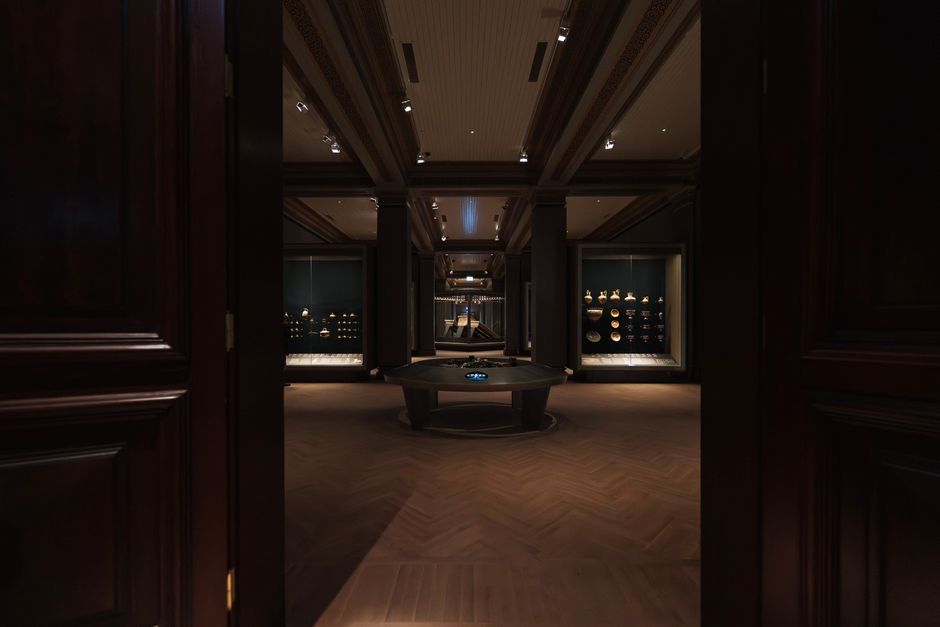
The 2,500-square-foot exhibition unfolds in six chronological rooms. It opens in West African Beginnings, where art objects on loan from museums around the country illuminate the customs of the captives’ homelands. Mobile and the Slave Trade follows, featuring the first-ever model of the Clotilda and demonstrating how the schooner was refitted after leaving Mobile to transport human cargo. The Last Voyage of the Last Slave Ship is a solemn, emotional space that confronts the horrors of the 45-day Middle Passage journey from present-day Benin.
The Establishment of Africatown celebrates what came next: the only community in America established and governed entirely by African-born Americans. Unable to fulfill their dream of returning to Africa, the 110 survivors — former shipmates — pooled their wages after emancipation and built their “African Town,” a story of resistance and resilience dating to the 1880s. In the Shipwreck room, visitors find more than a dozen actual remnants of the Clotilda, recovered from the still-submerged wreck discovered in the Mobile-Tensaw Delta in 2019 and displayed on loan from the Alabama Historical Commission — ceiling planks, nails and bolts shown publicly for the first time. The final room, Africatown Today and Tomorrow, plays a continuous video of descendants describing what it meant to grow up in the community.
Cudjoe Lewis, In His Own Voice
For many visitors the most moving moment comes in a room of recordings. Oluale Kossola — known to history as Cudjoe Lewis, the most famous survivor of the Clotilde, interviewed extensively in the 1920s and written about by Zora Neale Hurston in “Barracoon,” which was not published until 2018 — can be heard in preserved recordings speaking in his African dialect. Hearing what he endured, and the fortitude with which he carried it, is heartbreaking and inspiring at once. Emma Langdon Roche, who interviewed Lewis for her 1914 book “Historic Sketches of the South,” helped preserve those accounts.
A memorial wall identifies about three dozen known survivors by both their African and American names, punctuated by more than 70 repetitions of “Unknown” for those whose names were never recorded — with descendants’ voices reading every name aloud. Documentaries, photographs and interpretive panels create a multi-sensory space that brings the survivors’ stories to life. National Geographic named the museum the Best Museum Opening of 2023.
Planning a Visit
The Africatown Heritage House is open Tuesdays through Saturdays from 10 a.m. to 5 p.m., with tours beginning every 20 minutes. Reservations and advance ticket purchases are requested. Admission is free for Mobile County residents; visitors pay $15, with discounts for seniors, military and students. Signs along Interstate 165 lead to the museum at 2465 Wimbush Street, next to the Hope Community Center, and outside stands “The Memory Keeper” and the healing garden.
It is an impressive, thought-provoking visit that prompts reflection on the past and hope for the future — and the Africatown community, which built it and continues to guide it, has every reason to be proud. A late-afternoon visit followed by dinner and a long conversation at one of downtown Mobile’s restaurants is the right way to end the day. This museum is worth your time.