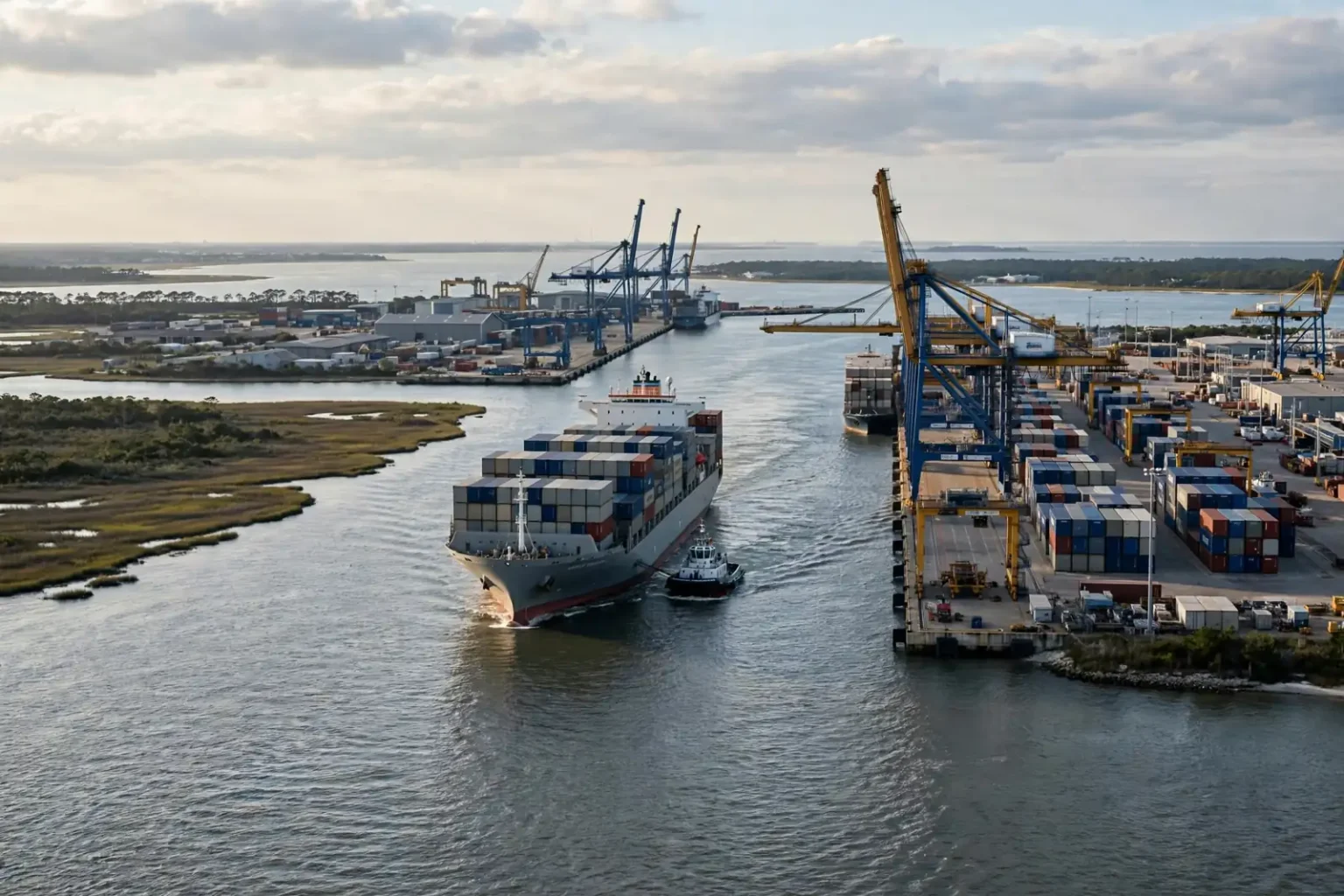
MOBILE, Ala. — The Alabama Port Authority has posted record revenue for the year that just ended, and the agency says the deeper Mobile Ship Channel is a big reason why.
The authority announced Tuesday that it closed fiscal year 2026 with revenue of about $245 million, an increase of more than 20% over the previous fiscal year and the strongest revenue year in its history. The milestone arrives just over a year after the channel connecting the Port of Mobile to the Gulf reached its authorized working depth of 50 feet.
According to the Port Authority, 168 vessels with a recorded draft of more than 45 feet have used the channel since it opened at the new depth on Oct. 3, 2025. Those drafts exceed the old channel’s 45-foot working depth. The authority said each of those sailings let customers move more cargo per trip, without the depth restrictions the old channel imposed, and that more deep-draft vessels are being added all the time.
“We saw the value of having a deeper channel immediately, and we are continuing to see its impact on the cargo our customers are now able to move,” Alabama Port Authority Director and CEO Doug Otto said. “It’s helping shippers make better use of their transportation dollars, and it’s allowed a greater volume of cargo to move through the Port of Mobile.”
What drove the record year
The deeper channel was only one factor. The Port Authority also credited increased customer demand, higher bulk cargo volumes and strong rail activity for the revenue jump.
The strong results did not come as a complete surprise. In July, members of the Port Authority’s board were told the agency was running well ahead of its budget for the year, with many lines of business outperforming projections. Among them were steel imports, coal exports and forest products, three cargo types that have long been pillars of business at the Port of Mobile.
The deepening matters most to the largest vessels. A ship’s draft is the distance between the waterline and the bottom of its hull, and it grows as a vessel is loaded. In a shallower channel, operators of big ships must either leave cargo behind or wait for favorable tides to avoid running aground. Adding five feet of depth allows those vessels to carry heavier loads on every call, spreading fixed shipping costs across more tons of cargo. That is the efficiency Otto described when he said the channel is helping shippers make better use of their transportation dollars.
The new depth is enough to handle some of the largest container ships in the world, putting Mobile in a better position to compete for business with other ports on the Gulf and Atlantic coasts.
The Mobile Harbor Modernization Project
The work behind the record year is known as the Mobile Harbor Modernization Project, a roughly $425 million state-federal partnership between the Alabama Port Authority and the U.S. Army Corps of Engineers. The goal was to deepen and widen the ship channel to accommodate larger, modern cargo vessels.
The project increased the channel’s working depth from 45 to 50 feet. It also widened a portion of the channel so that vessels can pass each other in two-way traffic, easing the bottlenecks that occur when large ships must take turns moving through a narrow stretch.
Key milestones in the project’s history include:
- 2018: Congress authorized the project in the Water Resources Development Act of 2018.
- 2019: The Corps of Engineers received final approval to proceed after presenting an environmental study. The Alabama Legislature passed the Rebuild Alabama Act, which provided the state’s share of the money.
- 2020: Dredging began.
- Oct. 3, 2025: The channel opened at its full 50-foot depth.
- Oct. 13, 2025: Local, state and federal officials and business executives gathered on the waterfront to celebrate the project’s completion.
Who paid for it
The Port Authority credited former U.S. Sen. Richard Shelby and Alabama’s congressional delegation with making full implementation of the project possible. Together, they helped secure more than $270 million in federal funding needed to carry out the work.
The State of Alabama invested $150 million to cover its share of the channel expansion and to pay for additional dredging at three of the Port Authority’s berths so they could match the new 50-foot depth. A deep channel does little good if the docks where ships tie up are shallower, so the berth work was a necessary companion to the federal project.
The state money came from the 2019 Rebuild Alabama Act, the infrastructure law championed by Gov. Kay Ivey that passed with bipartisan support in both chambers of the Alabama Legislature. Best known for raising the state’s gasoline tax to pay for road and bridge work, the act also set aside money for improvements to the Port of Mobile’s ship channel.
“We are already seeing the return on investments driven by a commitment from our state and federal partners,” Otto said. “With a historic level of capital investment underway, the channel expansion was a critical first piece of the infrastructure investments that are positioning the Port of Mobile and the State of Alabama for continued growth in the years ahead.”
More than $2 billion in port investments
The channel project is part of more than $2 billion in capital investments the Port Authority is making to increase its capabilities and capacity at the Port of Mobile and beyond. According to the authority, those investments include:
- A major expansion of the container terminal, including an ongoing multi-phase campaign to grow capacity at the APM Terminals container terminal.
- The development of inland rail facilities.
- Significant investments in terminals and rail infrastructure at the Port of Mobile.
The Port Authority has also been working to take advantage of the port’s railroad connections to open direct container service between Mobile and central and north Alabama. Moving containers by rail to inland hubs lets manufacturers and distributors far from the coast use the Port of Mobile without trucking every box across the state, and it helps the port compete for cargo that might otherwise move through larger ports in other states.
The Port Authority describes its mission as driving economic growth and global trade for Alabama through the Port of Mobile and a growing network of inland multimodal transportation assets. The authority calls the Port of Mobile, located along the central Gulf Coast, one of the nation’s fastest-growing seaports, connecting Alabama businesses and inland markets to international trade lanes.
A dredging debate that continues
The channel deepening has not been without controversy. When the Corps of Engineers sought approval for the project in 2019, its environmental study predicted there would be “no substantial impacts in aquatic resources” and that “overall effects to essential fish habitat and protected species would be temporary in nature.”
Those findings were disputed at the time. Since then, the Corps’ practice of dispersing some dredged sediment in the open waters of Mobile Bay, which the agency calls thin-layer placement, has become the subject of an ongoing fight. The environmental group Mobile Baykeeper has called the practice “mud-dumping” and argues it harms the bay, including its oyster habitat.
Earlier this year, the Alabama Legislature passed a law to limit the practice. As South AL News has reported, the measure, known as the Save Our Bay Act, took effect Oct. 1 and calls for at least 70% of dredged material to go to “beneficial use” projects such as marsh and shoreline restoration when federal funding is available for the more expensive options. The Corps has maintained that thin-layer placement is itself a form of beneficial use, setting up a continuing dispute over how the law will be applied. The debate has also drawn in federal lawmakers and the candidates for governor.
The Port Authority has pursued its own approach to sediment from its berths. Last month, Otto told board members that a fully funded plan to turn dredged material into 1,200 acres of new wetland habitat in Upper Mobile Bay is moving toward construction, with completion targeted for Thanksgiving 2027.
National cargo picture
The port’s record year comes amid strong container traffic nationwide. Descartes, a global logistics and shipping data company, said in a newly released report that U.S. container imports in September reached their highest September volume on record. Imports were 25.8% above the pre-pandemic level of September 2019 and 10.3% higher than in September 2025.
Imports from China accounted for most of the gain, according to Descartes. Containerized imports from China were up 4.5% compared with September 2025, and for the year to date they were up 21.2% compared with 2025, a year marked by uncertainty over tariffs imposed by the Trump administration.
Storm interruption
The announcement came days after Hurricane Isaias briefly halted activity at the port. The Port Authority suspended vessel and terminal operations at its public berths on Oct. 8 as the storm approached, and the U.S. Coast Guard has since been working with Gulf ports on recovery and reopening.
What comes next
Port officials say the channel was the first major piece of a broader building program. With container terminal expansion, inland rail facilities and other projects still underway, the Port Authority expects the deeper channel to keep drawing larger vessels and heavier loads to Mobile, while the debate over how to handle the sediment that keeps the channel open continues in Montgomery, Washington and on the bay itself.