Alabama Power Monitoring Plant Barry Ash Pond Ahead of ‘Historic’ Hurricane Sally
As Hurricane Sally approached, Alabama Power said it was closely monitoring the coal ash pond at Plant Barry, while environmentalists flagged the flood.
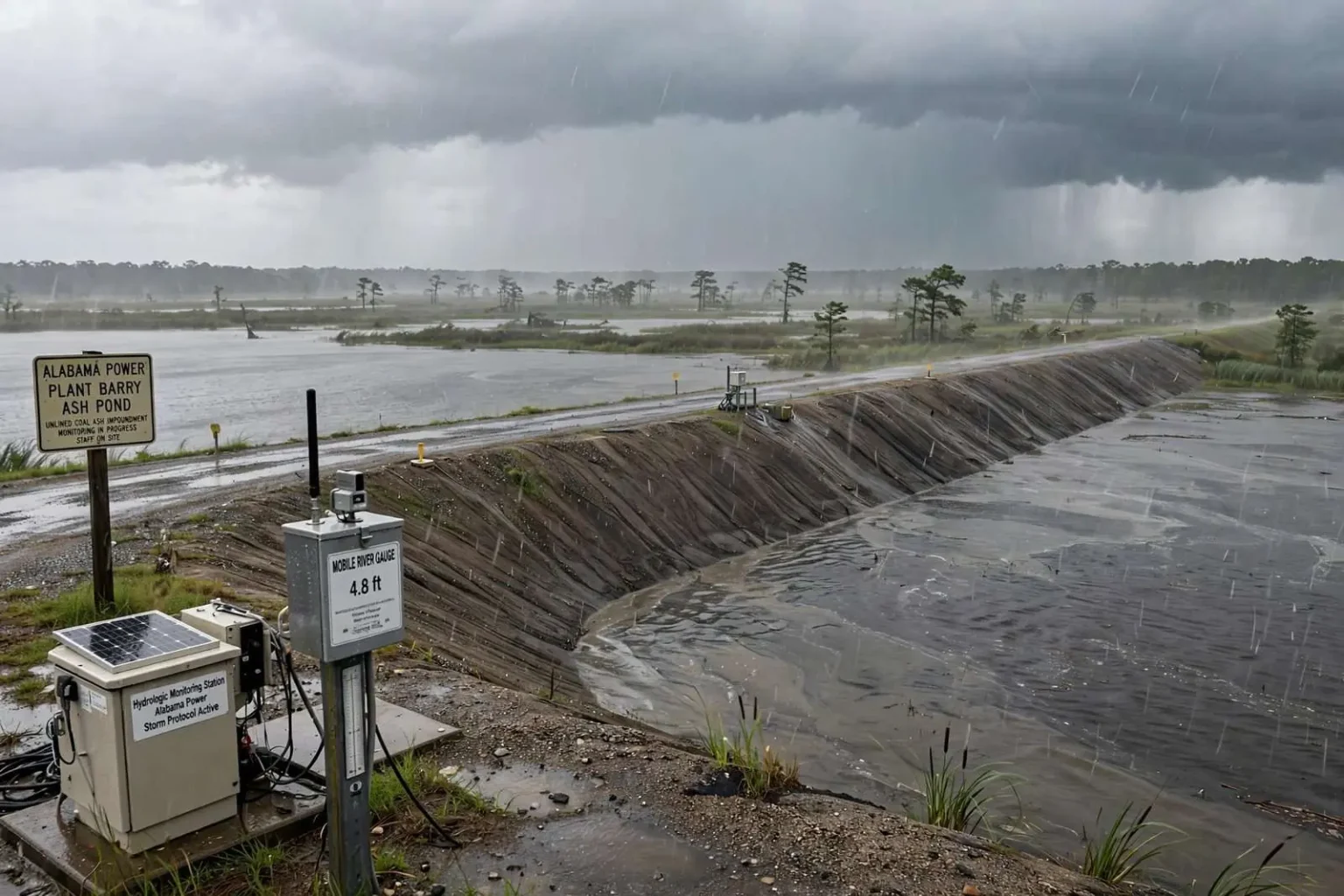
As Hurricane Sally bore down on the Gulf Coast with forecasts of 10 to 15 inches of rain, environmental advocates turned their attention to the nearly 21 million cubic yards of coal ash stored in an unlined pond at Alabama Power’s Plant Barry in north Mobile County. The pond, separated from the Mobile River by an earthen dam, has long been the focus of a running dispute between the utility and the clean-water group Mobile Baykeeper over what would happen if a major storm parked itself over the watershed. Sally, a slow-moving system expected to linger rather than push through quickly, threatened to test that arrangement directly.
Alabama Power spokesman Michael Sznajderman said Tuesday that the company was “closely monitoring” the storm and executing its safety protocols. He noted that the earthen dam separating the ash pond from the Mobile River received the highest rating available from the EPA during a 2010 inspection, a point the utility has repeatedly made in defending the pond’s structural integrity. Company crews, the spokesman indicated, would ride out the storm at the plant and assess conditions as the rain fell.
Mobile Baykeeper Program Director Cade Kistler said the concern cuts in two directions — storm surge pushing water in from the bay, and the slow, steady rainfall that drains into the Mobile-Tensaw Delta from points far north of the plant. “This kind of slow moving storm that fills up a watershed is definitely a big concern,” he said. Kistler noted that some of the worst coal ash spills on record happened not during a storm but days afterward, as floodwater kept flowing downstream and saturated embankments gave way under prolonged pressure.
Those warnings rest in part on a 2018 study funded by Baykeeper, which found that an extreme rainfall event could raise the pond’s water level by roughly 5.6 feet, leaving only a sliver of margin below the top of the dike. Alabama Power has since raised the dam, a change the company points to as evidence it has addressed the vulnerability. Advocates counter that the pond’s fundamental location — beside the river, in the floodplain of the largest river delta in the state — has not changed at all.
Watching the river gauge
On Tuesday, the Mobile River at Plant Barry stood near 4.8 feet and was projected to climb to about 10.3 feet by Saturday as Sally’s rains worked their way down the watershed. River forecasters caution that levels on the Mobile respond slowly, rising for days after rain stops because the system drains an enormous basin that stretches north across Alabama. That lag is precisely why post-storm conditions worry ash pond critics: the water stress on the embankment builds after the wind has died down.
Kistler said his organization would keep watching the river level as Sally moved ashore, hoping the rainfall would not trigger a breach but calling the storm “another wake up call” about the risks of storing coal ash next to the river. The group has spent years pressing Alabama Power and state regulators to move the ash out of the floodplain to a lined, upland landfill, arguing that no amount of engineering can fully insulate a dam in that location from the kind of water Sally was expected to deliver.
Sally’s forecast track placed the worst of its rainfall over the central Gulf Coast, with the heaviest bands expected to sweep across south Alabama and the Florida Panhandle for a day or more. Slow forward motion was the defining feature of the storm, and forecasters repeatedly warned that rain totals, not wind, would be its most damaging product for inland areas like the delta and the river towns above Mobile Bay.
Why Sally’s pace matters for the ash pond
The distinction between a fast hurricane and a slow one is central to the concern at Plant Barry. A fast-moving storm dumps rain and moves on, and rivers crest and fall within days. A slow mover like Sally sits over the same basin for a day or longer, wringing out repeated rain bands over the same ground. When that rain falls across the Alabama, Tombigbee and Mobile river basins, all of it eventually funnels past the plant before reaching Mobile Bay, and the crest arrives days after landfall.
Coal ash itself adds a second layer of worry to the flooding math. The waste, a residue of decades of coal burning at the plant, carries concentrated heavy metals including arsenic, lead, mercury and selenium. Stored wet in an unlined pond, the ash sits in constant contact with water, and scientists have documented at sites across the Southeast that those metals can leach into groundwater and surface water. A flood that overtopped or breached the dam would move pond water and potentially ash itself directly into the Mobile River, upstream of drinking water intakes, oyster beds and the delta’s fisheries.
Alabama Power has consistently argued that the pond is engineered to withstand severe weather. In addition to the 2010 EPA safety rating, the company notes that it has reinforced and raised the embankment, operates the pond under federal coal ash rules adopted in 2015, and monitors groundwater around the site. The utility has also said its closure plan — capping the ash in place rather than excavating it — meets those federal requirements and that the sealed site would remain stable through storm events.
Mobile Baykeeper rejects that reasoning, and Sally gave the group a fresh platform to make the case. The organization’s position is that a storm like this one is exactly the scenario the 2018 study modeled: a rain event big enough to raise pond levels several feet while the river outside the dam runs high, squeezing the embankment from both directions at once. Whether the raised dam provides enough margin, the group argues, is a question that should be answered by moving the ash, not by waiting to find out.
The pond’s critics and defenders do agree on the underlying geography. Plant Barry sits in the heart of the Mobile-Tensaw River Delta, the vast wetland where the Alabama and Tombigbee rivers meet to form the Mobile. The delta is one of the most biologically rich landscapes in North America, and everything in it drains to Mobile Bay, the estuary that anchors the region’s seafood industry and its shoreline tourism economy. That is why coal ash storage beside the river has drawn years of scrutiny from scientists, anglers, commercial fishermen and downstream communities alike.
What residents are watching for
In the days before landfall, the practical questions for people near the plant and downstream were straightforward: how high the river would climb, how much rain actually fell, and whether the dam showed any sign of distress. Utility crews and emergency managers tracked the same gauges the public does, and Baykeeper pledged to keep watching river levels through the week and beyond, since the danger window extends well past the storm’s exit.
The storm also renewed attention on the timeline for the pond’s closure. Under federal coal ash rules and state permits, utilities must close unlined impoundments that cannot demonstrate groundwater compliance, and the fight over Barry has centered on whether the ash leaves the floodplain in the process. Each major storm adds urgency to that debate, as advocates point to near misses and utilities point to dams that held. For now, nearly 21 million cubic yards of ash remain where they have been for decades, behind an earthen wall on the Mobile River, waiting out the rain.
The broader context is a Gulf Coast that has learned, repeatedly, to plan for water rather than wind. Forecasters and emergency managers across south Alabama have spent years urging residents to treat rainfall forecasts as seriously as hurricane categories, because flooding has proven to be the region’s costliest hazard. For the communities along the Mobile, Tensaw and Blakeley rivers, a storm that parks over the watershed is measured not in the hours of wind but in the days of water that follow it downhill toward the bay.
That hydrology is what keeps the Plant Barry debate alive between storms. The pond’s water level, the river’s stage and the saturation of the embankment are all functions of the same rain, and none of them peak at the same moment. Critics of closure-in-place argue that this asynchronous stress — surge first, rain next, river crest last — is precisely what an earthen dam in a floodplain is never fully engineered against, and why the ash should be relocated to higher ground where none of those forces can reach it.
The utility, meanwhile, has framed its monitoring as routine preparedness, noting that plants across the Gulf region activate storm protocols every season: securing materials, checking pumps, staffing sites and inspecting dams before and after landfall. From the company’s perspective, the pond held through past hurricanes and its embankment carries the strongest federal rating, so the responsible course is careful stewardship rather than an expensive relocation campaign. From the advocates’ perspective, every storm that comes close is one more roll of the dice the region did not have to take.
Whichever side of that argument residents land on, Sally guaranteed one thing: the coming days would provide a real-world test. River gauges above and below the plant, groundwater monitoring wells and the pond’s own level readings would all tell the story in slow motion, well after the rain ended. Baykeeper said it would publish what it observed, and the utility said it would report on conditions at the site. In a watershed this large, the answer would take days to arrive — which is, for both sides, the entire point.