Angie Swiger Resigns Baldwin County School Board Seat as Gulf Shores Split Looms
Angie Swiger has resigned her District 5 seat on the Baldwin County Board of Education, stepping aside just before a judge was set to rule on whether she could keep serving after Gulf Shores voted to form its own school system.
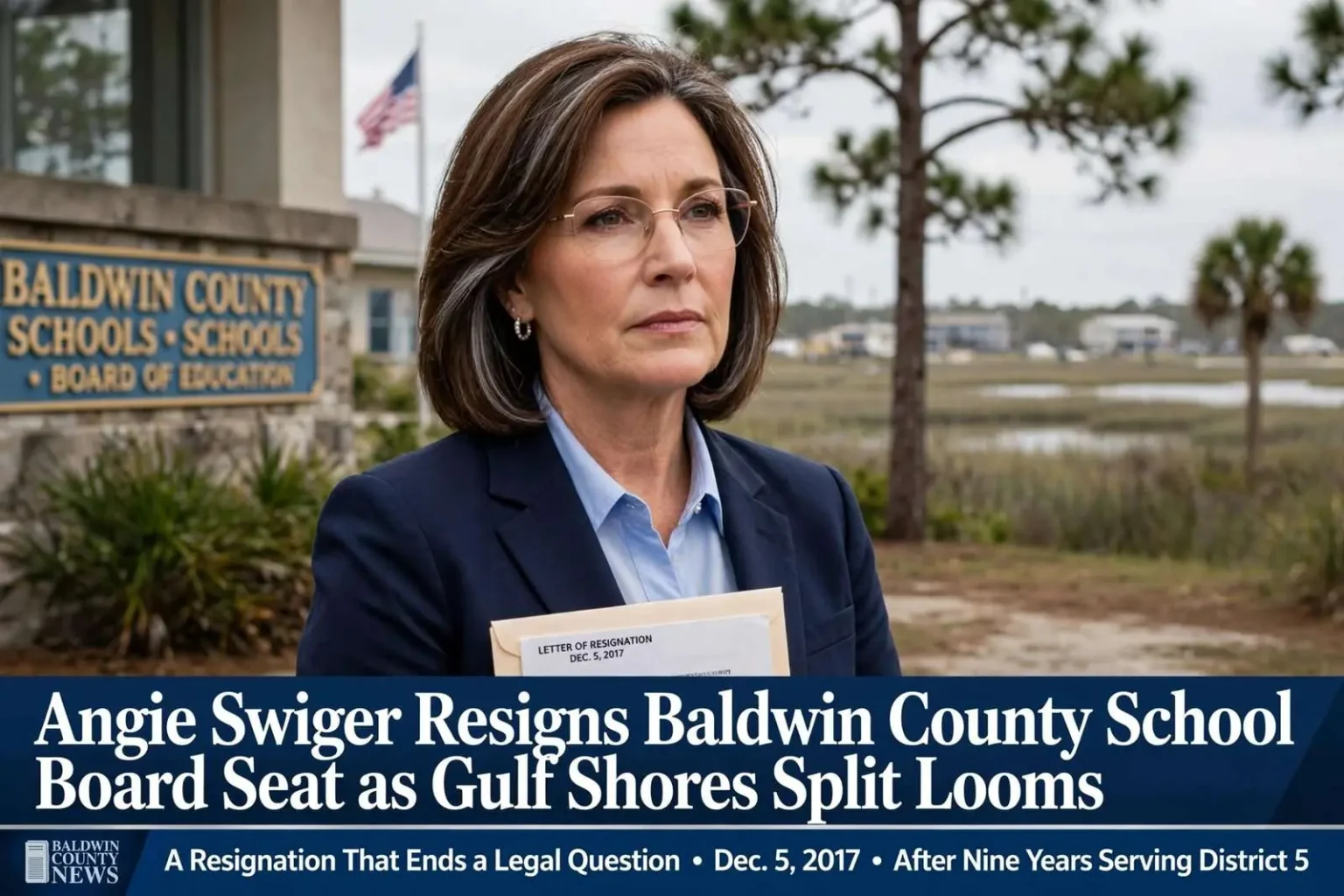
A Resignation That Ends a Legal Question
Angie Swiger has resigned from the Baldwin County Board of Education, stepping down from the District 5 seat she has held for nine years just as a legal fight over her eligibility to keep serving was headed to a judge. Swiger submitted her letter of resignation on Dec. 5, ending months of uncertainty about her status on the county board after Gulf Shores voters moved earlier this year to break away and form their own municipal school system.
Officials with Baldwin County Schools had asked the Alabama Attorney General’s office to weigh in on whether a board member living inside the boundaries of a newly created city school district could continue to represent a county board seat, and a judge had been expected to rule on the question before Swiger’s decision made it moot.
The question was more than procedural. When voters in a community vote to form their own city school system, the lines that define representation on the existing county board are thrown into doubt for anyone whose home falls on the new side of the divide. Resolving that question through the Attorney General’s office and the courts could have taken months, leaving District 5 in limbo while the county prepared for one of the most complex separations in its history. Swiger’s resignation removed the uncertainty in a single stroke.
‘My Heart Truly Lies in My City’
In her resignation letter, Swiger said she had grown weary of questions about where her loyalties lay as Gulf Shores worked through the process of separating from the county system. She said she had always tried to serve District 5 as a whole, a sprawling area that includes Gulf Shores, Orange Beach, Elberta, Fort Morgan and Ono Island, but acknowledged that her ties to Gulf Shores ultimately shaped her decision to step aside.
“Although I have served all areas of my district effectively and equitably, my passion, commitment, love, and support for my Gulf Shores community, its citizens, and its children is no secret,” Swiger wrote. “After a great deal of thought and consideration, I have come to the conclusion that my heart truly lies in my city and I have completed the job that 61% of the Gulf Shores voters elected me twice to do.”
The districts of Baldwin County’s school board cover enormous geographic and demographic range, and few are as varied as District 5. It stretches from the resort communities of Gulf Shores and Orange Beach, through the growing town of Elberta, to the peninsula communities of Fort Morgan and Ono Island. Representing it means balancing the needs of rapidly growing beachfront cities against those of smaller agricultural and residential communities, and Swiger’s resignation letter made a point of claiming effectiveness and equity across all of them.
Her reference to the 61% of Gulf Shores voters who elected her twice also underscored the central tension of her final months: she held a countywide district seat, but a decisive majority of the voters who chose her had just voted to leave the county system altogether.
A Decade of Programs She Helped Build
Swiger pointed to a list of initiatives she said she helped shepherd during her tenure, including plans for a new high school in Elberta, a 1:1 technology program spanning kindergarten through 12th grade in the Gulf Shores and Orange Beach feeder pattern, and a foreign language curriculum that begins in first grade.
She also cited the creation of ten college and career academies in the south end of the county, a program she said drew more than 400 visitors and praise from state education officials and has since been modeled by other school systems around the country.
Among the other accomplishments she listed was a dual enrollment partnership with Coastal Alabama Community College that gives students access to 13 different college-level courses in academic and career-technical fields. She also pointed to a partnership with South Baldwin Regional Medical Center that opened a full-time teaching facility in Orange Beach for the district’s Health Sciences Academy, along with collaborations with the cities of Gulf Shores and Orange Beach that created student pathways in fire science, criminal justice, emergency medical services, horticulture, engineering and the arts.
The academies model at the center of that record reorganizes parts of the high school experience around career themes, pairing traditional coursework with hands-on training and industry partnerships so students graduate with both a diploma and a head start on a profession. The visitors who toured the program, more than 400 of them, came from other districts studying how south Baldwin County organized its academies, and the fact that systems around the country have since copied the model is the kind of legacy a board member can point to long after leaving office.
The partnerships behind those programs also illustrate how modern school systems grow. Health sciences students train in a hospital-linked facility, fire science and emergency medical services students prepare under the guidance of the cities that will someday hire them, and dual enrollment lets high schoolers bank college credit through Coastal Alabama Community College before they graduate. Each program requires an agreement with an outside institution, and each one Swiger listed required a board member willing to build and maintain that relationship.
Two Years of Trying to Hold the System Together
Swiger said that when she was first elected, her goal was to help build a school system strong enough that no community within it would ever want to leave. She said she had spent the past two years trying to find common ground between the county system and the island communities pushing for separation, but that Gulf Shores ultimately made its own decision to move forward with a standalone system.
“At the end of the day, Gulf Shores has made the final decision to form a separate system and we must all move on from there,” she wrote.
The movement to split began as frustration over funding and representation in the county’s southern communities, and it gathered force through petitions and public meetings before reaching the vote earlier this year. Swiger’s account of the past two years, spent looking for common ground, describes the board’s side of an effort that ultimately could not reconcile what the island communities wanted with what a single county system could offer them.
What Comes Next for the Split
Gulf Shores voters approved splitting from Baldwin County Schools earlier this year, and the city has since been laying the groundwork for its own school board and administration, with officials targeting a 2018 opening for city-run schools.
Baldwin County Schools Superintendent Eddie Tyler has publicly questioned whether that timeline is realistic given the amount of work involved in dividing assets, staff and facilities between the two systems.
The separation Tyler must oversee is the kind of undertaking that can take years in other states that have seen city-versus-county splits. Schools themselves must be divided or purchased, transportation routes redrawn, staff assignments transferred, debts and assets apportioned, and an entirely new administrative structure hired and organized, all while roughly two school systems prepare to open their doors under separate banners. Tyler’s skepticism about the timeline reflects that reality, and the negotiation between the two systems over those logistics has continued even as Gulf Shores builds its own governing structure.
Filling the Seat
Swiger thanked the Baldwin County Schools staff she worked alongside for nearly a decade and said she was confident that Board President Cecil Christenberry and Superintendent Tyler would move quickly to find a replacement for her seat.
She said she expected whoever fills the District 5 position to continue serving the children of Baldwin County and the district with transparency and integrity.
Her resignation leaves the Baldwin County Board of Education to determine how to fill the vacant seat while the county and Gulf Shores continue working through the logistics of separating into two independent school systems.
Board vacancies are typically filled by appointment by the remaining members, and whoever takes over District 5 will inherit both the district’s ongoing operations and the complications created by the split. The seat’s constituency itself is in flux, since part of District 5 lies within the new Gulf Shores city district and part does not, a question that will shape how the position is defined going forward.
The timing also means Swiger’s successor will arrive mid-negotiation rather than at a clean starting point. The discussions over how to divide the system, from facilities and staff to the fine print of transition agreements, are exactly where a board member’s institutional knowledge matters most, and the new member will need to come up to speed quickly.
What the Departure Says About the Split
Swiger’s exit is, in miniature, the story of the entire separation: a community whose identity and loyalties shifted once it voted to chart its own course. Her years of service produced a list of programs, from career academies to dual enrollment to health sciences training, that will outlast her tenure in whichever system ends up operating them.
Her stated goal, a county system strong enough that no community would want to leave, went unfulfilled, but the effort behind it shaped the decade of growth that made the south end’s schools a destination for visitors from across the country. The academies, the technology program and the hospital partnership remain in place as the two systems divide, and whichever side of the new line they fall on, the students they serve will carry the benefit.
For now, the county board moves on with a vacancy to fill, a negotiation to conclude, and a system preparing to operate without its southernmost island communities for the first time in decades. The resignation letter Swiger submitted on Dec. 5 closes her chapter in that process and, in her own telling, closes it without regrets, with her heart, as she wrote, in her city.