Apple’s Tim Cook Reflects on Robertsdale Roots, Hints at Future U.S. Manufacturing Sites
Apple CEO Tim Cook discussed his Robertsdale, Alabama upbringing and hinted at where the company's next U.S. manufacturing plants could be located.
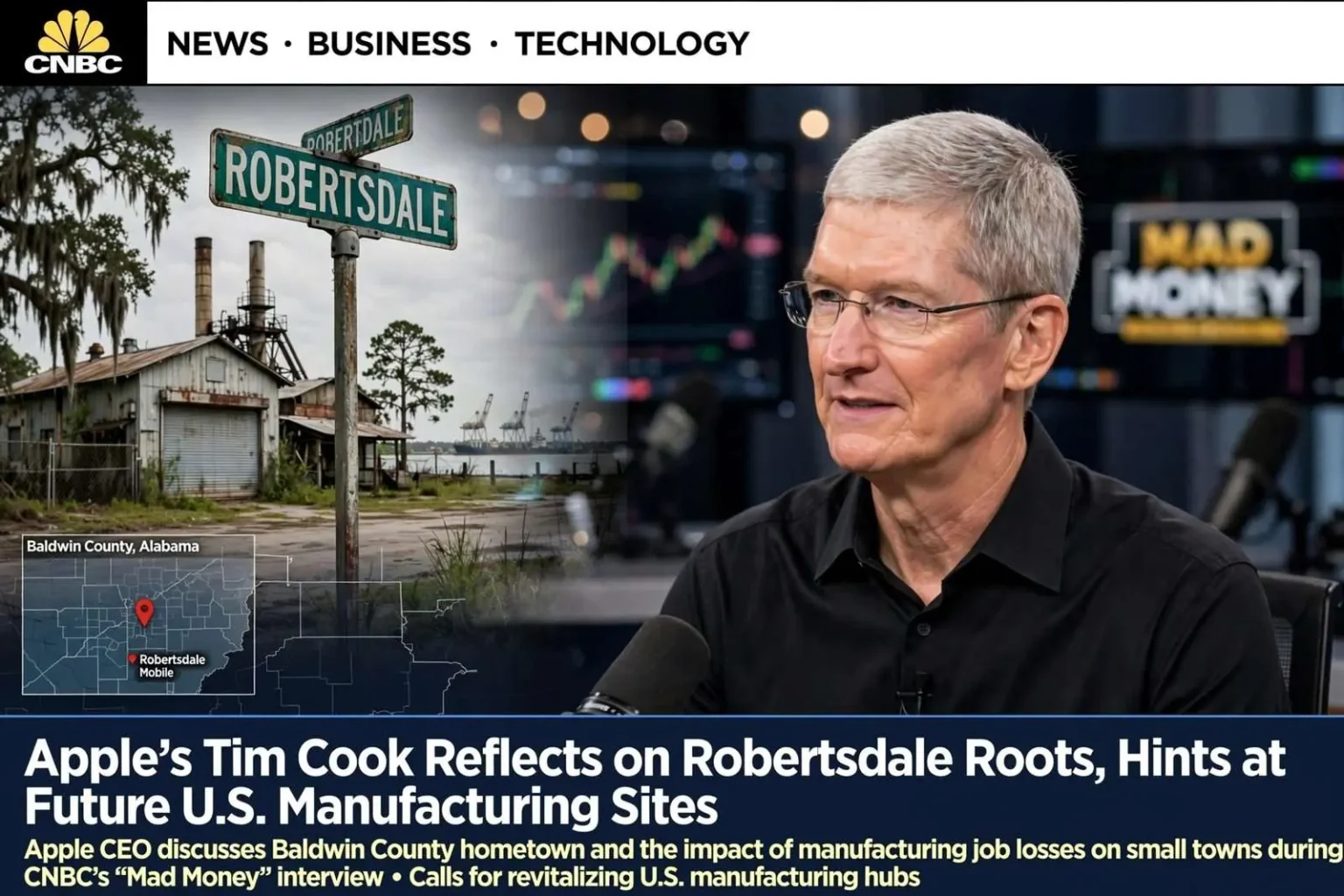
Apple CEO Tim Cook discussed his Baldwin County hometown of Robertsdale and the ripple effects of manufacturing jobs leaving small towns during an interview that aired Friday on CNBC’s “Mad Money.” Cook, who has led the iPhone maker since 2011, was appearing with host Jim Cramer when the conversation turned to his childhood near Mobile, Alabama, and to the long shadow cast by the closure of an International Paper plant that once employed much of the area. The exchange gave viewers a rare extended look at how the executive connects Apple’s manufacturing decisions to the fortunes of towns like the one he came from.
Asked by Cramer about growing up near Mobile, Alabama, and watching an International Paper plant that once employed much of the area shut down, Cook reflected on what it means for a community to lose its economic anchor. “Yeah, I do come from a very small town called Robertsdale,” Cook said. “It’s a few thousand people — they’re great salt-of-the-earth people. I come from a blue-collar family. My dad was in the shipbuilding business. It’s still around. It needs to be revitalized. And hopefully that is happening.”
Cook’s connection to Robertsdale runs deep. He was born in Mobile and grew up in the Baldwin County town, where he attended Robertsdale High School and worked a series of jobs — including delivering newspapers and working at an aluminum plant and a grocery store — before leaving for college. He has often credited that upbringing with shaping his work ethic and his practical approach to running a company whose products are assembled by millions of workers around the world.
The paper industry’s pullout hit the Gulf Coast region hard. International Paper operated a large mill in the Mobile area for decades, and generations of local families drew paychecks from the facility and from the timber supply chain that fed it. When major mills across the region closed or downsized amid industry consolidation and shifting demand, communities that had grown up around them were left scrambling to replace not only the direct jobs but the restaurants, retailers and service businesses that depended on plant payrolls.
Cook said he has seen firsthand what happens to communities when a major employer disappears, and stressed the importance of maintaining a “hub” of economic activity in different regions. “If we take this plant as an example, this plant creates so many jobs out in the community as well, because you have more restaurants, more stores, more groceries, all the things that people buy that work here,” Cook said. “And so, it’s a virtuous cycle that creates a hub of activity. And we’re doing that across America in 79 different factories now.”
That figure reflects Apple’s sprawling domestic supply chain. While most final assembly of iPhones and other devices happens overseas, Apple has long emphasized that its products rely on American factories producing components, materials and equipment across dozens of states. The company has also operated a manufacturing fund aimed at supporting U.S. production, and its executives have repeatedly described the domestic footprint as both a competitive advantage and a point of pride.
Cramer pressed Cook on whether Apple, like steelmaker Nucor, looks specifically for communities where manufacturing jobs have been “left behind” when deciding where to locate new plants. “There will definitely be different places that have those characteristics, yes,” Cook said, without naming specific cities under consideration.
The comparison to Nucor was pointed. The steelmaker, one of the largest in the United States, has built much of its operations around smaller communities across the South and Midwest, and Cramer’s question hinted at a growing conversation in business media about whether major manufacturers should deliberately target towns hollowed out by deindustrialization. Cook’s answer stopped short of a commitment, but he acknowledged that communities with that profile fit the characteristics Apple considers.
Why the Comments Matter in Baldwin County
For residents of Robertsdale and the surrounding central Baldwin County communities — Summerdale, Silverhill, Elsanor and the areas around U.S. 90 and Alabama 104 — Cook’s remarks carry obvious weight. Baldwin County has been among the fastest-growing counties in Alabama for years, driven by growth along the Eastern Shore and the beaches, while some of the more rural communities in the county’s interior have watched younger residents commute to jobs in Mobile, Daphne or Gulf Shores. A major advanced manufacturing employer in the area would reshape that dynamic.
The region is no stranger to courtship by large industry. Mobile has landed major industrial projects in recent decades, from aerospace assembly to steel and shipbuilding, and Baldwin County has chased a share of that growth. Shipbuilding, the trade Cook said his father worked in, remains an anchor of the Gulf Coast economy through the yards along Mobile Bay and the Florida Panhandle, though Cook’s observation that the industry “needs to be revitalized” speaks to the boom-and-bust cycles that have marked it for generations.
State and local economic development officials have increasingly courted advanced manufacturing with incentive packages, workforce training programs through Alabama’s community college system and industrial sites positioned along Interstate 10 and Interstate 65. Whether Apple ever places a facility in south Alabama, Cook’s comments put the region’s struggles and assets in front of a national business audience — a form of exposure local leaders could not buy.
The Long History of Cook and His Hometown
Cook has spoken about Robertsdale before, though usually briefly. He has described a childhood spent in a town where everyone knew their neighbors, where his mother worked at a pharmacy and his father at the shipyard, and where a pager from his newspaper delivery route was his first piece of technology. In interviews over the years he has returned to the theme that opportunity in his hometown was limited, and that education — in his case, studying industrial engineering at Auburn University before earning an MBA at Duke — was the path out.
That biography gives the “Mad Money” exchange a personal edge. Cook has often framed Apple’s approach to jobs and education through the lens of his own experience, championing coding education initiatives and workforce development programs as ways to spread opportunity to places that lost their industrial base. His insistence that a plant is more than its payroll — that it sustains an ecosystem of small businesses — mirrors the arguments local officials across the Gulf Coast have made for decades in courting manufacturers.
The interview also comes amid continued national debate about where American manufacturing should happen. Companies in technology and other sectors have faced pressure from policymakers to move more production to the United States, and supply chain disruptions in recent years have pushed many manufacturers to reconsider concentration overseas. Cook’s talk of factories “across America” and his acknowledgment that communities “left behind” by manufacturing fit that backdrop, even as he declined to preview any specific announcements.
For now, residents of Robertsdale can only read the tea leaves. Cook’s exact words — that there “will definitely be different places” with the characteristics Cramer described — were an acknowledgment, not a promise. But for a town of a few thousand people in Baldwin County, hearing its name on national business television from one of the most powerful executives in the world was itself a notable moment, and a reminder that the route from a Baldwin County childhood to the top of American business runs through places like the one International Paper left behind.
A Closer Look at the International Paper Legacy
The International Paper facility Cook referenced was a landmark of the Mobile area economy for most of the twentieth century. Mill jobs were known for solid wages, benefits and a measure of stability that few other employers in the region could match, and generations of families in Mobile and Baldwin counties counted at least one member among the mill’s workers. The timberlands of south Alabama fed the operation, connecting rural landowners across the two counties to the industrial economy through a steady market for pine.
When such a plant closes, the losses compound in ways that are easy to overlook. Paychecks that once circulated through local grocers, car dealers, hardware stores and restaurants vanish, property values around mill communities can soften, and school systems that counted on the children of steady industrial workers see enrollment drift. Cook’s description of a “virtuous cycle” running in reverse captures what sociologists and economists have documented in mill towns across the country, from the paper belt of the Southeast to the steel corridors of the Midwest.
Alabama’s experience mirrors that pattern in miniature. The state built much of its industrial identity on paper mills, textile plants and foundries scattered through small towns, and the late twentieth and early twenty-first centuries saw many of those employers consolidate or close. Economic development officials have spent the years since trying to recruit replacements — automotive plants, aerospace suppliers, data centers — with mixed results, and the towns that succeed most often are those that can offer trained workers, reliable infrastructure and sites ready for construction.
Cook’s comment that his father’s shipbuilding industry “needs to be revitalized” touches another strand of Gulf Coast economic history. Shipyards along the coast have risen and fallen with defense budgets, oil prices and commercial demand, and the region’s current strength in the sector owes much to the Navy and Coast Guard work concentrated at the large yards on Mobile Bay. Communities hoping to see that industry broaden its footprint have pinned hopes on workforce programs that train welders, pipefitters and electricians, trades in constant demand across the region.