Archdiocese of Mobile eases COVID-19 rules as pastors regain say over Holy Water, hymnals
The Archdiocese of Mobile has updated its COVID-19 restrictions, leaving Holy Water, hymnals and other Mass provisions to each pastor's discretion.
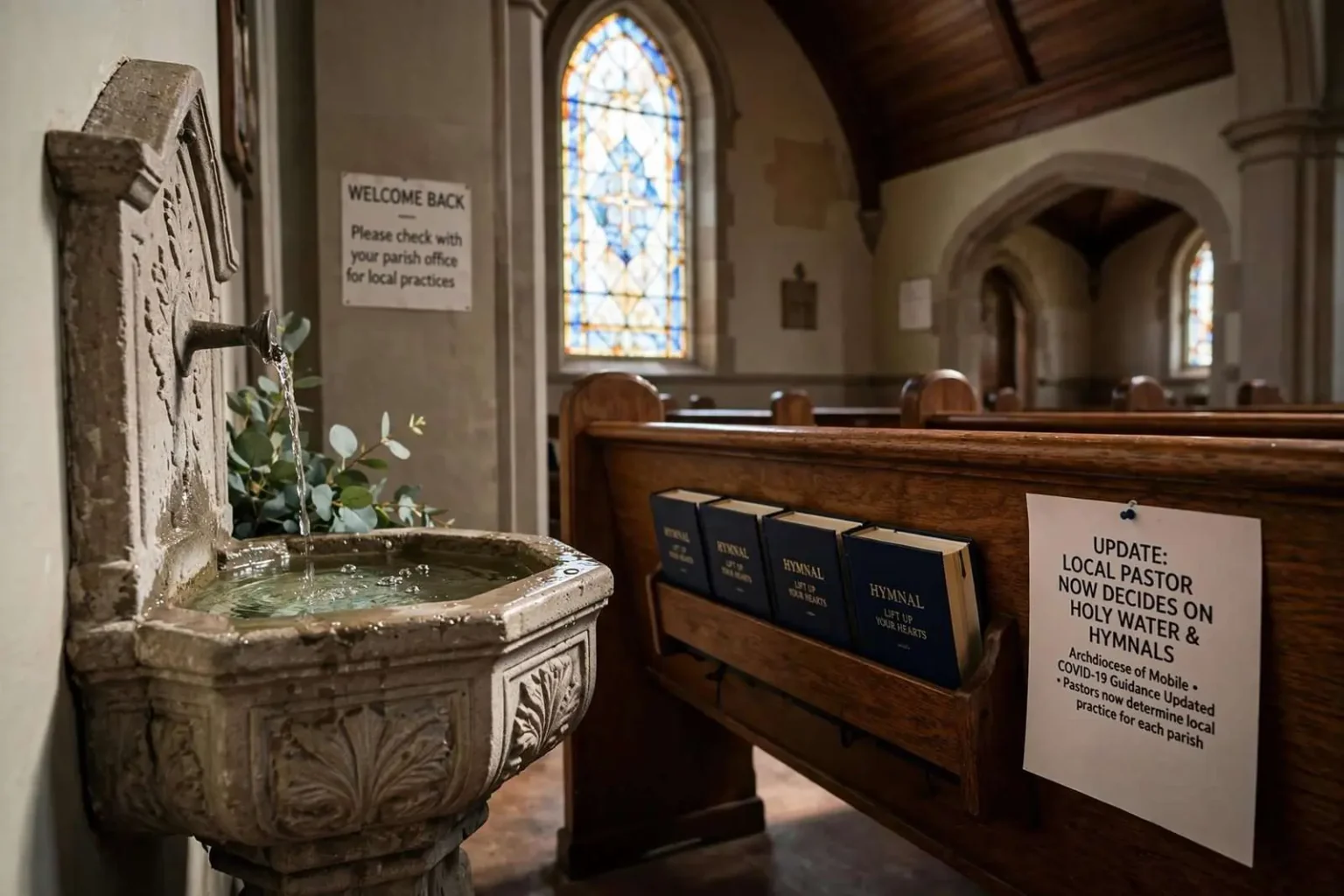
Archbishop Thomas J. Rodi has announced an update to the COVID-19 restrictions that have been in place at Catholic churches across the Archdiocese of Mobile, moving parishes a step closer to pre-pandemic worship. Under the updated guidance, decisions about several familiar elements of the Catholic Mass now rest with each parish’s pastor. That includes the return of Holy Water fonts, hymnals and other provisions that had been removed or suspended during the height of the pandemic.
The change shifts a meaningful slice of liturgical life back to the local level. For months, practices that Catholics in south Alabama had taken for granted for generations — dipping a hand into the baptismal font at the church door, opening a shared hymnal from the pew rack — were set aside under archdiocesan rules that applied uniformly to every parish from Mobile to the Florida line. Under the new guidance, whether those elements return, and how quickly, becomes a judgment call made by the priest who knows his own congregation, its makeup and its comfort level best.
That local flexibility is a deliberate feature of the announcement rather than a footnote. Congregations across the archdiocese are not identical: some draw older parishioners who have remained cautious about returning to church at all, while others serve younger families whose attendance recovered quickly. A pastor in one parish may restore the Holy Water fonts immediately, while a pastor across town, mindful of a large population of elderly or immunocompromised parishioners, may wait a few more weeks. Both approaches are now permitted under the same set of rules.
A Long Path Back to Normal Worship
The archdiocese, which oversees Catholic parishes across south Alabama, has adjusted its restrictions several times since the coronavirus outbreak began, balancing public health guidance with the resumption of public worship. The latest update gives pastors local flexibility as congregations continue returning to regular attendance.
The Archdiocese of Mobile traces its Catholic history back further than almost any other institution in the region, with roots in the colonial-era church presence along the Gulf Coast. Today it shepherds parishes across the southern third of the state, from the port city of Mobile through the Baldwin County beach communities and up through the Wiregrass region. Leading an institution spread across so much geography posed particular challenges during the pandemic: infection rates in metropolitan Mobile did not always track with conditions in smaller towns, and a single statewide-style rulebook could fit some communities poorly.
Archbishop Rodi, who has led the archdiocese since 2008, steered it through the earliest and strictest phase of the pandemic, when public Masses across Alabama were suspended entirely and churches stood empty on Sundays. Restrictions were relaxed in stages as circumstances allowed — first with capacity limits and distancing requirements, then with successive easements as vaccination rates rose and case counts fell. Each step moved worship closer to what parishioners remembered from before the outbreak, and each step required the archdiocese to weigh spiritual needs against the guidance of public health officials.
The return of Holy Water fonts and hymnals carries particular weight in Catholic practice. Holy Water is more than a convenience; Catholics bless themselves with it upon entering and leaving the church as a reminder of baptism, making its absence one of the most visible daily signs that something was different. Hymnals and missalettes, meanwhile, anchor congregational singing and participation in the Mass. Their removal during the pandemic — replaced by disposable worship aids, projected lyrics, or simply well-remembered words — changed the texture of every service in the archdiocese.
What the Update Means for Parishioners
Parishioners with questions about specific practices at their own church are encouraged to check with their parish directly, since individual pastors may restore elements on different schedules.
That advice acknowledges the practical reality of the new guidance: two members of the same family attending different parishes may see different practices on the same Sunday. A bulletin announcement, the parish website or a call to the church office will settle questions about what has returned and when. Pastors are also expected to communicate changes as they make them, so that congregations are not surprised by altered routines at the church door or in the pews.
The phased, pastor-by-pastor approach also mirrors how other institutions across south Alabama handled the return to normalcy. Schools, civic organizations and businesses in Mobile and Baldwin counties each moved at their own pace through the pandemic years, guided by local conditions rather than a single timeline. The archdiocese’s structure — with authority delegated to those closest to each congregation — fits that regional pattern.
Balancing Faith and Public Health
Decisions about communal worship have been among the most sensitive calls of the pandemic era in Alabama. Houses of worship across the state closed or limited attendance in the spring of 2020 as the virus first spread, then navigated months of evolving guidance about capacity, distancing, singing and the sharing of common objects. Singing in particular drew attention early on, because projecting one’s voice was understood to spread respiratory droplets further than speaking — a consideration that touched Catholic Masses, where hymns are integral to the liturgy.
The sharing of communion under one form or another, the exchange of peace, the use of shared vessels and books: each element of the Mass was examined and, for a time, modified somewhere in the Catholic world. The archdiocese’s successive updates rolled those modifications back in reverse order of risk, saving the most intimate practices for the final stages of reopening. The restoration of Holy Water fonts and hymnals marks another milestone in that progression, returning to parishes the small physical habits that make a church feel like itself.
For south Alabama’s Catholic community, the announcement arrives as attendance figures have been steadily recovering across the region. Parishes in Mobile, Fairhope, Daphne and the surrounding towns have reported congregations filling back in as caution faded, and the return of familiar rituals is expected to encourage the last hesitant parishioners to come back as well. The pace of that return, under the new guidance, now rests in the hands of the pastors who lead them.
The archdiocese has indicated that continued flexibility remains part of the plan. Should conditions change, guidance can be adjusted again — but for now, the direction is unmistakably toward the normal order of Catholic worship in south Alabama, one parish and one pastor at a time.
The Significance of the Small Rituals
It is easy to underestimate how much weight Catholics place on the elements now being returned to parish discretion. The Holy Water font at the entrance of a church is often the first point of physical contact a parishioner has with the sacred space, and the gesture of blessing oneself — thumb to forehead, chest and shoulders — is among the earliest religious habits a Catholic child learns. Its disappearance for more than a year quietly altered the rhythm of every visit to every church in the archdiocese, and its return signals, in a way no announcement quite can, that the emergency is genuinely behind.
Hymnals tell a similar story from the pews. Congregational singing is an act of participation in the Mass, not decoration, and the shared hymnal has been the vehicle for that participation in south Alabama parishes for generations. During the restrictions, some parishes printed disposable sheets of music, others relied on projected lyrics where screens existed, and many congregations simply sang from memory or listened as cantors carried the music alone. Restoring the hymnal racks returns the full, unified sound of a congregation singing together — something many pastors and music directors across the region describe as the last missing piece of ordinary Sunday worship.
Other provisions named in the update, beyond the fonts and hymnals, cover the remaining touches that were suspended at the height of the outbreak. Each was removed for a documented public health reason — shared surfaces touched by dozens or hundreds of hands weekly — and each is now restored under the judgment of the pastor, who can adopt sensible local practices if his community’s circumstances warrant them.
Looking Ahead for South Alabama Parishes
The update positions the Archdiocese of Mobile alongside dioceses across the country that have moved from mandates to recommendations as the pandemic has receded. In practice, that shift changes the conversation from compliance to pastoral care: rather than asking what is allowed, pastors now ask what serves their flock, and parishioners who remain cautious can find reassurance in knowing their pastor is weighing their circumstances personally.
Parishes in the archdiocese span a remarkable range of settings — historic downtown Mobile churches whose congregations date back more than a century, rapidly growing suburban parishes in west Mobile and across Baldwin County, and small rural churches in Washington, Clarke and Monroe counties that anchor communities of only a few hundred families. The flexibility granted to pastors acknowledges that a rule fitting a large suburban parish with a young congregation may sit poorly with a rural church whose members are disproportionately older.
For the moment, the message from the archdiocese is simple: the elements of Catholic worship suspended during the worst of the pandemic are coming back, the pace is set locally, and anyone wondering what their own parish is doing should ask there. After two years of uniform rules handed down from above, the return of local decision-making is itself a kind of restoration — a step back toward the ordinary life of the church in south Alabama.