At 83, Fairhope Civil Rights Veteran Bob Zellner Says the Work Isn’t Finished
Fairhope's Bob Zellner, 83, still consults on civil rights and voting access six decades after joining the movement as a white Alabama activist.
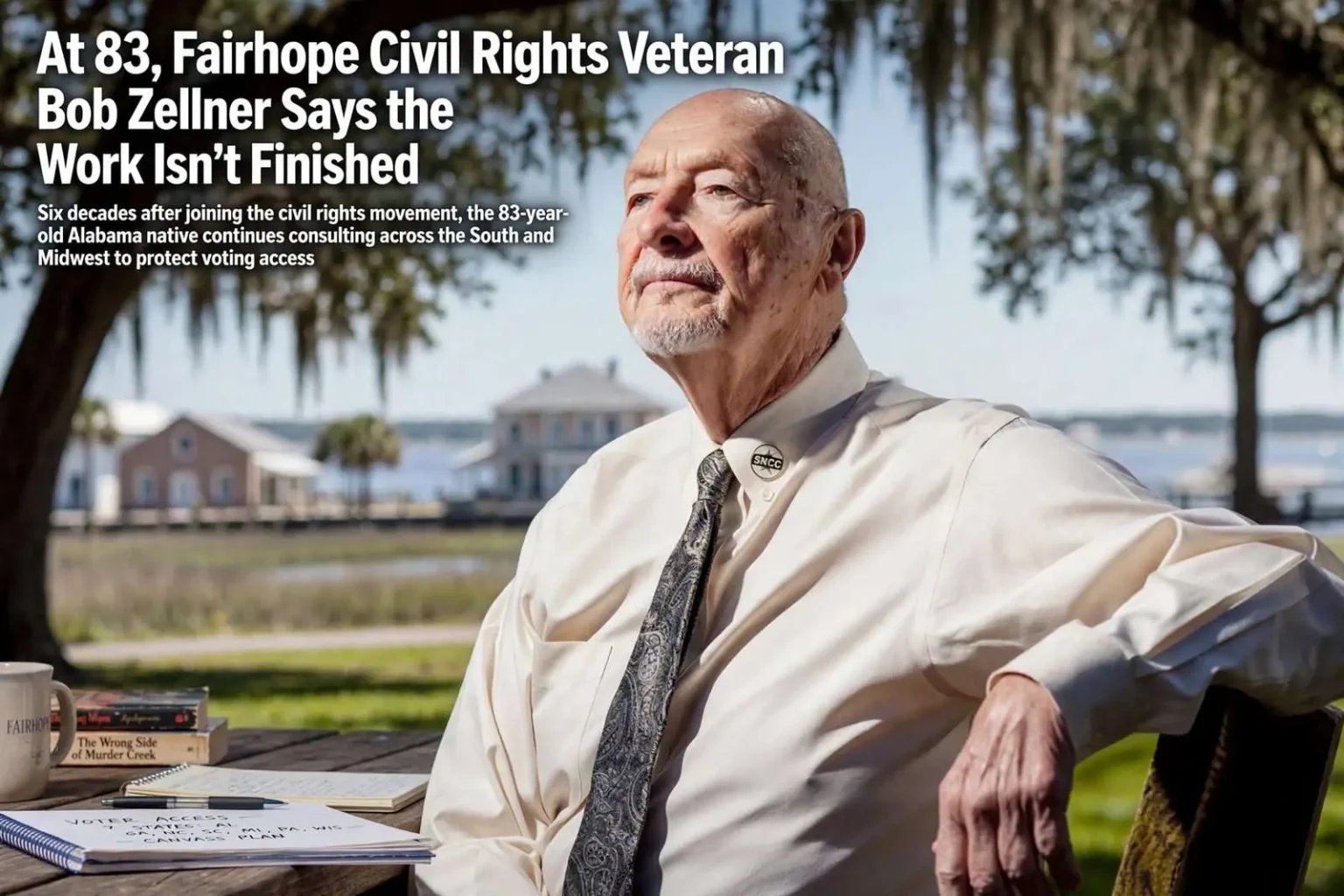
Six decades after he became one of the few white Southerners to join the front lines of the civil rights movement, Bob Zellner is still working full time — and he says he has no plans to stop. The 83-year-old Alabama native, who lives in Fairhope, spends his days consulting rather than resting. “We do consulting with universities, colleges, political campaigns, and also people who are writing history, so that’s what we do full time,” Zellner said.
Zellner works alongside his wife, Pamela Smith. The pair take assignments across the country but are currently concentrated in seven states across the South and Midwest — states Zellner describes as closely divided politically. He frames the current moment as a new chapter in the civil rights struggle rather than a coda to the old one. His central concern, he says, is access to the ballot box.
“So there’s a group in our country who want to do away with voting,” Zellner said. “That means doing away with democracy, but the majority don’t want that. And we’re about the business of organizing that majority to take back its power.”
From Murphy High to the Movement
Zellner’s own history is well documented. A graduate of Murphy High School in Mobile, he was the son and nephew of Methodist ministers and grew up inside the very world the movement set out to change — a circumstance that made his eventual path all the more unlikely. As a young man he joined the Student Nonviolent Coordinating Committee, becoming one of the organization’s first white field secretaries, and spent the early 1960s organizing and demonstrating across the South at a moment when doing so could cost a person his life.
He wrote about his experience as a white Alabamian who joined the movement in his memoir “The Wrong Side of Murder Creek,” a title that captured his position as a native son who crossed the line his community drew. The film “Son of the South” was adapted from that book, bringing his story to audiences who never sat in a civics classroom where the 1960s got more than a paragraph.
Few of his contemporaries from those years remain active in public life. The students who sat in at lunch counters and marched across the Edmund Pettus Bridge are in their late seventies and eighties now, and the movement’s veterans have spent the past decade being honored with statues, museum exhibits and documentary retrospectives — tributes that often arrive as the honorees’ working days are ending. Zellner’s schedule suggests his have not ended.
He says the anxiety of the movement’s peak years feels familiar today. The tension he describes — the sense that fundamental rights are contested territory — is the same feeling veterans of the 1960s have reported returning to them in recent election cycles, as courts, legislatures and county boards across the country have redrawn the rules governing how and when Americans vote.
Ballot Access as the Modern Battleground
His focus on voting rights is not abstract. Battles over ballot access have moved to the statehouse and the county election office: identification requirements, registration deadlines, polling place consolidations, and the administrative machinery that determines whether an eligible voter’s ballot counts. Civil rights organizations have described the cumulative effect of such changes as the defining voting-rights question of the era, and the South — where much of that machinery has been rewritten — is where Zellner and his wife are concentrating their work.
The seven states they are currently working across, in Zellner’s telling, are the ones where elections are decided by narrow margins and where organized citizens can move outcomes. It is a strategy as old as the movement itself: go where the need is greatest and the stakes are clearest, and build power from the ground up.
Asked whether he has considered slowing down, Zellner offered a comparison drawn from an older era. “I’ve tried to actually stop, but you can’t,” he said. “We’re like the old horses that used to pull the fire engine — when the bell rings you charge out of the stable and go to where the fire is.” By his account, there is no shortage of fires left to answer.
The Fairhope Years
That Zellner makes his home in Fairhope closes a circle of sorts. The Eastern Shore town has long been a haven for writers, artists and independents — a place founded by a group of reformers who came south in the 1890s betting they could build something fairer than what they left behind. The Single Tax Colony’s idealism has faded from its charter, but the town’s identity as a place apart has never quite left it, and it has drawn its share of people who spent their lives on losing causes that eventually won.
For Fairhope and the wider Mobile area, Zellner is a living connection to a history the region has often struggled to tell. Alabama’s civil rights story is usually told through Montgomery, Birmingham and Selma, but the coast contributed its own figures — students who left Mobile for the organizing fields, ministers who sheltered them, and a Murphy High School graduate who became one of the few white Southerners willing to stand where standing was most dangerous.
At 83, Zellner’s consulting calendar puts him on college campuses and in political offices where most of the people in the room were born after the movement he joined. That is precisely the work, he says: carrying the memory forward not as a museum piece but as a working education, for a generation now facing its own version of the question he answered six decades ago — what part will you play? His answer took a lifetime. He is still giving it.
The arc of Zellner’s life runs through the movement’s defining chapters. As a student in Montgomery in the late 1950s, he encountered the nonviolent teachings that were reshaping the struggle, and his decision to join SNCC — the Student Nonviolent Coordinating Committee — placed him among the organizers who registered voters and built movement infrastructure in some of the most hostile territory in America. He was arrested repeatedly, beaten, and chased out of more than one town, experiences he has recounted in classrooms and documentaries for decades without ornamentation.
The memoir that carries that story, “The Wrong Side of Murder Creek,” takes its name from the waterway that runs through the heart of Alabama’s Black Belt, and from Zellner’s sense that he had grown up on the wrong side of history and crossed over. The book became a staple on Southern history syllabi, and its film adaptation, “Son of the South,” introduced his student years to a national movie audience — a rare case of a movement veteran living to see his younger self on screen.
The consulting work he and Pamela Smith do now operates in that same tradition of education. When universities bring him in, the subject is often how ordinary students became foot soldiers — the mechanics of organizing, the discipline of nonviolence, the difference between sympathy and commitment. When political campaigns seek him out, the subject is closer to strategy: how to talk to communities that feel unseen, and how turnout is built person by person rather than purchased by advertising.
His warning about voting — that a country can lose its democracy through the slow accumulation of small barriers, not only through dramatic ruptures — echoes the testimony of his era. In the 1960s the barriers were poll taxes, literacy tests and violence; the movement’s answer was to make the denial of the vote visible and unbearable. The modern equivalents are subtler: registration purges, closed precincts, confusing rules. But Zellner’s framework for responding is the same one SNCC used — identify the voters, organize them, and make the system answer to them.
The seven states where he and Smith concentrate their work are, by his description, places where those small barriers and narrow margins intersect — states where a shift of a few points in turnout changes control of legislatures and governorships. It is the map of the modern battleground, drawn not by the movement of the 1960s but by the arithmetic of the present one.
For now, the fire horse keeps answering the bell. Colleagues describe a schedule that would tire organizers forty years younger, split between campuses, campaign offices and the archival requests of writers reconstructing the era. Zellner has said that the movement taught him a simple durable lesson: history does not move on its own. Someone has to push it. Six decades in, he is still pushing — from Fairhope, at 83, full time.
Local readers who want to hear that story firsthand often get the chance at events across the Gulf Coast, where Zellner has been a familiar speaker at schools, churches and civic groups. Educators in the region note that few living witnesses can describe the movement from inside the Alabama communities where it was most contested, and fewer still can describe the choice to join it as a white native son. That perspective — part history, part challenge to the listener — is what he carries into every classroom and campaign office that asks.