Baldwin County Health Officials Issue New Swimming Advisory for Wolf Bay at Orange Beach
The Baldwin County Health Department has issued a swimming advisory for a section of Wolf Bay at Orange Beach Waterfront Park after two consecutive water samples came back rated poor. The advisory was issued again in September 2026 under the same conditions.
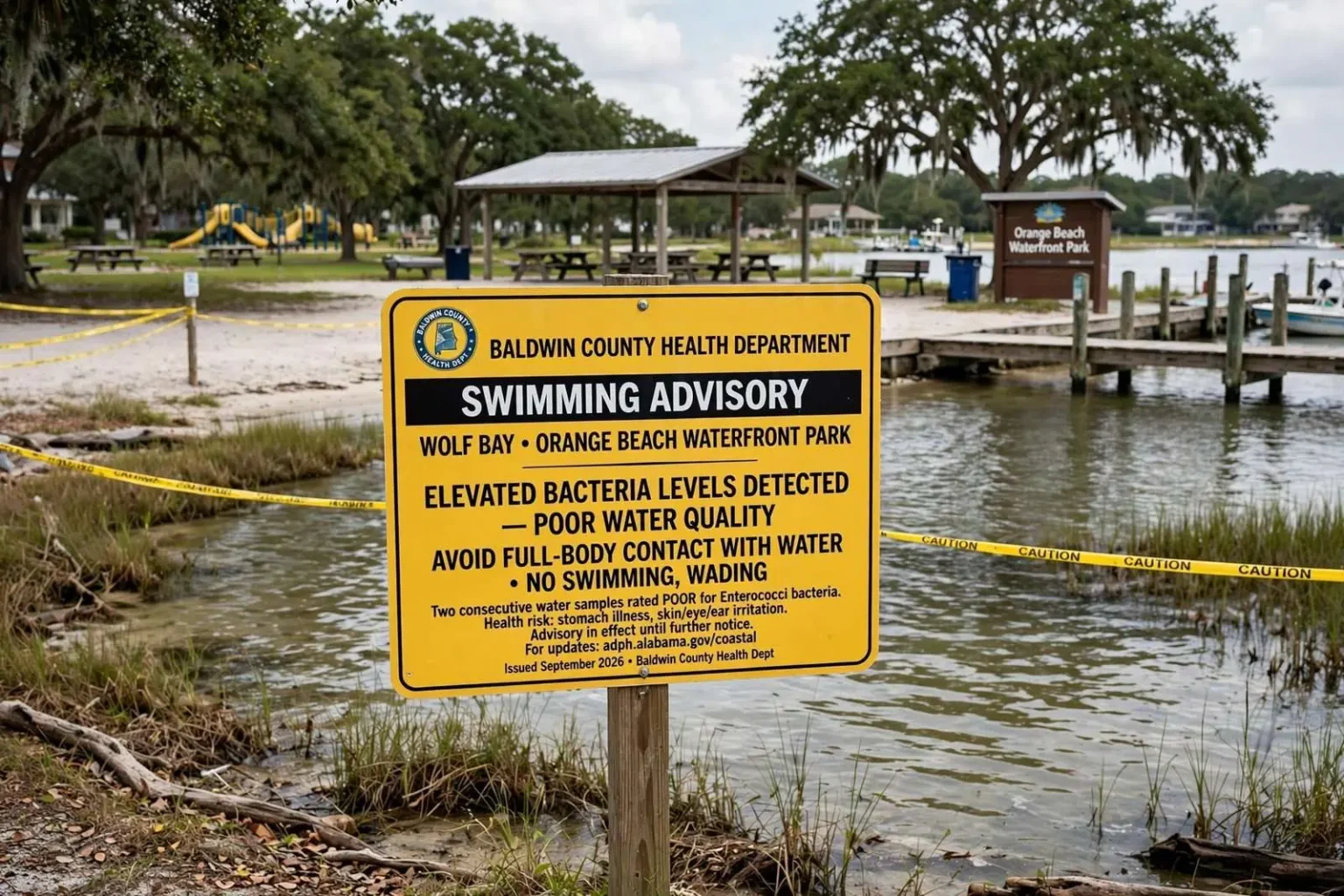
The Baldwin County Health Department has issued a swimming advisory for a section of Wolf Bay at Orange Beach Waterfront Park after water quality testing showed elevated bacteria levels. The advisory follows two consecutive water samples from the area that came back rated “poor,” according to the health department. Officials said swimming in the affected water may lead to an increased risk of illness and are urging beachgoers to avoid contact with the water until conditions improve.
Swimming advisories like this one are a routine part of the public health apparatus along Alabama’s Gulf Coast, but they still catch plenty of visitors off guard. The signs going up at a popular waterfront park can be confusing for families who arrived with coolers and beach chairs, expecting an ordinary day on the water. In practice, the advisory does not close the park or the shoreline. It is a warning from public health officials that the water itself, at least for now, does not meet the standards considered safe for full-body contact.
Orange Beach Waterfront Park sits on Wolf Bay along Canal Road, and it is one of the most heavily used public spaces in the city. The park’s sandy beach, shaded picnic areas, playground, and boat launch make it a favorite for locals and tourists alike, particularly families with small children who want calm water rather than the surf of the Gulf front beaches. Because so many people swim, wade, and paddle there, the site is part of the regular water quality monitoring network that covers public beaches and swim areas in Baldwin and Mobile counties.
That monitoring is the reason health officials knew about the problem in the first place. Water samples collected from the advisory area were analyzed for Enterococci, a group of bacteria that lives in the intestines of warm-blooded animals and serves as an indicator organism for possible fecal contamination. Enterococci themselves rarely make swimmers sick, but their presence in elevated numbers signals that other, more dangerous organisms capable of causing gastrointestinal illness, skin infections, or ear and eye infections may be in the water as well.
How the testing program works
Coastal Alabama’s swim-area testing program is a long-running partnership between the Alabama Department of Public Health and the Alabama Department of Environmental Management, with local county health departments such as Baldwin County’s carrying out the fieldwork and public notification. Samples are collected at fixed stations on a regular schedule during the swimming season, then delivered to a laboratory where technicians measure the concentration of Enterococci bacteria in the water.
Results are rated against criteria established by the U.S. Environmental Protection Agency, the federal agency whose recreational water quality standards serve as the benchmark nationwide. A sample that comes back within the acceptable range earns a “good” or “moderate” rating. A sample that exceeds the threshold is rated “poor,” which triggers a re-sample to determine whether the first reading was a fluke or part of a persistent problem. When two consecutive samples from the same station come back poor, the health department issues a public swimming advisory for that location.
The two-strike system is deliberate. Bacteria counts in coastal waters can spike for a day and fall back the next, depending on rainfall, wind, tide, and other conditions, so a single high reading is not treated as conclusive. Requiring a second consecutive poor sample before an advisory is issued helps officials avoid alarming the public over a transient blip while still moving quickly when contamination appears to be sustained. Once an advisory is in place, sampling continues, and the advisory stays up until results meet or fall below the EPA’s acceptable range.
In this case, that is exactly the sequence the Baldwin County Health Department has described: two consecutive poor samples from the Wolf Bay station, an advisory issued, and continued monitoring until conditions improve. The department has not speculated publicly about the source of the elevated bacteria, and advisories of this type typically do not come with a confirmed cause. What officials can say is what the laboratory results show and what the safe course of action is for swimmers in the meantime.
Why bacteria levels rise in coastal bays
Elevated Enterococci counts in Wolf Bay and other back bays along the Alabama coast can stem from a range of sources. Heavy rainfall is the most common driver. Stormwater washing off roads, lawns, and parking lots carries waste from pets, wildlife, and failing septic systems into the bayous and bays that fringe the coastline. Baldwin County has grown rapidly for decades, and with that growth has come more paved surface, more stormwater runoff, and more pressure on both centralized sewer infrastructure and the private septic systems that serve many neighborhoods outside municipal sewer lines.
Tides and wind also play a role in how bacteria concentrate and disperse. Wolf Bay is a shallow, largely protected estuary connected to the Gulf through Perdido Pass and to the Intracoastal Waterway, which runs just north of the park. Shallow, slowly flushing embayments can hold contaminants longer than open beaches where waves and currents refresh the water constantly. That is one reason the state’s monitoring network includes both Gulf-front stations and bay and sound stations such as the one at Orange Beach Waterfront Park: the two environments behave very differently after rain.
Wildlife contributes as well. The Wolf Bay watershed is home to large populations of birds, and roosting gulls, pelicans, and other waterfowl can add measurable bacteria to the water near piers and beaches. Boat traffic, pet waste left near the shoreline, and occasional sewage spills or line breaks round out the list of usual suspects. Without a specific investigation, health departments generally do not attribute an advisory to any single source, because the indicator test cannot distinguish between human, animal, and other origins of the bacteria it detects.
The health risks officials are warning about
The advisory language about increased risk of illness refers to well-documented effects of swimming in contaminated water. The most common complaints are gastrointestinal: swimmers who swallow water with elevated bacteria can experience stomach cramps, nausea, vomiting, and diarrhea in the days that follow. Skin rashes and infections, particularly around cuts and scrapes, are another recognized risk, along with ear and eye irritation. Children, elderly adults, pregnant women, and people with weakened immune systems are generally considered the most vulnerable groups.
Public health guidance during an advisory is straightforward. People should avoid swimming, wading, and other full-body contact with the water in the affected area. Officials also commonly advise against letting pets enter the water, since animals can ingest contaminated water and carry bacteria on their coats. Activities that keep people out of the water, such as picnicking, playground use, fishing from the shore or pier, and boating, are not affected by a swimming advisory, which applies to contact recreation rather than to the park as a whole.
Wolf Bay and the park it fronts
Wolf Bay occupies roughly 8,000 acres between Orange Beach and Elberta in southern Baldwin County, and it has long been prized for fishing, kayaking, and quiet family outings away from the busier Gulf beaches. The bay’s shoreline mixes residential neighborhoods, marsh, and maritime forest, and its waters feed into the Perdido Bay watershed to the east. For generations, the bay has been central to the identity of the eastern end of the county, from the fishing camps of an earlier era to the waterfront restaurants and neighborhoods of today.
Orange Beach Waterfront Park, where the advisory applies, gives the public access to that bay in a way few other sites do. The city developed the park as a community gathering space, and over the years it has hosted festivals, concerts, and civic events alongside the everyday use by swimmers and boaters. Its beach on Wolf Bay is one of the few spots on the back bays where families can spread a towel and let children play at the water’s edge, which is precisely why a swimming advisory there draws attention quickly.
The bay has been the subject of long-term environmental attention as well. Local organizations and researchers have studied Wolf Bay’s water quality, habitat, and shoreline changes for years, and the watershed has felt the same growth pressures as the rest of fast-developing southern Baldwin County. Stormwater from new construction, aging septic systems in unsewered areas, and the steady conversion of forest and wetland to rooftops and pavement all have the potential to influence bacteria levels in the bay’s tributaries and coves.
What happens next
Under the standard procedure, Baldwin County Health Department staff will return to the Wolf Bay station and collect additional samples. Each new result is compared against the EPA’s acceptable range, and the advisory remains in effect until the bacteria counts meet or fall below that threshold. When the numbers come back acceptable, the department lifts the advisory and updates its public notification channels, including the state health department’s coastal beach monitoring website, which lists current ratings for each monitored station along the coast.
How quickly that happens depends on conditions in the bay. Advisories tied to a rain-driven runoff event often clear within days once the water flushes and sampling confirms the drop. Advisories tied to a persistent source, such as a leaking sewer line or a chronic runoff problem, can last longer until the underlying issue is found and fixed. Because the indicator bacteria are measured directly from the water rather than modeled, the advisory’s end is determined by laboratory results, not by a set schedule.
For residents and visitors planning a trip to the area, the practical advice is to check the current advisory status before heading into the water. The Alabama Department of Public Health posts swimming advisory information for monitored coastal stations, and local news outlets in Baldwin County routinely report when advisories are issued and lifted. Conditions can differ from one bay or pass to another, so a station rated poor at Waterfront Park does not automatically mean the Gulf-front beaches or other boat launches are affected.
The advisory also serves as a reminder of the broader system working behind the scenes at Alabama’s beaches. Every summer, technicians fan out across Baldwin and Mobile counties to collect samples from Gulf Shores to Dauphin Island, generating the ratings that appear on beach information signs and websites. The program has operated for more than two decades and is credited with giving the public timely warnings during spills, heavy runoff events, and other episodes when water quality degrades temporarily.
The larger picture for Baldwin County waterways
Wolf Bay is one of several Baldwin County waterways that periodically post elevated bacteria readings, and each advisory renews a familiar community conversation about growth and infrastructure. The county’s population has expanded enormously over the past three decades, stretching municipal sewer systems and leaving many rural households reliant on septic tanks of varying age and condition. Local governments, watershed groups, and state agencies have responded with septic repair programs, stormwater improvements, and watershed management planning aimed at reducing the bacteria and nutrient loads reaching the bays.
Groups focused on the Wolf Bay watershed have worked with volunteers to monitor tributaries, plant shoreline buffers, and educate residents about pet waste, septic maintenance, and construction runoff. Those efforts do not make headlines the way a swimming advisory does, but they address the same problem from the upstream end. Public health officials note that the monitoring program and the advisories it generates are a diagnostic tool, and that long-term improvement in ratings depends on reducing what washes into the bay in the first place.
In the meantime, the guidance from the Baldwin County Health Department remains simple: stay out of the water at the affected section of Orange Beach Waterfront Park until further notice, and watch for the announcement that the advisory has been lifted. The department has committed to continuing its testing at the site and to notifying the public as soon as the bacteria levels meet the EPA’s acceptable standard. Until then, the rest of the park remains open, and the warning applies specifically to anyone tempted to take a dip in Wolf Bay.
Update, September 2026: Advisory Issued Again for Wolf Bay at Orange Beach Waterfront Park
The Alabama Department of Public Health has again issued a swimming advisory for the waters of Wolf Bay at Orange Beach Waterfront Park, according to a Baldwin County Health Department news release.
As with the earlier advisory, the trigger was two consecutive swimming water quality tests that came back rated poor. “Swimming in this area may lead to an increased risk of illness,” the release said.
Officials said the waters will continue to be monitored and that another release will be issued once the water is safe for swimming again. Residents and visitors looking for current conditions can find additional information on the Alabama Department of Environmental Management website.
The pattern is a familiar one along the Gulf Coast: a swimming advisory is not a closure, and it does not extend beyond the specific stretch of water named in the notice. It signals that bacteria levels measured in that location have exceeded the threshold health officials use to judge contact recreation safe, and it stays in place until testing shows the water has recovered.