Federal Judge Lets Baldwin County Man’s Immigration Enforcement Lawsuit Proceed to Discovery
Chief U.S. District Judge Jeffrey Beaverstock denied the government's motion to dismiss Administrative Procedure Act claims, clearing the way for depositions and document production in Leo Garcia Venegas' Fourth Amendment case.
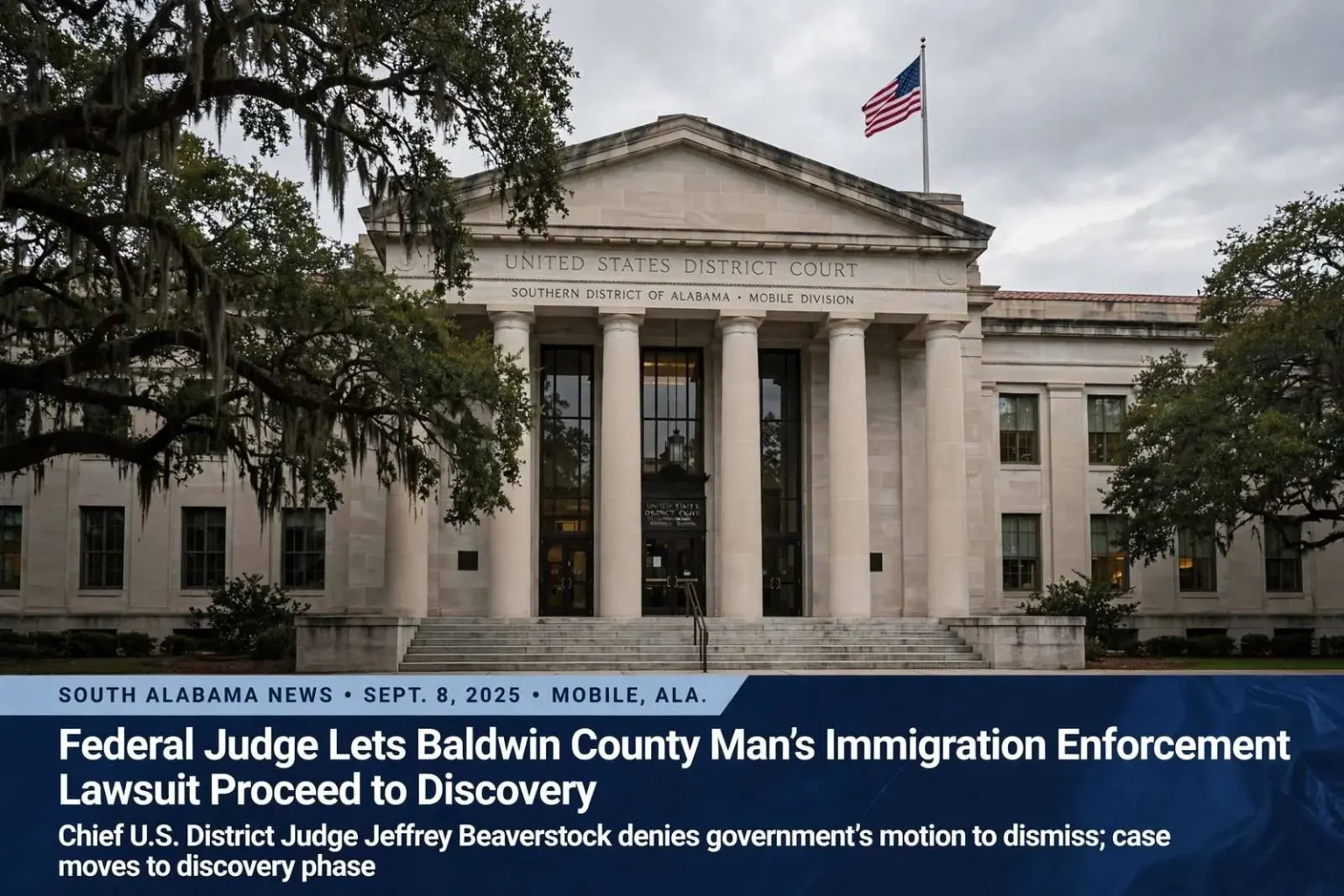
MOBILE, Ala. — A Baldwin County man’s federal lawsuit challenging immigration enforcement cleared an important procedural hurdle Wednesday when a federal judge declined to dismiss it.
Chief U.S. District Judge Jeffrey Beaverstock denied the government’s bid to dismiss claims brought against the Department of Homeland Security under the Administrative Procedure Act, ruling from the bench that those claims can continue.
What the Ruling Unlocks
The decision allows the case to move into the discovery phase, where attorneys for plaintiff Leo Garcia Venegas will be able to obtain emails and documents from the government and question federal agents under oath.
Jared McClain, a senior attorney with the Virginia-based Institute for Justice, said that process is what his team needs to build its case.
“We’re excited that the case is moving forward,” he said. “We can now get to discovery, and as the judge said in there, we can start taking depositions, get some documents from the government and show that these policies exist, just like we’ve alleged in our complaint, and as Leo’s experience and the experience of other construction workers in this region have shown.”
The Plaintiff and the Allegations
Venegas is an American citizen. He claims that federal agents twice unlawfully detained him during raids at construction sites where he was working.
His lawsuit seeks a preliminary injunction prohibiting the government from enforcing three policies he contends violate his and others’ Fourth Amendment rights.
The suit alleges that the government’s policies instruct agents to enter private construction sites without warrants, and instruct agents to detain workers without a “particularized suspicion” involving a specific person or persons.
Particularized suspicion is the constitutional standard at the center of the dispute. Fourth Amendment doctrine generally requires that a detention be based on facts about the individual detained rather than on the person’s presence at a location or membership in a group.
The Government’s Position
Assistant U.S. Attorney Sam Ladd, representing the government, reiterated his contention that the policies described in the lawsuit do not exist.
He told Beaverstock that the plaintiffs cannot point to any evidence that any of the federal agencies involved in immigration enforcement instruct their agents to do what the lawsuit alleges.
“There’s not a press release,” Ladd said. “There’s not a publication from the agency.”
The Chicken-and-Egg Problem
McClain countered that discovery is precisely how such policies would be documented — that the absence of a public announcement proves nothing about whether internal direction exists.
He argued that the repeated practices of agents strongly suggest they are following top-down rules rather than acting independently.
“There was a hierarchy. … Everyone seems to be carrying out the same policy,” he said.
That argument goes to a recurring structural difficulty in cases challenging government practice: a plaintiff generally cannot prove an internal policy exists without access to internal records, but must survive a motion to dismiss before obtaining that access. Wednesday’s ruling resolves that sequencing question in Venegas’ favor for the APA claims.
The Judge’s Observation
Beaverstock noted from the bench that immigration enforcement activity appears to have changed in recent months, and suggested that shift is itself indicative of a policy.
“I watch the news, and I don’t feel like there’s been the same activity that was clearly present,” he said.
Two Questions Left Open
Beaverstock withheld ruling on two other issues.
The first is the plaintiffs’ request to certify the matter as a class action, which would allow others to share in any monetary award. Ladd argued that the potential members of the class are too “amorphous” to define. The judge said he wants to wait for facts to emerge from discovery before ruling on certification.
The second is the request for a preliminary injunction barring agents from the conduct the lawsuit describes. Ladd argued that an injunction would be an “extraordinary remedy” that would be difficult to comply with in practice.
Beaverstock raised the possibility of issuing a stay instead of an injunction, and asked the attorneys about the practical differences between the two. McClain told the court that violations of an injunction are easier to enforce than violations of a stay — a distinction that matters because an injunction carries contempt consequences that a stay does not carry in the same form.
The Class-Action Fight Ahead
McClain said he is confident he will ultimately be able to proceed on behalf of more than just Venegas.
“The government’s been making the same argument for 50 years that when it violates people’s Fourth Amendment rights, you can’t deal with it on a class-wide basis, and courts have been rejecting that argument for over 50 years,” he said.
What Comes Next
With the motion to dismiss denied as to the APA claims, the parties move into discovery. That phase will determine whether the documentary record supports the existence of the policies the lawsuit alleges — the question on which the class-certification and injunction rulings were expressly deferred.
South Alabama News will report further rulings as the case proceeds in the U.S. District Court for the Southern District of Alabama.
Update: Discovery Begins, and Two Major Motions Remain Undecided
With U.S. District Judge Jeffrey Beaverstock’s denial of the government’s motion to dismiss, the case brought by Baldwin County resident Leonardo Garcia Venegas is now moving into the exchange of evidence — and, according to his lawyers, moving slowly.
“We had our discovery conference with opposing counsel, and we’re waiting on them to get us edits on our proposed schedule,” said Jared McClain, an attorney with the Virginia-based Institute for Justice who represents Venegas. “Once that gets going, we’ll get to do requests for documents and take depositions and stuff, and they’ll be able to depose Leo and ask for any documents he has, whether it’s like employment contract stuff.”
McClain said a trial is unlikely to arrive quickly. “I’d be surprised if the trial is before 2028,” he said.
Two Questions Still on the Table
McClain said Beaverstock left two significant matters undecided at the end of the Sept. 2 hearing.
The first is a motion to enjoin Immigration and Customs Enforcement from conducting certain raids on construction sites across southern Alabama. That motion has been pending since May, when both sides argued over whether such a pause should be imposed.
The second is a motion to certify the litigation as a class action — a ruling that would determine whether the case remains one man’s Fourth Amendment claim or becomes a vehicle for a broader group of workers subjected to the same enforcement practices.
As of Tuesday, Sept. 8, Beaverstock had not filed a written order on the dismissal motion or the Sept. 2 hearing.
The Procedural History
The dismissal motion denied this month was the second such bid rejected since litigation began in September 2025; an earlier motion arguing Venegas lacked standing to sue was also denied.
Venegas sued the federal government in September 2025 after being detained twice. He alleges officers violated his Fourth Amendment rights by detaining him and refusing to accept his government-issued identification before releasing him, and that the raids were conducted in a discriminatory manner through the selection of construction sites. He has further alleged the operations were carried out under ICE policies adopted in 2025 directing agents to arrest as many people without lawful immigration status as possible.
The federal government maintains that Venegas’s rights were not violated, that agents acted lawfully in the Baldwin County operations, that he lacked standing to sue, and that a second raid he says occurred in June never happened.
The Regional Backdrop
At the time the suit was filed, Baldwin and Mobile counties were reported hot spots for immigration enforcement activity, with the construction industry specifically targeted, according to developers and workers. By September 2025, coastal Alabama had seen the largest number of such raids of any region of the state and the highest number of arrests stemming from them.
At a May hearing, P.J. Lavoie, the Department of Homeland Security Mobile office’s resident agent in charge, testified that enforcement activity in coastal Alabama was at or above the level reported in 2025.
More on the Plaintiff, His Lawyers and What the Government Told the Court
The Baldwin County man at the center of the case is Leo Garcia Venegas, a U.S. citizen who says he was detained three times by federal immigration officers despite carrying a REAL ID. He is represented by the Institute for Justice, a national public-interest law firm.
“The court’s decision was an important first step,” said IJ Senior Attorney Jared McClain. “We know the Department of Homeland Security thinks it can raid construction sites without a warrant, round up all the workers, and refuse to credit their government-issued IDs. Now we’ll have the chance to prove these violations of the Fourth Amendment.”
Three Detentions
According to the filings, immigration authorities detained Venegas at two different construction sites in May and June of 2025. On both occasions, officers declined to accept that he was a citizen or to recognize his REAL ID as proof of legal status. Earlier this year, officers followed him home and confronted him in his own driveway. His attorneys say that even as he was attempting to show his REAL ID, he was pulled from his car, tackled to the ground, handcuffed, shackled and placed in the back of a vehicle.
“Americans cannot be stopped and held by law enforcement when they are doing nothing wrong,” Venegas said. “I’m glad my case is moving forward, and I hope it can make lasting change.”
The REAL ID Question
At a May hearing on the motion for a preliminary injunction, a DHS official testified that agents do not treat REAL ID as reliable proof of legal presence. That testimony sits awkwardly beside the department’s own role: DHS certifies and administers the REAL ID Act, and then-Secretary Kristi Noem spent considerable time last year urging the public to obtain REAL ID credentials.
The ‘Open Fields’ Theory
DHS also testified that agents treat construction sites as “open fields” that they may enter without a warrant or particular reason. Venegas’s attorneys argue that his second detention — which occurred inside a mostly-constructed home — illustrates how far that theory reaches in practice.
What Is Still Pending
The court has not yet ruled on Venegas’s request for a temporary injunction against the raids and detentions. His attorneys have emphasized that the government has not disavowed using similar tactics elsewhere in Alabama.