Bentley Reshapes Mobile County’s Board of Equalization
Gov. Robert Bentley cleaned house at the Mobile County Board of Equalization, installing three new appointees, among them a veteran Democrat, to replace members named by his predecessor.
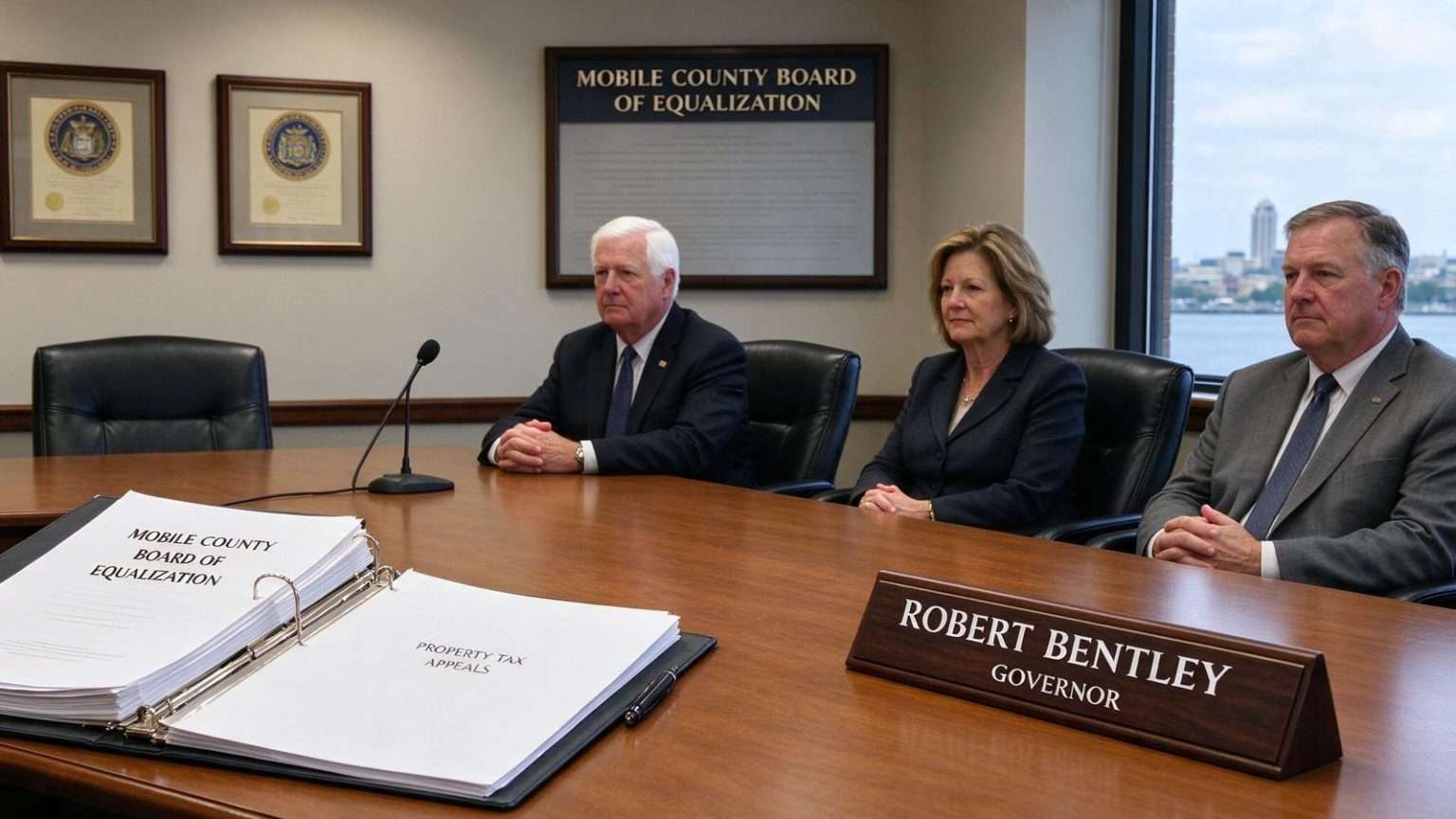
Gov. Robert Bentley cleaned house at the Mobile County Board of Equalization, installing three new appointees to replace members named by his predecessor, and in doing so displayed once again his willingness to defy conventional political expectations. The board, which reviews property values in the county, forms part of the machinery that underlies local property taxation, and its membership carries quiet but real consequences for how assessments are handled in Alabama’s second-largest county.
Boards of equalization occupy an unusual corner of Alabama’s tax structure. Every county in the state maintains a body charged with reviewing the valuations placed on real estate by the county revenue commission, and each board hears appeals from property owners who believe their homes, businesses or land have been valued incorrectly. The decisions made in those hearings help determine the base on which local property taxes are levied — revenue that in turn supports schools, county government and municipal services across Mobile County. The work is technical, largely administrative and rarely discussed outside the hearing room, which is precisely why changes to board membership tend to escape public attention even though they touch nearly every property owner in the jurisdiction.
That is what made the governor’s moves at the Mobile County board worth noting. When a new administration takes office in Montgomery, thousands of appointments across state boards, commissions and county-level bodies eventually come up for renewal or replacement, and each governor arrives with his own network of allies, supporters and advisors to place. Bentley, a Tuscaloosa physician who had never held elective office before winning the governorship, was watched closely by Alabama political observers for how he would exercise that patronage power, and the Mobile County equalization board turned out to be an early illustration.
An unorthodox pick
Among Bentley’s choices was a name that raised eyebrows: venerable Democratic figure William Clark, a former state legislator and retired school administrator. His many rental properties, observers noted wryly, arguably qualified him to sit in review of property values. For a Republican governor to appoint a longtime Democrat underscored Bentley’s penchant for the unexpected, and it reflected the kind of accommodation that once characterized Alabama politics more than the rigid partisanship of later years.
Clark’s background gave him an unusual résumé for the post. His years in the Legislature familiarized him with how state law shapes local taxation, his career in school administration acquainted him with public budgets and the pressures of funding government operations, and his ownership of rental properties placed him on the paying side of property assessments himself. Whatever one’s view of the wisdom of naming a large property owner to a board that reviews property valuations, the appointment was a reminder that Alabama’s boards have historically drawn from a small pool of residents with experience in law, government or business — and that the pool of people willing to take on a low-paying, time-consuming public role is correspondingly limited.
The cross-party nature of the pick also carried symbolic weight in Mobile County, a jurisdiction where Democratic politics remained a durable presence in city government even as the state swung decisively Republican. A governor willing to reach across the aisle for a qualified candidate signaled that, at least at the level of a part-time review board, governing experience and local standing mattered more than a party card.
The rest of the slate
The governor’s other appointees were former state Rep. Ken Kvalheim and Tommy Tyrrell, the latter of whom had also recently been appointed to the Board of Water and Sewer Commissioners of the city of Mobile. Tyrrell’s dual service illustrated how a relatively small circle of engaged residents often recurs across multiple boards in Mobile, lending institutional memory from one body to the next. The water and sewer commission oversees utility matters for the city, while the equalization board deals with property valuation questions, and the overlap gave Tyrrell a working knowledge of two distinct sides of local government finance at the same time.
The part-time equalization board position paid about $12,000 a year — a figure that explains much about the character of the job. No one serves on a county board of equalization for the salary. The pay is a modest stipend for what can be a demanding calendar of hearing days during the property tax appeal season, when Mobile County homeowners and commercial property owners exercise their statutory right to contest assessments. Members are expected to listen to evidence about property conditions, comparable sales and valuation methods, and to apply state law fairly to each case that comes before them.
Out with the old
The new appointments displaced members named by former Gov. Bob Riley. Those leaving the board included former state legislator Jeannette Greene, real estate businessman Ruffin Graham and former county revenue commission official Doug Sanders. All three brought experience to the seats they were vacating — Greene from legislative service, Graham from a career in the local real estate market and Sanders from his years inside the county’s own revenue apparatus — and their departures removed that accumulated familiarity with Mobile County’s assessment practices.
The turnover reflected the way a change in the governor’s office can reshape appointed boards down to the county level, as a new administration installs its own choices in positions that had been filled under a predecessor. Riley had named these members during his two terms in office; once Bentley took over, seats held at the pleasure of the governor became available for his own slate. Similar waves of replacement rolled through boards, commissions and authorities across Alabama in the early months of any new administration, touching everything from hospital authorities to industrial development boards. The equalization board was simply one example of the pattern, notable here because of the prominence of some of the people involved and because of the unorthodox cross-party appointment at the center of the new slate.
For the departing members, the change was a routine consequence of political transition rather than a judgment on their service. For the incoming members, it was an opportunity to shape how one of the county’s least visible but most consequential review processes would operate in the years ahead.
How the picks are made
The process behind the appointments ran through several hands. Various municipalities throughout Mobile County recommend prospects for the equalization board to the state revenue commissioner, a post then held by Julie Magee of Mobile County. The commissioner, in turn, forwarded her selections to the governor for appointment. That layered process gave local governments a role in suggesting candidates while leaving the final decision with the state, a structure that balanced local input against gubernatorial authority.
The county’s sheer size gives that municipal input real meaning. Mobile County encompasses the city of Mobile, Prichard, Chickasaw, Saraland, Satsuma, Creola, Mount Vernon, Bayou La Batre and Dauphin Island, along with large stretches of unincorporated communities such as Tillman’s Corner and West Mobile. Property owners in each of those places have a stake in how valuation appeals are handled, and the municipal recommendations help ensure the board’s eventual members are not drawn exclusively from one part of the county or familiar only with one slice of its real estate market. A board member acquainted with waterfront property on the Causeway approaches an appeal differently than one who knows the older neighborhoods of Prichard or the newer subdivisions along Schillinger Road.
The route through the state revenue commissioner also tied the county board into the wider state apparatus that oversees Alabama’s property tax system. That office administers the rules under which county revenue commissions assess property and county boards of equalization review those assessments, so a commissioner’s screening of candidates served as a check on qualifications before names ever reached the governor’s desk. The arrangement meant Bentley’s choices, though his own, arrived pre-filtered through both municipal suggestion and departmental review.
Quiet work, real stakes
Boards of equalization rarely command public attention, yet their work touches property owners directly. By reviewing valuations, the board influences the base on which property taxes are levied, making its composition a matter of consequence even if it seldom makes headlines. For an individual homeowner, a board’s fairness can mean the difference between an assessment that reflects a modest residence and one that inflates a tax bill; for commercial owners with large holdings, the amounts at stake in a single appeal can be substantial enough to justify professional representation.
Bentley’s reshaping of the Mobile County board, and particularly his cross-party appointment of Clark, offered a small but telling example of how the governor approached the many appointments that fell to his office. It showed a willingness to look beyond the usual roster of party loyalists for candidates with local standing and practical experience, even when the choice invited a second look. For Mobile County, the changeover installed a new slate to carry out a function that, however low-profile, remained a fixture of local government — the body to which every property owner in the county could turn when a valuation did not seem right.
As the new members took their seats, the expectation was that the board would continue its work much as before: hearing appeals, weighing evidence and applying state law to the thousands of parcels that make up Mobile County’s property tax rolls. The names had changed; the quiet but consequential job remained the same.