
Bentley Reshuffles Mobile County Board of Equalization, Names a Democrat
Gov. Robert Bentley cleaned house on the Mobile County Board of Equalization, replacing three Riley-era appointees and, in a bipartisan twist, naming veteran Democrat William Clark to the property-review panel.
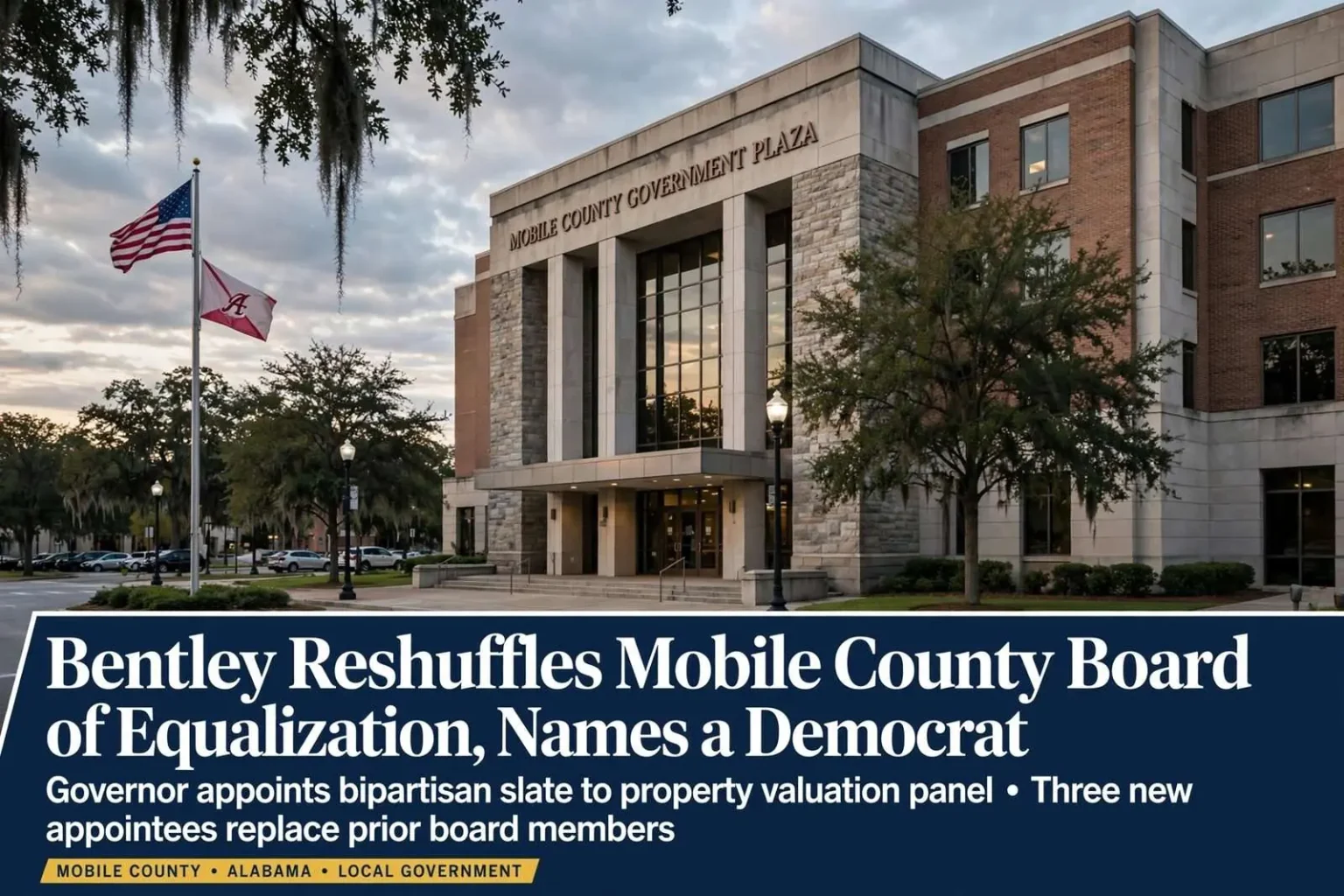
Gov. Robert Bentley moved to remake the panel that reviews property values in Mobile County, replacing three appointees of his Republican predecessor, Bob Riley, with a slate that included a surprise choice from across the aisle. The governor’s appointments to the Mobile County Board of Equalization drew immediate attention in local political circles, both because of the caliber of the members leaving the panel and because of the bipartisan flavor of the group coming on. Appointments to obscure-sounding boards rarely make news, but in a county where property valuations touch every homeowner, landlord and business, the composition of this particular panel carries consequences that reach well beyond the Statehouse.
A bipartisan pick
The most talked-about of the governor’s appointments was William Clark, a former Democratic state legislator and retired school administrator. Clark, a party stalwart whose extensive rental holdings gave him a working familiarity with real estate, was an unorthodox choice for a Republican governor. His selection signaled that Bentley, still early in his term, was willing to look past party registration when filling positions that reward practical experience. Clark’s years in the Legislature gave him a grasp of how state and local tax policy fit together, while his background as a property owner on a significant scale spoke directly to the kind of disputes the board weighs.
Bentley’s two other selections were former state Rep. Ken Kvalheim and Tommy Tyrrell, the latter also recently appointed to the Board of Water and Sewer Commissioners of the city of Mobile. Tyrrell’s dual appointments placed him in two corners of local government at once, a relatively uncommon arrangement that underscored how quickly the new administration was moving to put its own stamp on Mobile County’s appointed boards. Kvalheim’s legislative service, like Clark’s, brought experience with the lawmaking side of the tax questions the board regularly encounters.
The part-time board seats pay roughly $12,000 a year. The modest pay belies the weight of the work: members sit in judgment of contested valuations that determine how much property tax a household or enterprise owes in one of Alabama’s largest counties. Members are expected to bring patience, attention to detail and a working knowledge of real estate to hearings that can be dry but are rarely trivial to the people involved.
Three departures
Leaving the panel were three Riley appointees: former state legislator Jeanette Greene, real estate businessman Ruffin Graham and former county Revenue Commission official Doug Sanders. Each had carried experience suited to the board’s mission, and Sanders in particular brought inside knowledge of the appraisal apparatus whose conclusions the board reviews. The turnover of the full slate marked one of the more sweeping early personnel moves Bentley made on an appointed board in the county.
Transitions like this are a routine feature of a change in governors. Alabama’s chief executive fills a long list of board and commission seats, and a new administration typically installs its own choices as terms allow. What made this round notable was less the housecleaning itself than the identity of one of the incoming members — a registered Democrat — and the message that choice sent in a county where Republican dominance has grown year after year.
How the seats are filled
Under the process, municipalities across Mobile County recommend prospects to the state revenue commissioner — at the time Julie Magee of Mobile County — who forwarded her picks to the governor. That structure gives city halls a voice in the composition of the board while reserving final authority for the state’s chief executive. For the municipalities, the recommendations are a chance to elevate residents with real estate or public-service backgrounds; for the governor, the pipeline provides a vetted list from which to choose.
Party loyalty in the background
The appointments landed against a backdrop of recurring friction within the local Republican Party, which had been tested repeatedly on questions of loyalty and ideological purity. Officials pointed to episodes ranging from Jeff Glidewell’s judicial campaign years earlier to more recent legislative contests in south Mobile County involving Scott Buzbee and David Sessions, as well as executive committee members who had backed Constitution Party nominee Bill Atkinson over Sessions in the special House District 105 election. Each episode fed an ongoing debate inside the party over where the line between healthy competition and disloyalty should sit.
Although the Mobile County Republican Executive Committee had weighed disciplining members Mike Burdine and Lee James for straying, the committee was not expected to take punitive action. Still, there were rumblings that the party would move to “inform” voters of what some described as “RINO-like” conduct by candidates in the coming primaries. The label — shorthand for “Republican in name only” — has long been a weapon in intra-party fights, and its circulation in Mobile County reflected the broader national tension between party organizations intent on discipline and voters willing to split their support.
MCREC Chairwoman Terry Lathan struck a conciliatory tone about Bentley tapping a Democrat for the local board. “I have not heard any information on the decision, but I do know the governor served with Rep. Clark and is probably showing a bipartisanship appointment for our county,” she said. “I also know that Ken and Tommy are great conservatives, as are Jeanette and Doug. A new governor gets to place people in appointed positions at his choice. It’s very common.”
Lathan’s framing captured the practical view many party figures took: a governor’s appointment power is his own, and the men and women displaced by the move were themselves respected conservatives. Her comments also highlighted the personal relationships that undergird county-level politics — Bentley had served alongside Clark in the Legislature, and that history gave the pick a veneer of personal trust rather than ideological calculation.
What the board does
The Board of Equalization occupies a quiet but consequential role in county government, hearing challenges to property assessments and helping ensure that valuations are applied fairly. For property owners who believed their assessments were out of line, the board offered a first avenue of appeal — making the makeup of the panel a matter of more than passing interest to homeowners and businesses alike.
Alabama’s property tax system is built on a chain of institutions. Local revenue commissions appraise property and set valuations; boards of equalization hear taxpayer objections and corrections; and the combined millage rates approved by the state, county and municipal and school authorities determine the final bill. Residential owner-occupied property is assessed at a fraction of appraised value under state law, a structure that keeps Alabama’s effective property taxes among the lowest in the nation. When a homeowner disputes the value assigned to a house, the board is where the dispute gets a full airing.
A well-functioning board matters to the county’s finances as well. Fair, consistent valuations protect the tax base that funds schools, roads and public safety, while an approach perceived as arbitrary erodes taxpayer confidence. Members who understand both the appraisal process and the realities of the local real estate market — rental holdings, commercial development, land values along the Eastern Shore and in west Mobile — are better positioned to sort legitimate grievances from wishful thinking.
Why it matters to Mobile County property owners
For the average homeowner, the board’s work becomes tangible once a year. When notices of assessed value go out, owners who disagree with the county’s figure can file an appeal, present evidence about comparable sales or condition of the property, and make their case to the board. The panel can sustain, lower or adjust valuations, and its decisions shape both the individual tax bill and, cumulatively, the fairness of the entire tax roll.
The board’s decisions ripple outward to landlords and commercial operators as well. In a county with an unusually large share of rental housing, as Clark’s own portfolio illustrated, assessment outcomes affect the cost structure behind rents and the climate for investment. Business owners watching industrial and retail development along the I-10 corridor have a direct stake in whether the appeals process is viewed as even-handed.
Homestead exemptions add another layer that residents should understand in connection with the board’s work. Owner-occupied homes qualify for exemptions that reduce taxable value, and seniors and disabled residents may qualify for additional relief under state law. The appeals board and the exemption system together form the safety valves that keep the state’s famously low property taxes manageable for households on fixed incomes.
A governor’s early pattern
Observers noted that the reshuffle reflected Bentley’s willingness, still early in his term, to make appointments that did not always follow strict party lines, even as local Republican leaders continued to grapple with the steady migration of longtime Democrats into GOP ranks. That migration has been one of the defining political stories of south Alabama over the past two decades, as conservative Democrats — particularly in rural and suburban areas — shifted their registration and their candidacies to the Republican side.
Against that trend, adding a Democrat to a county board was a small but symbolic counterpoint. It suggested an administration more interested in competence and relationships than in partisan bookkeeping. It also reflected the governor’s own history: Bentley had spent years in the Tuscaloosa-area Legislature before winning the state’s top office, and he drew on personal acquaintance as often as on party credentials when filling posts.
For residents, the practical takeaway is straightforward. The people who hear property appeals are named by a process that begins in city halls and ends at the governor’s desk, and each election cycle renews the power to reshape that bench. Property owners who want a voice in how assessments are judged have a stake not only in paying attention to the board’s hearings, but in the municipal recommendations and gubernatorial choices that determine who sits there.
The new slate inherits a workload that never truly pauses. Valuations rise and fall with the market, exemptions change with the law, and every reassessment cycle generates a fresh crop of disputes. Whether the reconstituted Board of Equalization earns a reputation for fairness will depend on the same qualities its members brought to their other careers — Clark’s experience with property and public schools, Kvalheim’s and Tyrrell’s legislative and civic service, and the institutional memory of an appraisal community that continues on beneath the appointments.
