
Bishop State Offers Students Up to $1,467 in CARES Act Tuition Grants
Bishop State Community College offers degree-seeking students up to $1,467 in CARES Act emergency relief for Fall 2021 tuition and fees.
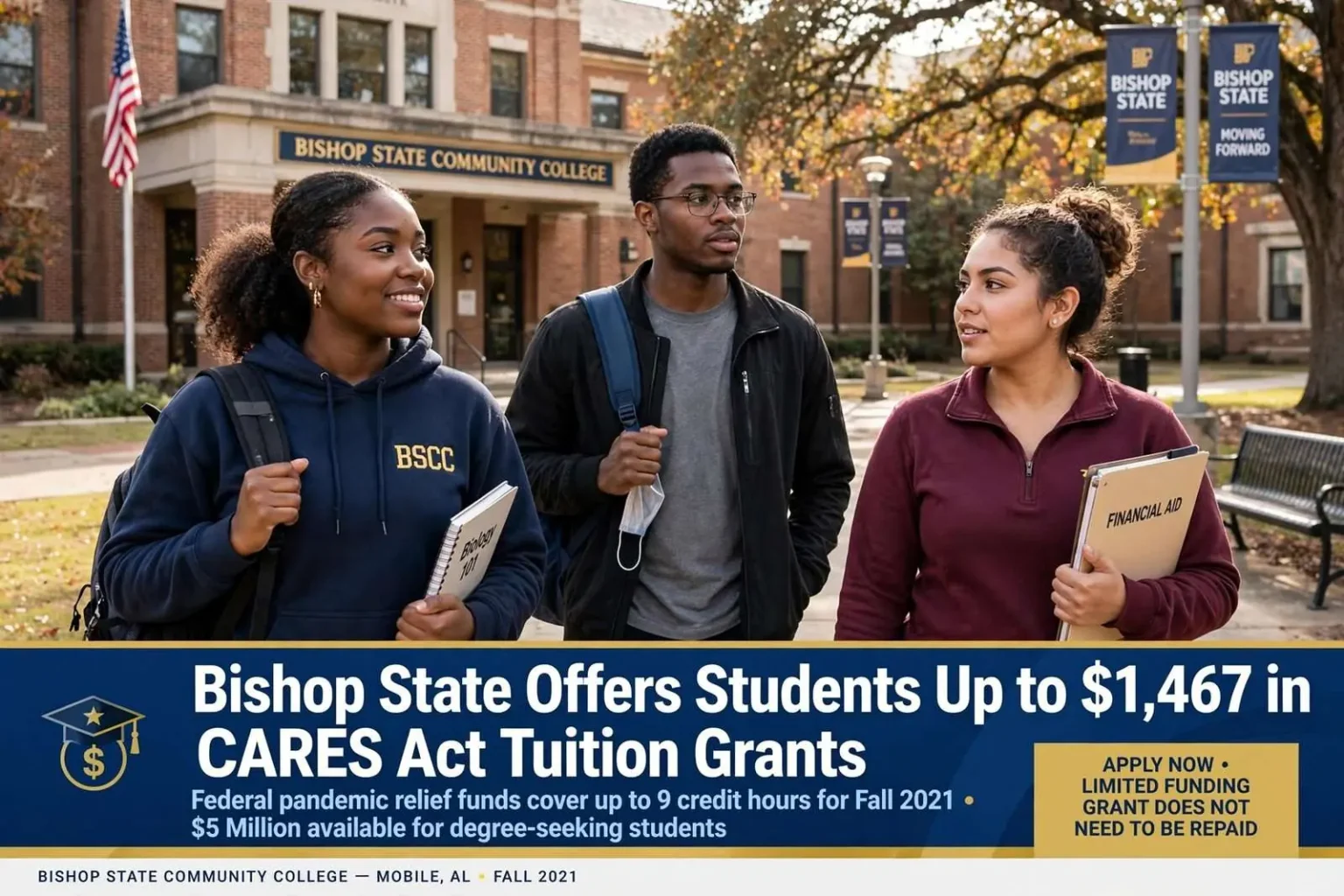
Students at Bishop State Community College could get a significant chunk of their fall tuition covered, thanks to federal pandemic relief money. The college has $5 million in CARES Act funding available to help students “get back on track with their education,” according to a news release. The money is aimed directly at students still feeling the financial fallout of the pandemic, from lost jobs to delayed enrollment, as the college works to bring enrollment back to pre-pandemic levels.
Degree-seeking students can receive up to $1,467 through the Bishop State CARES – Emergency Relief Grant for the Fall 2021 semester. The grant covers up to nine credit hours of in-state tuition and fees, a package that can knock hundreds of dollars off the cost of a semester for a part-time student and remove a major barrier for those deciding whether to return to the classroom at all.
Students pursuing degrees at the Mobile campus can apply the money directly toward their fall costs as they return to classrooms still feeling the effects of the pandemic. College officials encouraged eligible students to act quickly so the relief reaches their accounts before the fall term gets fully underway, warning that the window to claim the money is limited by federal spending deadlines.
What the Grant Covers
The $1,467 figure is tied to the cost of nine credit hours of in-state tuition and fees at Bishop State, which is enough to cover a substantial part-time course load — typically three classes — for one semester. For students carrying a heavier load, the grant can still be applied to a portion of their bill, reducing the amount they must pay out of pocket or borrow to stay enrolled. Fees bundled into a semester bill, which often catch students by surprise at registration, are covered alongside tuition up to the grant limit.
The relief is structured as a grant rather than a loan, meaning recipients do not repay it. That distinction matters for community college students, many of whom balance coursework with jobs and family responsibilities and for whom even a modest tuition balance can force a mid-semester withdrawal. Financial aid officials at community colleges across the country reported during the pandemic that direct grants of this kind were among the most effective tools for keeping students enrolled through periods of economic upheaval.
To qualify, students must be degree-seeking, which distinguishes them from students taking occasional classes for personal enrichment or job skills without pursuing a credential. The requirement reflects the federal intent behind the money: getting students on a path to a certificate or associate degree, credentials that translate into higher earnings in the Gulf Coast job market.
Where the Money Comes From
The CARES Act — the Coronavirus Aid, Relief, and Economic Security Act signed into law in March 2020 — directed billions of dollars to colleges and universities nationwide through the Higher Education Emergency Relief Fund. A share of that money was reserved specifically for emergency grants to students, allowing institutions to help students cover expenses related to the disruption of campus operations, including tuition, food, housing, course materials, technology, and child care.
Community colleges were among the biggest beneficiaries of the student-aid portion, since their enrollments skew toward lower-income students and working adults — the populations hit hardest by pandemic job losses. Alabama’s two-year college system, which includes Bishop State, channeled tens of millions of dollars in federal relief to students across the state, with each campus setting its own application process and award amounts within federal guidelines.
Bishop State’s $5 million allocation placed it among the larger recipients in the Mobile area, a reflection of both its enrollment and the financial need of its student body. The college has used federal relief funding across the pandemic not only for direct student grants but also for technology upgrades, campus health measures, and hybrid course delivery as instruction shifted between in-person and remote formats.
About Bishop State
Bishop State Community College is a public, historically black community college headquartered in downtown Mobile, with additional instructional sites serving the surrounding area. It is part of the Alabama Community College System and offers associate degrees, certificates, and workforce training in fields ranging from health care and nursing to skilled trades, business, and information technology. Many of its graduates transfer to four-year universities in Alabama, while others move directly into the region’s workforce through applied programs aligned with local employers.
The college plays a distinct role in Mobile’s educational landscape. As an open-admission institution with some of the lowest tuition rates in the region, it serves as both a starting point for recent high school graduates and a re-entry point for adults returning to school years after leaving. Its health sciences programs, in particular, feed nurses and allied health workers into Mobile’s hospitals and clinics, a pipeline that became even more visible during the pandemic when health care employers across the Gulf Coast struggled with staffing shortages.
That mix of students — recent graduates, working parents, career changers — is exactly the population pandemic relief grants were designed to reach. Administrators have noted throughout the pandemic that students who stop out for even one semester are far less likely to finish a credential, which is why direct tuition relief has been treated as a retention tool as much as a financial aid measure.
Why Fast Action Matters
College officials urged students not to wait, and the urgency has a practical basis. Federal relief funds came with spending deadlines, and grants are typically awarded until the allocation is exhausted. Students who apply late in a term can miss the money entirely, even if they are otherwise fully eligible. Applying early also gives the college’s financial aid staff time to process awards before tuition payment deadlines, preventing holds or schedule purges that can derail a semester before it starts.
Students interested in the grant were directed to the college’s financial aid office for application details and eligibility requirements. Staff there can also help students combine the CARES grant with other aid — federal Pell Grants, state scholarships, and institutional awards — to cover the full cost of attendance. For many Bishop State students, stacking those sources is the difference between attending full time and part time, or between enrolling and sitting out.
The Broader Recovery Picture
The fall 2021 semester marked a turning point for colleges nationwide as campuses returned to largely in-person instruction and worked to recover from historic enrollment losses. Community colleges were hit hardest of all higher education sectors during the pandemic, with double-digit enrollment declines reported nationally, as students confronted job losses, caregiving demands, and remote-learning hurdles. Emergency grant programs like Bishop State’s were a central part of the strategy to win those students back.
In Mobile, the stakes extend beyond campus. Bishop State’s enrollment recovery affects the local workforce, since the college trains the certified nursing assistants, welders, electricians, technicians, and paralegals that area employers depend on. Every student the grant keeps enrolled is a potential graduate entering that pipeline — which is why college leaders framed the $5 million not as a handout, but as an investment in getting students, and the region, back on track.
How Students Can Use the Money
The grant is applied to the fall 2021 bill at the Mobile campus, but its practical effect reaches further than the bursar’s statement. A student whose nine credit hours are covered can redirect whatever they would have spent on tuition toward transportation, books, child care, or reducing the hours they work during the semester — all factors that research consistently links to whether students finish the courses they start. Financial aid counselors at two-year colleges often describe grants like this one as breathing room: the difference between dropping a class in October and staying enrolled through finals.
The timing also lines up with the fall registration cycle, when students who owe balances face the greatest risk of being dropped from their classes. By covering up to nine credit hours, the grant can clear a balance at the moment it does the most damage, keeping a schedule intact rather than forcing a student to re-register later for whatever sections remain open. For students in sequenced programs such as nursing, where a missed semester can push graduation back by a full year, that protection has real value.
A Lifeline for Working Students
Bishop State’s student body includes a large share of students who work while enrolled, many in the service and hospitality jobs along the Gulf Coast that were battered by pandemic closures. Those students saw hours cut or jobs disappear entirely in 2020 and 2021, and even as businesses reopened, household finances were slow to recover. A $1,467 grant does not replace a lost income, but it removes one large, fixed expense from a tight budget during the exact semester when students are trying to re-establish momentum in school.
The college’s own framing — helping students get back on track — reflects what enrollment data showed across Alabama’s two-year colleges as the pandemic wore on: thousands of students who left in spring 2020 had not returned, and cost was frequently the reason. Direct grants aimed at tuition remove the single most cited obstacle, which is why institutions across the state built emergency relief programs with their federal allocations and marketed them aggressively at the start of each term.
For Mobile families, the program also carries a second-generation benefit. Community college students are disproportionately parents, and every semester a parent stays enrolled moves the household closer to a credential and the higher wages that follow. Local educators have long pointed to Bishop State as an accessible first step into higher education for families across Mobile County, and the federal relief money was aimed squarely at keeping that door open through the most disruptive period for higher education in generations.
Checking Eligibility
Students who are unsure whether they qualify were encouraged to contact the college directly rather than assume they are not eligible. Degree-seeking status is the central requirement, but the financial aid office can confirm eligibility, explain how the grant interacts with other aid already awarded, and identify any documentation needed to complete an application. Students already receiving Pell Grants or state aid can still receive the CARES grant, since the federal emergency money was designed to supplement — not replace — traditional financial aid.
The message from the college to its students as the fall term approached was simple: the money exists, it does not have to be repaid, and the only students who cannot benefit from it are the ones who never apply. With $5 million allocated to emergency relief for the year, the grant program represents one of the most direct forms of pandemic assistance Mobile students will see — delivered not through a government office, but through the campus where they are working toward their degrees.