Historic downtown Brewton, AlabamaBrewton in Escambia County.

Historical community report, published from archived local news coverage.

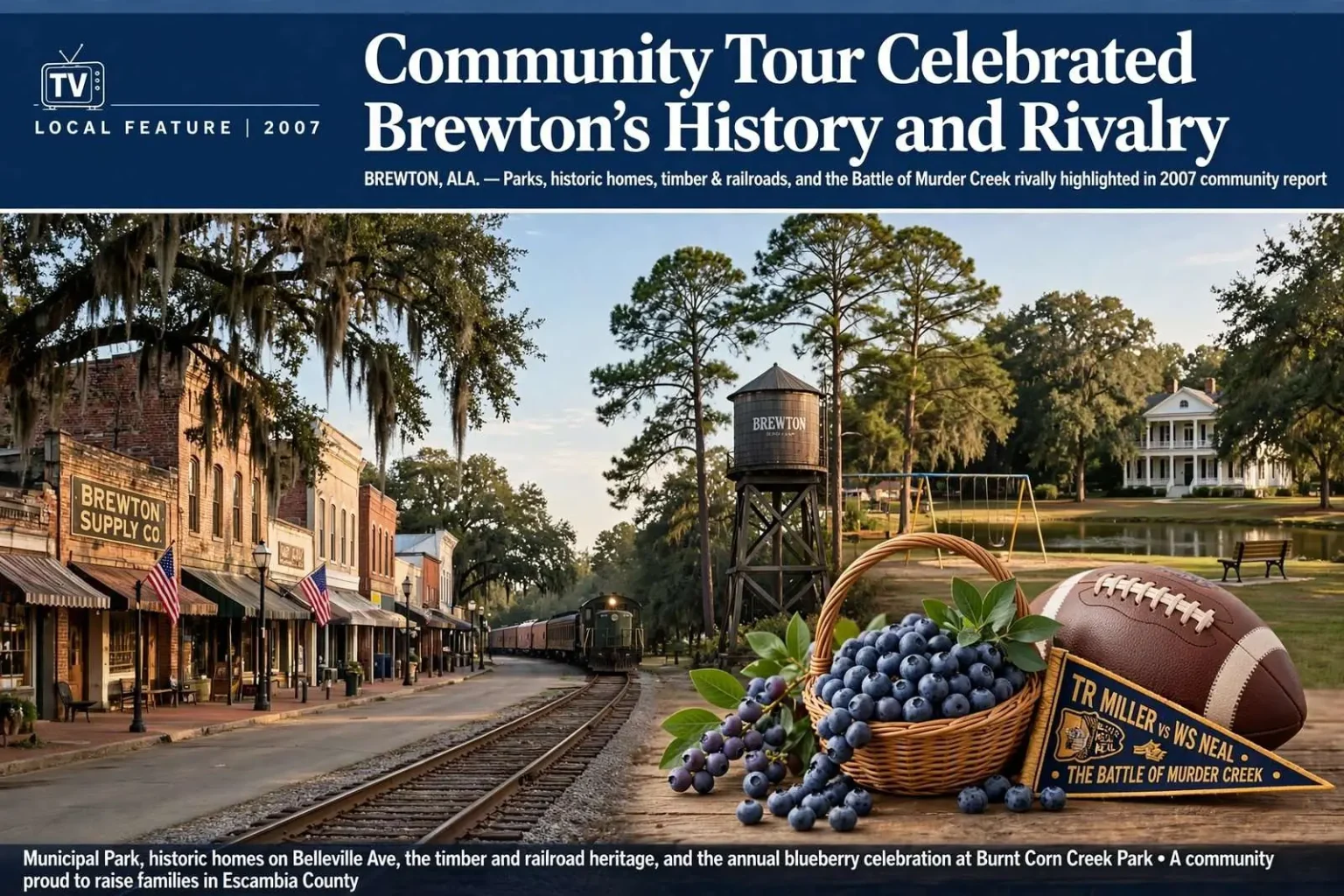
An archived local community feature celebrated Brewton’s parks, historic character and the intense football rivalry between T.R. Miller and W.S. Neal high schools, painting a portrait of a small Escambia County city whose identity rests on timber, railroads and generations of family ties.

The report, drawn from coverage of the area published years ago, described a community that takes evident pride in its appearance and its institutions — from the shade of its municipal parks to the historic homes that line one of its most admired streets. It offered a look at Brewton as residents themselves describe it: a small city with outsized civic pride.

Parks at the center of town

The feature described Brewton’s Municipal Park, along with the city’s golf course, pool and playground, as the gathering places around which much of local life rotates. In cities Brewton’s size, a single park complex serves as sports field, walking trail, picnic ground and social hub all at once, and the account made clear that Brewton’s facilities are used exactly that way.

Municipal parks in Alabama’s smaller cities carry a role that larger cities spread across a dozen venues. Youth leagues, church gatherings, reunions and after-school play all share the same grounds, and the quality of those facilities is one of the first things prospective residents notice. The report treated Brewton’s as a point of pride, maintained by a city that sees its parks as part of how it presents itself.

Downtown, the feature noted public art displayed around the city, part of an effort many small Alabama municipalities adopted to brighten commercial blocks and draw visitors out of their cars. Combined with the historic storefronts of the downtown district, the artwork gives the center of town a curated feel that the report highlighted.

Historic homes along Belleville Avenue

Among the most admired features of the city, the report cited the historic homes along Belleville Avenue, a street known for its collection of stately residences dating to Brewton’s boom years. The avenue reflects the wealth the timber industry generated here in the late 19th and early 20th centuries, when lumber barons built homes intended to last and did.

Brewton’s historic district remains one of the distinguishing features of the city, and the homes along Belleville Avenue are frequently photographed and featured on regional tours. The report’s description placed them alongside the parks and the downtown as the visual signature of the community.

Timber and railroads built the town

The feature traced the community’s development to timber and railroads, the two forces that created most of the towns across south Alabama’s pine belt. Brewton grew as a processing and shipping point for the longleaf pine forests that covered Escambia County, and the railroad lines that carried lumber out brought passengers, mail and commerce in.

See also  Foley Man Charged in June Stabbing at Double Deuce That Sent Two Point Clear Men to the Hospital

Noting that trains still moved through downtown, the report connected the city’s present to its founding era — a working reminder that Brewton exists because of the rail lines that crossed south Alabama more than a century ago. The passing trains remain part of the town’s everyday soundscape and, for residents, part of its character.

The timber industry’s imprint runs deep in the area’s institutions as well. Generations of Brewton families have worked in forestry, milling and the businesses that support them, and the industry’s presence shaped everything from the city’s tax base to the rhythms of local life.

The Battle of Murder Creek

The feature devoted attention to what residents consider the event of the year: the annual football meeting between T.R. Miller High School of Brewton and W.S. Neal High School of East Brewton, known as the Battle of Murder Creek. The rivalry takes its name from the creek that runs through the area, and it has divided households, workplaces and neighborhoods across the two towns for generations.

Rivalry games like this one function as civic holidays in small Alabama cities. Attendance swells beyond the normal Friday night crowd, former residents plan trips home around the game, and the week leading up to it fills with school spirit events, merchant promotions and good-natured trash talk that persists all year in either direction.

The report described the rivalry as a familiar focus for the area — one of those traditions that gives a community its calendar and its conversation. For students at both schools, the game is the memory that outlasts the season; for alumni, it is the thread that connects their years in town to the ones being made on the field now.

A place to raise a family

Residents spoke warmly of Brewton as a place to raise a family, and the report built its portrait around that sentiment. Small cities across south Alabama compete for young families on the same terms — affordable housing, safe neighborhoods, good schools, parks and traditions — and the account presented Brewton as checking each box in the eyes of the people who live there.

The community institutions the feature catalogued support that claim: the park system, the pool and golf course, the schools and their rivalry, the churches and civic clubs that organize the town’s annual events. In cities of this size, those institutions are not amenities layered on top of daily life; they are daily life.

See also  Escambia County Deputies Investigate Man’s Death as Homicide at Ferry Pass Apartment

Blueberries at Burnt Corn Creek Park

The feature also noted the annual blueberry celebration at Burnt Corn Creek Park, one of the area’s signature festivals. Blueberries are a substantial crop in south Alabama, and communities across the region celebrate the harvest with festivals that draw vendors, musicians and crowds from surrounding counties.

Festivals of this kind serve double duty in small cities — they support local growers and craft vendors, and they give the town a reason for former residents and visitors to come back each year. The blueberry celebration at Burnt Corn Creek Park has played that role for Brewton, anchoring the community calendar alongside the football rivalry and the school events that fill a small city’s year.

This is a historical portrait of the Brewton area drawn from archived local coverage. Current facilities, events and local conditions may differ from those described in the original report.

Where Brewton sits

Brewton serves as the county seat of Escambia County in far south-central Alabama, near the Florida line. The city and its neighbor East Brewton sit along the Murder Creek watershed, in a landscape of pine forest, creeks and river bottoms that defines the whole region’s look and economy.

The location shaped the town’s history directly. Rail lines running through the county connected the pine forests to ports and markets, and Brewton developed at the junction where those interests converged. U.S. Highway 29 and the state routes that followed later tied the city to Pensacola to the south and the Black Belt towns to the north, keeping the community connected while leaving its small-city character intact.

Residents in the feature described a place where distances are short and ties are long — a city close enough to larger towns for shopping and medical care, but far enough out to keep the pace and the familiarity that families cited when they talked about raising children there.

The schools at the heart of the story

T.R. Miller High School carries the name of one of Brewton’s most influential industrial families, a reminder of how deeply the timber fortune and the community’s institutions are intertwined. The school’s athletic and academic traditions span more than a century, and its teams have built a record that residents follow with the intensity the rivalry game reflects.

See also  ADECA Gathers Input From Mobile, Baldwin, Clarke and Escambia Leaders on $500 Million Hurricane Recovery Plan

W.S. Neal High School serves East Brewton across the creek, giving the two communities mirror-image institutions and the natural rivalry that follows. Generations of families have attended one school or the other, and marriage between the two fan bases is a standing local joke that the feature’s account of the rivalry echoed.

High school football’s role in towns like Brewton is difficult to overstate. It is the community’s largest regularly scheduled gathering, its most visible tradition and, for many residents, the lens through which they follow the town’s young people as they grow up.

Preservation and pride

The report’s emphasis on historic homes, downtown art and maintained parks reflected a broader theme that runs through communities like Brewton: the deliberate work of preservation. Keeping a historic district intact, maintaining public facilities and investing in public art are choices that small cities make when they decide how they want to present themselves to visitors and to their own children.

Brewton’s approach, as the feature described it, leans on the assets the city already has — the architecture of its boom years, the natural setting of its creeks and parks, and the traditions that give the calendar its shape. That kind of stewardship is why archived portraits of the city from years past still read as recognizable to residents today.

Reading the archive today

Archived community features like this one serve as snapshots: they capture how a place understood itself at the moment the coverage was published. Brewton’s story — timber, railroads, parks, schools and rivalry — is a common one across south Alabama, but each town tells it with its own names, its own creek and its own Friday nights.

Readers comparing the archive to the Brewton of today will find some things changed and many that have not. The trains may run less often, the schools have seen decades of graduating classes pass through, and the festivals have grown with the region — but the historic homes still line Belleville Avenue, the parks still fill on weekend afternoons, and Murder Creek still divides two towns that meet every fall to settle their rivalry on the football field.