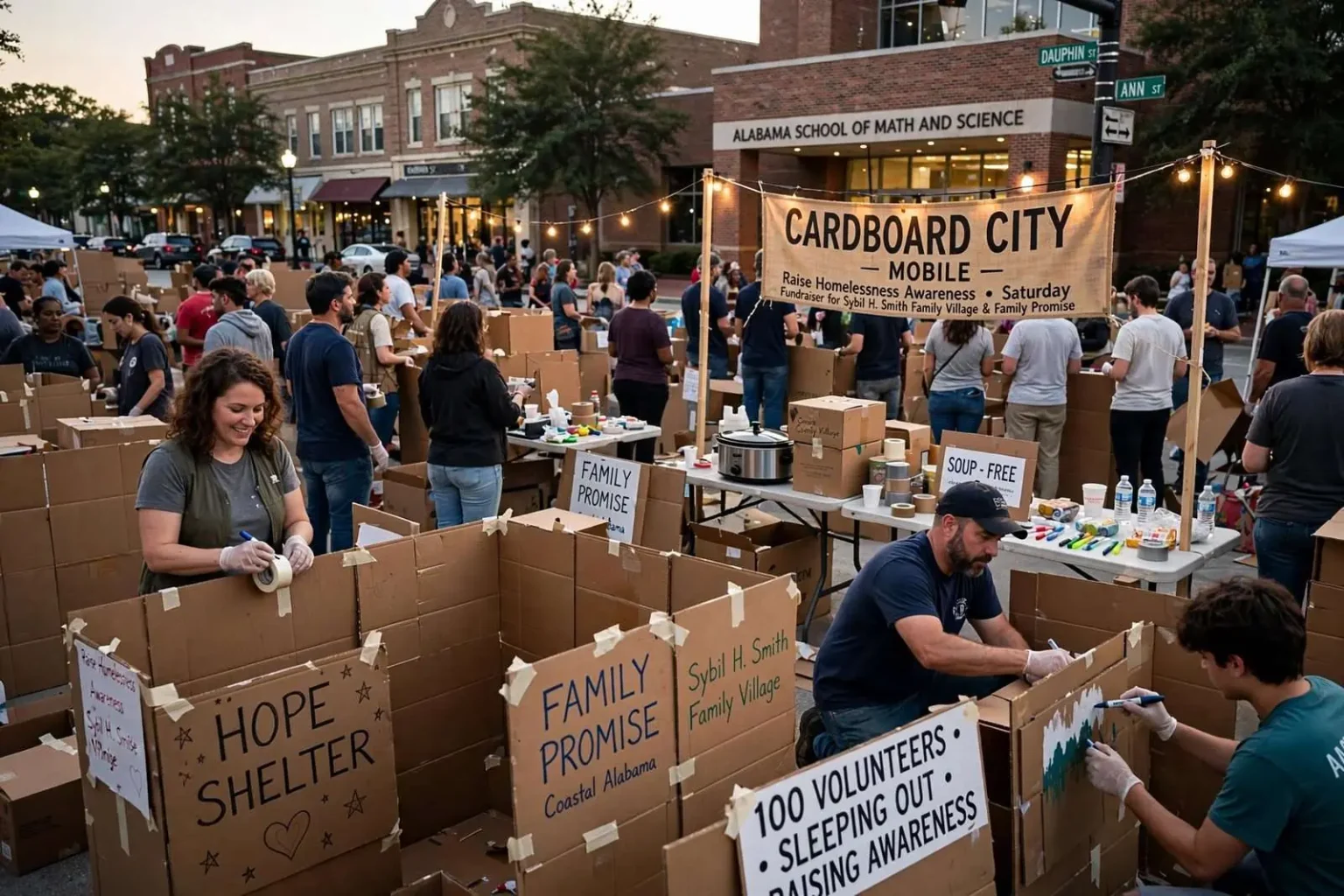
Volunteers building cardboard shelters for a homelessness awareness event in downtown MobileCardboard City brings volunteers to downtown Mobile each year to raise awareness of homelessness.

About 100 volunteers are expected to spend Saturday night sleeping in homemade cardboard shelters near the Alabama School of Math and Science in downtown Mobile, part of an annual push to keep the issue of homelessness visible in the Port City.

The event, known locally as Cardboard City, invites supporters to build makeshift housing out of cardboard at the corner of Dauphin and Ann streets and then spend the night in their creations. Organizers describe it as both an awareness campaign and a fundraiser, with proceeds split between the Sybil H. Smith Family Village and Family Promise of Coastal Alabama, two organizations that provide transitional housing and support services to homeless women, children and families in the Mobile area.

“We encourage everybody to come, even if they don’t want to spend the night,” said Diane McCaskey, director of the Sybil H. Smith Family Village, describing an evening built around music, food and conversation as much as the shelters themselves. “Come and enjoy the music and the soup and be part of something fun for a good cause.”

Participants pay a $100 “rent” to build and sleep in their cardboard structure, with construction and decorating beginning in the afternoon to give builders enough daylight to finish before the evening program starts. McCaskey said past events have typically attracted around 100 overnight participants and dozens of additional visitors who stop by without spending the night, though organizers are hopeful this year’s turnout could exceed previous years.

The stakes behind the awareness campaign are significant. According to the most recent point-in-time count of homelessness in the area, an estimated 600 men, women and children go without stable shelter in the Mobile area on any given night, though McCaskey and other organizers say they believe the true number is considerably higher than what such counts typically capture.

Previous years’ events have raised meaningful money for both partner organizations — last year’s Cardboard City brought in roughly $12,000 — and organizers say the need for that support is growing rather than shrinking. Both the Sybil H. Smith Family Village and Family Promise are bracing for potential funding cuts tied to federal housing assistance programs and tighter restrictions on some government grants, McCaskey said, making community fundraisers like Cardboard City increasingly important to keeping services running.

The Sybil H. Smith Family Village, operated through the Dumas Wesley Community Center, provides transitional housing specifically for women and children experiencing homelessness. Family Promise relies on a network of local congregations to provide meals, temporary shelter and other support to families working to get back on their feet. A similar Cardboard City event is held each spring in Baldwin County.

See also  Seventeen Attorneys Line Up for Mobile County District Court Vacancy

Organizers say online donations are also accepted for anyone unable to attend in person but wanting to support either organization’s work.

Mobile is the county seat of Mobile County in southwest Alabama and the state’s only saltwater port. Situated where the Mobile River meets Mobile Bay near the northern Gulf of Mexico, the city has long served as a commercial and cultural gateway between Alabama and the wider Gulf Coast. Founded in 1702 as Fort Louis de la Louisiane and ruled in turn by France, Britain, and Spain before joining the United States in 1813, Mobile carries a layered heritage distinct from the rest of the state.

Today Mobile anchors a metropolitan area spanning Mobile County and neighboring Baldwin County, and it remains a center for shipping, aerospace, healthcare, and higher education in the region. Its downtown and waterfront have seen sustained revitalization, while historic neighborhoods preserve architecture from its colonial and antebellum past. The city’s identity is shaped as much by its working port and industrial base as by its festivals and food culture, making it a frequent focal point for news about growth and change in southern Alabama.

Alabama is a state in the southeastern United States bordered by Tennessee, Georgia, Florida, the Gulf of Mexico, and Mississippi. Often called the Heart of Dixie, it spans Appalachian foothills in the north and flat coastal plains in the south. Its largest cities include Birmingham, Montgomery, Huntsville, and Mobile.

Alabama’s history encompasses Indigenous roots, Spanish and French colonial settlement, a cotton-plantation economy, the Civil War and Reconstruction, and the Civil Rights Movement of the 1950s and 1960s, followed by a shift toward manufacturing, aerospace, and technology. Local news across the state frequently reflects this mix of tradition and change.

Baldwin County sits directly east of Mobile County across Mobile Bay and is the largest county in Alabama by land area. It encompasses the Eastern Shore communities of Daphne, Fairhope, Spanish Fort, and Foley and stretches south to the beaches of Gulf Shores and Orange Beach along the Gulf of Mexico.

Long among the fastest-growing counties in the state, Baldwin blends suburban development near the bay with tourism-driven coastal economies. Its proximity to Mobile and its position on the Eastern Shore make it a recurring subject of regional news covering growth, infrastructure, schools, and the balance between development and coastal preservation.

See also  Mobile Nail Salon Donates Thousands of Masks and Gloves to Providence Hospital

The Gulf of Mexico borders Alabama’s southern edge and defines much of the state’s coastal identity. Alabama’s Gulf coastline, centered on Dauphin Island, Gulf Shores, and Orange Beach, supports a tourism industry built around beaches, charter fishing, and marine recreation, while offshore waters host shipping lanes and energy interests.

The Gulf’s warm, shallow shelf and exposure to hurricanes make weather and disaster preparedness recurring concerns for communities from Mobile to Baldwin County. The marine environment also underpins commercial seafood harvests that have sustained Gulf Coast families for generations, tying the region’s economy and culture closely to the water.

The economy of the Mobile region is diversified across shipping and logistics, aerospace and shipbuilding, healthcare, tourism, and manufacturing. The Port of Mobile is one of the nation’s busiest seaports and a cornerstone of the local and state economy.

Major employers in aviation and defense contribute to a skilled workforce, while economic-development organizations aim to attract investment and jobs through incentives and infrastructure improvements. Small businesses, from restaurants to professional services, form the backbone of neighborhood commerce.

The health of the regional economy is a frequent subject of public discussion and reporting. Workforce development, recruitment of industry, and the fortunes of local retailers all feed into a broader picture of how the Gulf Coast competes and adapts in a changing national economy.

Mobile lays claim to a long tradition of outdoor festivals and public celebration, most famously its Carnival or Mardi Gras season, which predates the better-known celebrations of New Orleans. Throughout the year the region hosts music festivals, food and arts events, and waterfront gatherings that draw visitors from across the Gulf Coast.

Such events are economic and cultural anchors for the area, supporting hospitality, tourism, and local artists while fostering a sense of community identity. Organizing them involves coordination among city government, business sponsors, public-safety agencies, and volunteers, and they frequently appear in local news coverage of the region’s cultural life.

For many residents, these gatherings are also a point of civic pride and a way to mark the seasons. The mix of nationally known and local performers common to regional festivals reflects the area’s dual character as both a close-knit community and a stop on broader touring circuits.

See also  2009 Was a Big Year for New Music From Mobile Bay Artists

Charitable and nonprofit organizations form a vital safety net across South Alabama, addressing needs from hunger and homelessness to disaster relief and holiday assistance. Groups such as The Salvation Army operate local corps that provide shelter, food, and seasonal programs funded largely by community donations.

The generosity of Gulf Coast residents, often mobilized after hurricanes and economic hardship, underscores how tightly knit many of these communities are. Local philanthropy also relies on volunteers and corporate partners, and the progress of fundraising efforts is a recurring subject of regional news because it reflects the community’s capacity to care for its most vulnerable members.

Holiday campaigns in particular reveal the scale of need and the reach of volunteer networks. The rhythm of annual giving, from food drives to toy distributions, is woven into the regional calendar and into the coverage that keeps residents informed about how to help and where support is most needed.

Local government in the Mobile area operates through a combination of mayor-council or commission structures at the municipal level and a county commission in Mobile County, with elected officials handling budgets, public safety, infrastructure, and zoning. Baldwin County has its own commission and a collection of incorporated municipalities.

Decisions made in council chambers and commission meetings affect roads, school funding, economic development, and quality of life, which is why coverage of local government is a staple of regional journalism. The interplay between city, county, and state authorities often determines how effectively the area can address shared challenges.

Because many services residents rely on are delivered at the local level, the choices of elected officials have direct, everyday consequences. Budget priorities, in particular, reveal a community’s values and shape the trajectory of growth and public welfare for years to come.

Education in South Alabama spans public school systems in Mobile and Baldwin counties, a network of private and parochial schools, and institutions of higher learning including the University of South Alabama, Spring Hill College, and community colleges. Public-school governance rests with locally elected boards.