Children’s & Women’s Hospital Receives $100,000 Grant for Pediatric Cancer Research
Hyundai Hope on Wheels is awarding a $100,000 grant to USA Health Children's & Women's Hospital to support pediatric cancer research, bringing its total giving to the Mobile hospital past $310,000.
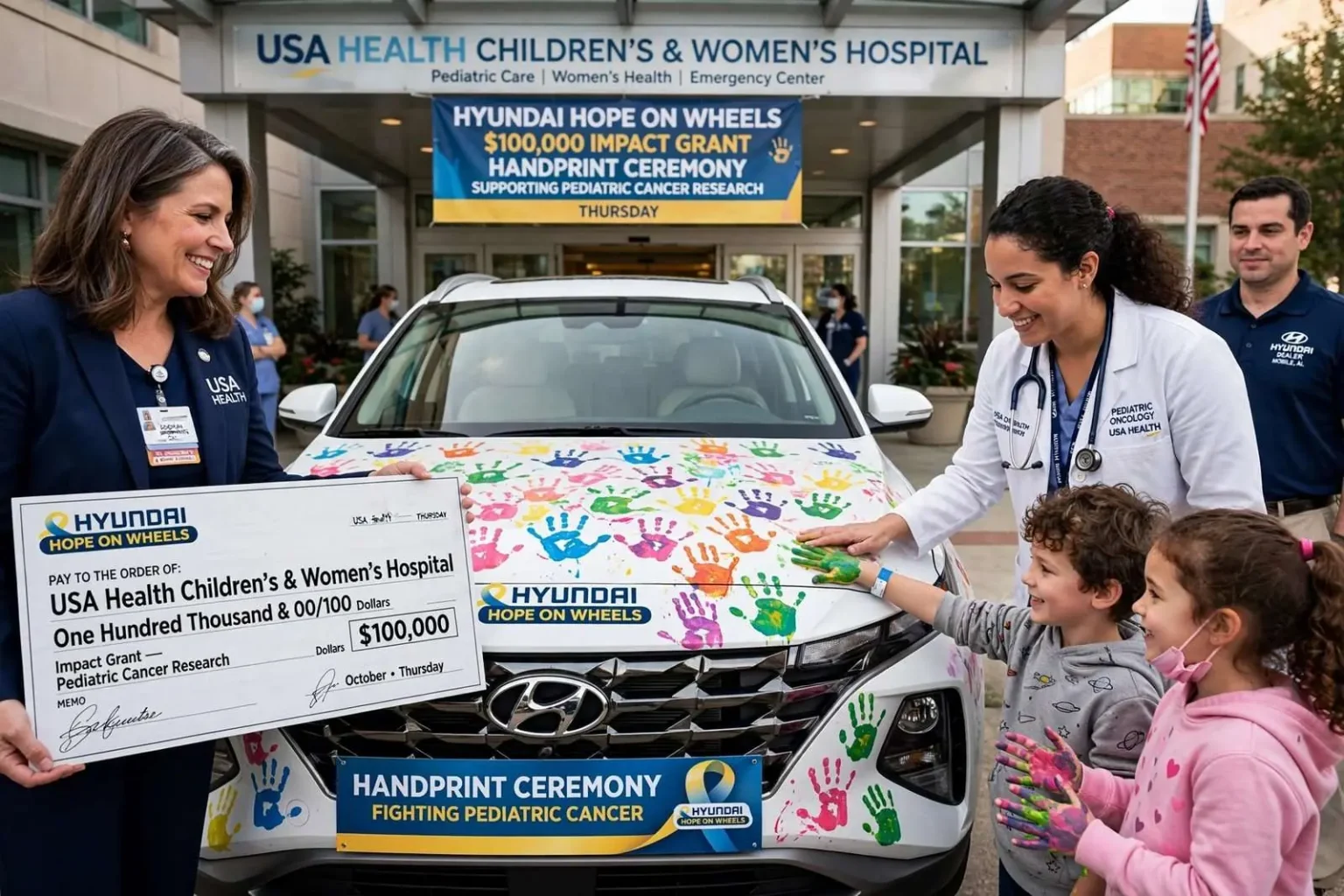
USA Health Children’s & Women’s Hospital in Mobile will receive a $100,000 Impact Grant from Hyundai Hope on Wheels to support pediatric cancer research and the hospital’s pediatric oncology department. The grant will be presented Thursday during a Hyundai Hope on Wheels Handprint Ceremony at the hospital, the organization’s signature event in which children affected by cancer place their painted handprints on a Hyundai vehicle as a symbol of their fight against the disease and their hope for a cure.
The Handprint Ceremony is the emotional center of the organization’s giving model. A vehicle arrives at the hospital white and unmarked; by the end of the ceremony it is covered in bright, multicolored handprints, each one left by a child who has faced cancer and each one remaining on the car as it travels. For families who have spent months or years in treatment, the ritual flips the visual language of illness — hospital wristbands, IV lines, waiting rooms — into a public mark of survival and hope that children themselves create.
The ceremony will bring together representatives from Hyundai Hope on Wheels, Hyundai Motor America and local Hyundai dealers alongside pediatric oncology physicians and researchers, hospital leaders, and children and families impacted by pediatric cancer. That combination is deliberate. The program is funded by Hyundai and its national network of dealers, which means the people presenting the check include the dealership owners and operators from the Mobile area whose sales help fund the research being honored — a direct line between the showrooms along the Gulf Coast and the laboratory work happening inside the hospital.
With this latest award, Hyundai Hope on Wheels has now provided more than $310,000 to Children’s & Women’s Hospital to support pediatric cancer research. The cumulative figure reflects a multi-year relationship between the organization and the hospital rather than a single gift, and it has arrived at a moment when the hospital’s pediatric oncology program has been expanding its role as the referral center for children with cancer across the upper Gulf Coast region.
“We are incredibly grateful to Hyundai Hope on Wheels, Hyundai Motor America and our local Hyundai dealers for this generous $100,000 grant and for the compassion they continue to show to children and families facing cancer,” said Deborah Browning, MSN, RN, CENP, chief executive officer at Children’s & Women’s Hospital. “Every child deserves the opportunity to grow up healthy, and investments like this help our physicians and researchers move us closer to that goal.”
Browning’s remarks carry the weight of an administrator who runs the region’s only dedicated children’s and women’s hospital — a facility that serves families from across south Alabama, Mississippi and the Florida Panhandle, many of whom would otherwise face long journeys to larger cities for pediatric specialty care.
The Need for Pediatric Cancer Research
More than 15,000 children are diagnosed with cancer each year in the United States, according to the hospital, creating a critical need for research investment that can lead to more targeted and safer treatments. Pediatric cancer is rare relative to adult cancer, and that rarity shapes its economics: childhood cancers do not attract the commercial research investment that common adult malignancies do, which leaves philanthropy and federal funding to carry a larger share of the work. Grants like this one fund the studies that would otherwise go unstarted.
The treatments that exist today — the multi-drug regimens that have pushed childhood cancer survival rates far above where they stood a generation ago — were built on decades of exactly this kind of funded research, much of it conducted at children’s hospitals and pediatric oncology programs like the one in Mobile. The unfinished work is significant: survivors of current protocols often carry lifelong side effects from treatments designed decades ago, and the research frontier has shifted toward therapies that target a child’s specific cancer while sparing growing bodies the collateral damage of blunt chemotherapy and radiation.
Hyundai Hope on Wheels has worked since 1998 to fund childhood cancer research and raise awareness of the disease; the organization is set to surpass $303 million in lifetime giving nationwide in 2026. The milestone places the program among the largest private funders of pediatric cancer research in the country, and its model — dealer-funded, hospital-directed, and built around the Handprint Ceremony — has made it a familiar presence at children’s hospitals across the country for nearly three decades. Every Hyundai vehicle sold through participating dealerships contributes a portion of proceeds to the fund, which is then awarded back to hospitals in the communities those dealers serve.
The Impact Grant designation sits within that structure as an award directed to a hospital’s pediatric oncology program to advance a specific area of research. For Children’s & Women’s, the $100,000 arrives at a hospital that functions as the anchor of the USA Health system’s pediatric care — a teaching-hospital environment where University of South Alabama physicians and researchers treat patients while training the next generation of pediatric specialists, and where research funding directly extends the menu of clinical options available to local families.
Hospital officials say the continued support is helping strengthen Children’s & Women’s Hospital’s role in the fight against pediatric cancer on the upper Gulf Coast, funding research aimed at improving treatment options for children throughout south Alabama. That regional framing is the practical significance of the award. Families in Mobile, Baldwin, Washington, Escambia and Clarke counties — and across the state line in Mississippi and Florida — rely on the hospital’s oncology program as the closest source of specialized pediatric cancer care, and every research dollar that stays in Mobile expands what can be offered without leaving the region.
The Thursday ceremony is open to the hospital community, with the handprinted vehicle serving as the event’s centerpiece and a rolling monument to the children whose handprints it carries. For the physicians and researchers receiving the grant, the occasion doubles as a reminder of who the work is for: the children in the audience, painted hands pressed against the car, watching adults promise that the fight against their disease will continue — funded, in part, by the neighbors who sell cars down the street.
What an Impact Grant actually funds varies by hospital, but the categories are consistent across the program’s history: laboratory research into the biology of childhood cancers, clinical trial support that connects local patients to emerging therapies, and program support that helps pediatric oncology units expand their capacity to treat. For a hospital the size of Children’s & Women’s, a $100,000 award can underwrite the infrastructure a research program needs to compete for larger federal grants — the staffing, data systems and pilot studies that turn a promising idea into a fundable project.
The grant also lands in a region where the logistics of pediatric cancer care carry real weight. Families in south Alabama’s rural counties can face round trips of two hours or more for a single chemotherapy appointment, and treatment for a child with cancer routinely means months of near-weekly visits. Research and program investment that strengthens the Mobile program’s capabilities shortens those journeys — more trials available locally, more specialists on staff, more of the treatment course completed close to home.
Hyundai Hope on Wheels’ arrival in Mobile this week will also highlight the local dealership network’s stake in the program. The organization’s funding comes from Hyundai Motor America and Hyundai dealers nationwide, who pledge a portion of every vehicle sale to the fight against pediatric cancer, and the Mobile-area dealers who will stand alongside hospital leadership on Thursday represent the local end of that national commitment. The connection is more than symbolic for the organization, which has always presented its grants in the communities where the money was raised.
The Handprint Ceremony format has become one of the most recognizable rituals in pediatric hospital philanthropy for a simple reason: it puts the children at the center of the event rather than at the edges. Instead of a ribbon-cutting or a check presentation staged for adults, the ceremony hands the paint to the patients. The resulting vehicle — covered edge to edge in handprints from children in treatment, survivors and, in some ceremonies, siblings remembering children who did not survive — becomes a traveling exhibit for the dealership and the hospital, carrying the story of pediatric cancer into public view.
For Children’s & Women’s Hospital, the ceremony and the grant together mark another chapter in a partnership that has now exceeded $310,000 in cumulative support. Hospital leaders have framed the relationship as exactly the kind of sustained investment a regional pediatric program needs: not a one-time gift but a recurring commitment from a national organization with local roots, arriving at a hospital whose oncology program serves as the safety net for children with cancer across the upper Gulf Coast.
The numbers behind the need remain sobering — more than 15,000 American children diagnosed each year, and a national research enterprise that has spent decades chipping away at each type of childhood cancer one funded study at a time. The work happening in Mobile, now with another $100,000 behind it, is part of that national effort — conducted by physicians and researchers whose patients are the same children who will press their painted hands against a white Hyundai on Thursday and, with any luck, grow up to watch their handprints ride around town.