Citronelle Man, 25, Killed When Motorcycle Strikes Tree Near Citronelle
ALEA says John D. Talbott, 25, of Citronelle died when his motorcycle left Sand Ridge Road and struck a tree near Citronelle.
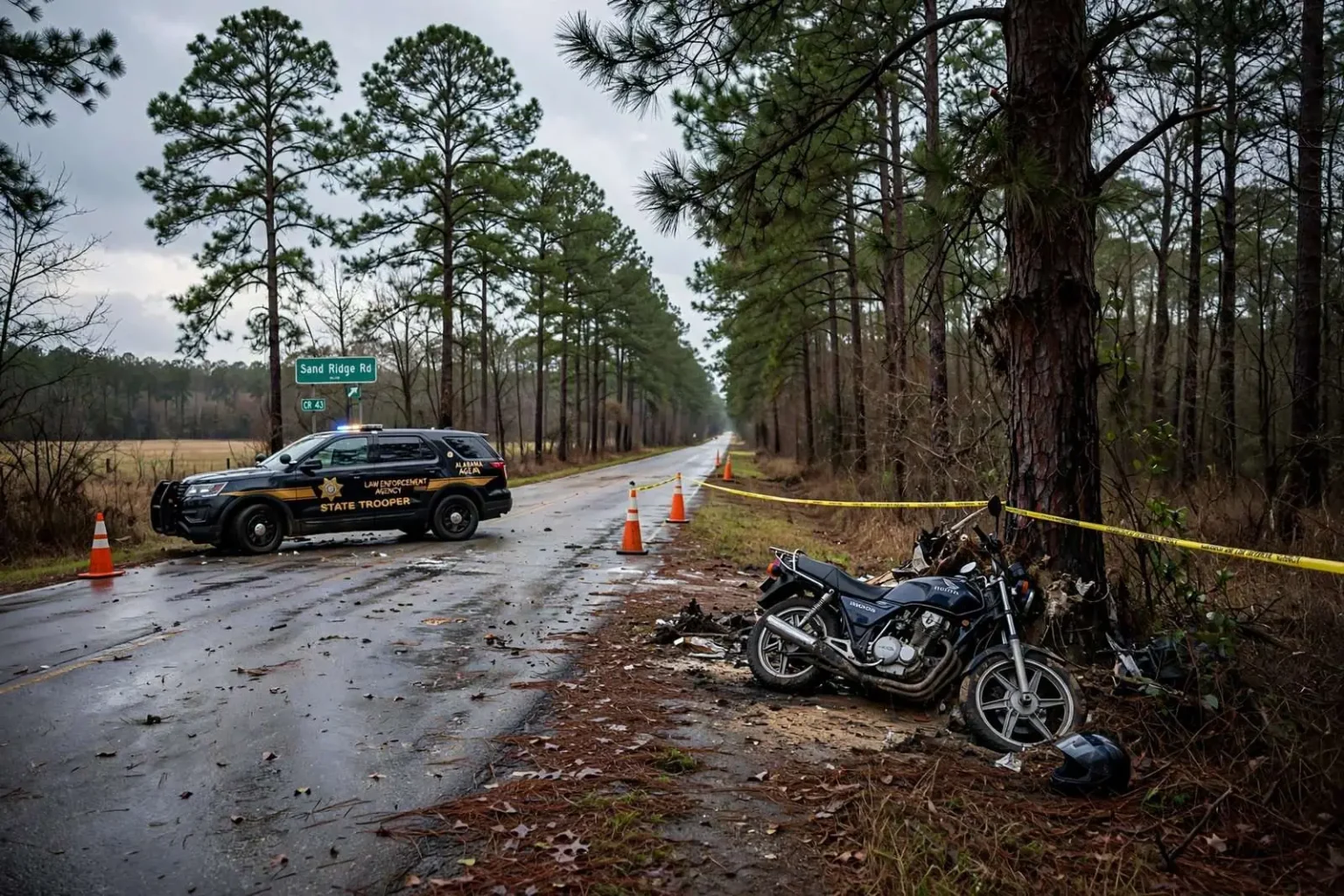
A 25-year-old Citronelle man died Monday afternoon after the motorcycle he was riding left the road and struck a tree in northern Mobile County, according to the Alabama Law Enforcement Agency. The rider was identified as John D. Talbott of Citronelle. He was pronounced dead at the scene, and no other vehicles were reported to have been involved in the crash.
Troopers said Talbott was riding a 2006 Honda motorcycle on Sand Ridge Road at approximately 1:05 p.m. Monday, Nov. 21, when the bike departed the roadway and struck a tree roughly a mile south of Citronelle. The crash occurred along a rural stretch of road in one of the most sparsely populated corners of Mobile County, an area of pine forest, open fields and scattered homes.
Single-vehicle run-off-the-road crashes are among the most common fatal crash types investigated in rural Alabama. When a motorcycle leaves the travel lane at speed, the rider has little protection against fixed objects such as trees, embankments and utility poles, and collisions with trees account for a disproportionate share of rider deaths on two-lane roads.
Where the crash happened
Citronelle is the northernmost city in Mobile County, sitting near the Washington County line along U.S. Highway 45 about 35 miles north of downtown Mobile. The city of roughly 4,000 residents serves as a commercial and service hub for the surrounding rural communities, and roads like Sand Ridge Road carry a steady mix of local traffic, logging trucks and farm equipment.
The terrain around the crash site is gently rolling, with dense vegetation lining the shoulders. Curves and elevation changes on rural two-lane roads can be unforgiving for motorcyclists, particularly when a rider carries speed into a bend or when surface conditions change abruptly. Investigators have not said what caused the motorcycle to leave the road, and troopers have released no details about the rider’s movements before the wreck.
The investigation
The Alabama Law Enforcement Agency’s Highway Patrol Division is leading the investigation. ALEA troopers handle crash reconstruction and death investigations on state, county and municipal roadways across Alabama, and in cases like this they typically document the scene, examine the motorcycle and interview any witnesses before determining what factors contributed to the crash.
Authorities said no further information has been released. It is not yet known whether speed, impairment, roadway conditions or a mechanical issue played a role. Findings in ALEA fatal-crash investigations are often not made public until the review is complete, a process that can take weeks in serious cases.
Motorcycle safety on Alabama’s rural roads
Crashes like the one on Sand Ridge Road highlight the risks riders face on rural two-lane highways. Alabama routinely records more than 100 motorcycle fatalities in a year, and a large share of them occur on rural roads outside municipal limits, where travel speeds are higher, curves are sharper and emergency medical response times are longer than in urban areas such as Mobile or Prichard.
Run-off-the-road crashes are especially dangerous for riders. A car or truck that slides off the pavement may strike a ditch or heavy brush and come to a stop. A motorcycle that leaves the roadway more often throws the rider directly into the path of the same fixed objects that line the shoulder. Safety officials with the Alabama Department of Transportation and regional highway safety offices regularly urge riders to wear approved helmets, ride within their line of sight, and treat unfamiliar rural curves with caution.
Alabama’s universal helmet law requires every rider to wear a helmet regardless of age or experience, a rule that has been on the books for decades and remains one of the stricter motorcycle helmet statutes in the Southeast. Authorities have not said whether Talbott was wearing a helmet at the time of the crash.
A dangerous stretch of the year
The crash came in the days leading up to Thanksgiving week, historically one of the busiest and most hazardous travel periods of the year on Alabama roads. ALEA typically announces heightened enforcement across the state during the holiday season, with troopers concentrating on speeding, impaired driving and seat belt violations along the major corridors connecting Mobile to the rest of the state.
Shorter daylight hours, cool mornings that leave fog in low-lying areas, and sporadic rain add to the hazards on rural routes in northern Mobile County during late November. Riders commuting or traveling recreationally through the region face reduced visibility and occasional slick patches on shaded roadways that hold moisture through the day.
How fatal crashes are worked in Mobile County
In a fatal crash, ALEA troopers close the roadway while they measure and photograph the scene, then release it to local authorities for cleanup. The motorcycle is typically inspected for mechanical condition, and toxicology testing is a standard part of the protocol in death investigations. The completed case file goes to the district attorney’s office for review if evidence points to criminal conduct; in many single-vehicle deaths, the file closes with a determination of the contributing factors.
The Mobile County Sheriff’s Office and the volunteer fire departments that serve the county’s rural communities routinely assist ALEA at crash scenes in the northern part of the county, providing traffic control, extrication and first response while troopers work. Response distances in that region can stretch the time between a 911 call and the arrival of advanced medical care well beyond what residents of Mobile’s city limits experience, which safety planners say is a factor in rural crash outcomes.
Resources for riders
Alabama’s motorcycle rider education program, administered through state safety agencies and partner organizations, offers courses covering hazard avoidance, cornering technique and defensive riding. Completion of an approved course can substitute for the skills test required for a motorcycle endorsement on an Alabama driver license, and safety advocates credit formal training with reducing crashes among new riders.
Regional advocates also encourage riders to plan routes before traveling through rural southwest Alabama, where cell coverage can be spotty and services are spread out. Carrying basic tools, staying visible with bright gear and headlights, and riding sober remain the consistent messages from law enforcement across the Gulf Coast.
Community impact
Fatal crashes hit small communities like Citronelle hard, where emergency responders and investigators often know the victims and their families personally. Local churches and civic groups in northern Mobile County regularly rally around families after roadway deaths, and grief counseling resources are typically made available through area schools when the victim has young connections in the community.
The death is the latest in a string of serious and fatal crashes investigated across Mobile County this year, a list that has included motorcycle, pedestrian and head-on collisions on both urban and rural roadways. Traffic safety officials use each fatal crash to renew calls for slower speeds, greater attention behind the wheel and helmet use among riders.
Anyone with information about the crash on Sand Ridge Road is encouraged to contact ALEA’s Highway Patrol Division. The investigation remains ongoing, and no further information has been released.
The toll in numbers
Statewide, Alabama logs several hundred traffic deaths in a typical year, and Mobile County consistently ranks among the counties with the highest totals because of the volume of traffic moving through the Port City and along the Interstate 10 and Interstate 65 corridors. Rural northern Mobile County accounts for fewer crashes in raw numbers, but its fatality rate per mile traveled tends to run higher because of the speeds and response distances involved.
Motorcycles make up a small fraction of registered vehicles in Alabama but appear in a much larger share of fatalities. Federal and state data have long shown that motorcyclists are far more likely than passenger vehicle occupants to be killed or seriously injured in a crash of similar severity, a gap driven by exposure, visibility and the absence of the protective structure a car provides.
What investigators look for
When a motorcycle leaves the roadway without a collision with another vehicle, troopers focus on a short list of questions. Was the rider carrying speed into a curve? Did the bike strike gravel, sand or standing water that broke traction? Was there a mechanical problem with the tires, brakes or steering? Was the rider experienced, licensed and sober? Each answer shapes the final determination in the crash report.
Roadway factors also come under review. The condition of the shoulder, the sharpness of the curve, drainage and vegetation that limits sight lines can all be noted in a reconstruction, and in rare cases findings lead to county road maintenance requests. More often, the report simply documents a tragic combination of speed, terrain and timing.
For the family and neighbors of John D. Talbott, those technical answers matter less than the loss itself. The investigation by ALEA’s Highway Patrol Division remains ongoing, and anyone with information about the crash is asked to come forward.