Citronelle Man Killed in Head-On Crash on U.S. 45 Near Chunchula
ALEA says a Citronelle man died after a head-on crash on U.S. 45 near Chunchula in Mobile County. The other driver was also hospitalized.
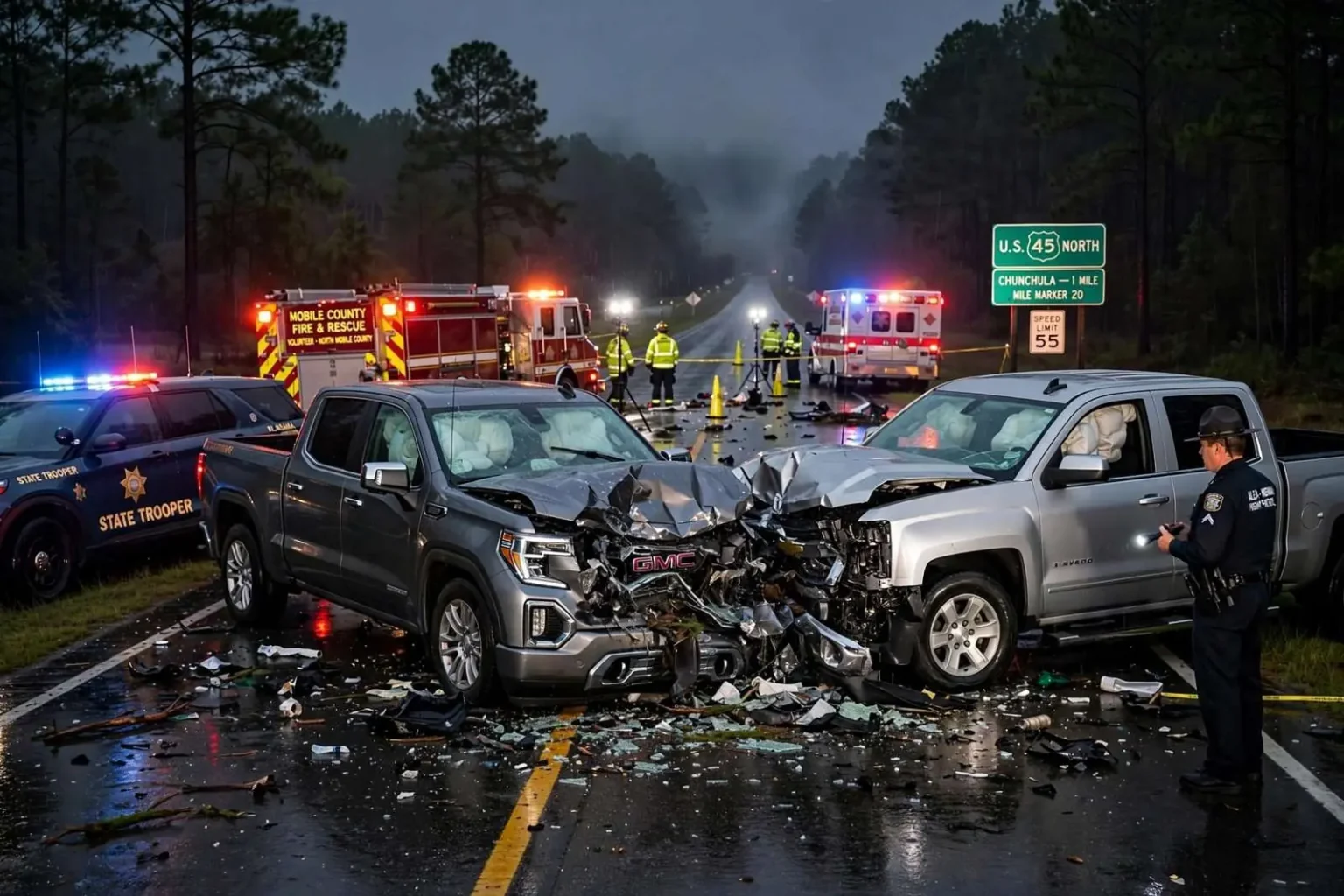
A 63-year-old Citronelle man has died following a head-on collision on U.S. 45 in northern Mobile County, according to the Alabama Law Enforcement Agency. Troopers identified the victim as Mark S. Stricker, who was driving a GMC Sierra pickup when it struck a Chevrolet Silverado head-on shortly before 6:30 p.m. on Monday, Dec. 5.
The crash occurred on U.S. 45 near the 20 mile marker, about a mile north of the Chunchula community — a stretch of two-lane highway that carries commuter, school, and commercial traffic between the Mobile metropolitan area and the small towns of north Mobile County. Troopers said Stricker was taken to USA Hospital in Mobile, the Level I trauma center at the University of South Alabama, where he was pronounced dead despite emergency treatment.
The driver of the Silverado, identified by ALEA as Clayton L. Geter, 32, of Mississippi, was also transported to the hospital for treatment of injuries sustained in the collision. Authorities did not release details about his condition. Troopers with ALEA’s Highway Patrol Division continue to investigate the crash, and no additional information has been made available about what caused the two vehicles to meet head-on in the northbound-southbound lanes of the highway.
The Crash Scene on U.S. 45 Near Chunchula
U.S. 45 is one of the primary north-south corridors of west Alabama, running from its southern terminus in Mobile through Prichard, Whistler, and Chunchula before continuing north through Mount Vernon and Citronelle on its way to the Mississippi state line and ultimately Meridian. In northern Mobile County it remains a conventional two-lane rural highway for much of its length, with a painted centerline, a posted speed limit of 55 miles per hour or higher in open stretches, and limited turn lanes at side roads and driveways.
That combination is a familiar recipe for head-on collisions. On a two-lane road, every passing maneuver and every moment of distraction or fatigue places a vehicle within inches of oncoming traffic, and a mile north of Chunchula the highway curves and rises through the gently rolling terrain of the Mobile-Tensaw delta’s western edge. At roughly 6:30 p.m. on an early-December evening, darkness had already fallen across north Mobile County, and the stretch of road near the 20 mile marker would have been lit only by vehicle headlights and whatever ambient glow reaches that far from the city.
The severity of the crash reflects the physics of head-on impacts. Two vehicles closing on each other at highway speeds produce a combined closing rate that can exceed 100 miles per hour, and a pickup truck struck head-on absorbs that energy in a fraction of a second. Emergency responders from rural volunteer fire departments and county EMS units are typically the first on scene at crashes in this part of the county, with the most seriously injured patients transported roughly 25 miles south to USA Hospital in Mobile, the region’s only Level I trauma center.
ALEA’s Role in Investigating Fatal Crashes
In Alabama, fatal and serious-injury crashes on state and federal highways are investigated by the Alabama Law Enforcement Agency, the consolidated state agency formed in 2015 that merged the former Department of Public Safety with other state law enforcement functions. Its Highway Patrol Division posts troopers by district, and crashes in northern Mobile County fall under the jurisdiction of troopers assigned to the Mobile post of the Southwest Alabama region.
ALEA investigations of head-on fatalities typically examine the roadway itself, the vehicles, and the movements of each driver in the moments before impact. Investigators look at lane positioning, skid and yaw marks, vehicle damage patterns, and the scene debris field to reconstruct how the crash occurred. Toxicology testing is standard in fatal crashes, and findings — along with any citations or charges — are generally included in the final crash report rather than announced at the scene. That process can take weeks, which is why agencies frequently note that no additional information is available in the days immediately after a deadly collision.
Citronelle and the Communities Along the Corridor
Citronelle, the victim’s hometown, sits near the northern edge of Mobile County, roughly 35 miles from downtown Mobile, and serves as a commercial and school center for a rural area of farms, timberland, and small communities. Residents of Citronelle and neighboring communities such as Chunchula, Mount Vernon, and Wilmer depend heavily on U.S. 45 for daily travel — commuters driving to jobs in Mobile and Prichard, students riding buses to schools in the area, and log trucks and other commercial vehicles moving through the corridor at all hours.
Chunchula itself is an unincorporated community a few miles south of Mount Vernon, and the 20 mile marker referenced by troopers places the crash site along the rural stretch where the highway leaves the denser development around the community and opens into countryside. For people who live along the route, crashes there are a recurring worry that surfaces whenever plans are made to travel the road after dark, and fatal collisions in the area ripple quickly through close-knit rural communities where victims are often known personally to first responders.
The human toll of crashes on the corridor extends beyond those directly involved. Rural volunteer fire departments in north Mobile County respond to wrecks on U.S. 45 many times a year in a typical span, and fatal crashes place a heavy burden on the volunteer responders, many of whom know the victims. Air and ground ambulance crews face long transport distances to trauma care, and the difference of even a few minutes can shape outcomes for patients with severe internal injuries like those common in head-on collisions.
The Dangers of Rural Two-Lane Highways
Nationally, rural two-lane roads carry a disproportionate share of serious and fatal crashes relative to the traffic they move, and head-on collisions are among the deadliest crash types because of the combined closing speed of the vehicles. Common contributing factors include vehicles crossing the centerline during passing attempts, drivers drifting over the line due to fatigue, distraction, or medical events, poor visibility on curves and hills, and wet or foggy conditions that reduce traction and sight distance. South Alabama’s frequent rainfall and early winter darkness add to those hazards during the fall and holiday season.
Safety officials have long promoted a set of countermeasures for corridors like U.S. 45: wider lane and shoulder pavements, rumble strips along the centerline and shoulders, reflective pavement markings and upgraded signage, passing zones evaluated against sight distances, and turn lanes at high-conflict intersections. The Alabama Department of Transportation periodically makes such improvements on federal routes in Mobile County, though funding limits mean upgrades tend to arrive incrementally and are often prioritized after crash histories document a pattern of severe incidents.
For individual drivers, the advice safety agencies repeat for two-lane rural travel is simple but consequential: leave generous following distances, use pull-offs rather than the shoulder for any stopped need, pass only in marked zones with clear sight lines, slow down for curves and weather, and remain especially alert during dusk and nighttime hours when oncoming vehicles are harder to judge at distance. Because so many rural crashes involve lane departures, maintaining constant attention to lane position is one of the most effective habits a driver on a road like U.S. 45 can build.
What Happens Next in the Investigation
As the Highway Patrol’s investigation continues, the final report will document the sequence of events, the condition of each vehicle, and any factors investigators identified, and it will be available to the families involved and, in some circumstances, to prosecutors if evidence supports charges. ALEA has released no further details about the circumstances of the Dec. 5 collision, including what, if anything, caused the GMC Sierra and the Chevrolet Silverado to collide head-on near the 20 mile marker north of Chunchula.
Investigators in crashes of this kind generally complete an on-scene phase within hours — documenting the vehicles, roadway, and evidence — and then spend weeks on follow-up work that can include downloading data from the vehicles’ airbag control modules, reviewing toxicology results, and interviewing witnesses. The finished report matters not just for any legal process that follows, but for the families who are often left with few answers beyond the basic facts of time and place that were released in the first hours.
The death of Mark S. Stricker marks another loss for a small community where news of a serious crash travels fast. For the families of both drivers — the Citronelle man who did not survive the trip to the hospital and the Mississippi man recovering from injuries — the weeks ahead will bring the difficult work of funerals, medical care, and questions that only the completed investigation can answer. Anyone with information about the crash who has not already spoken with investigators can contact ALEA’s Highway Patrol post in Mobile, as details from witnesses along the highway that evening often prove valuable in reconstructing events on rural corridors where camera coverage is scarce.