Citronelle Police Chief Crosses Paths With Black Bear Near Saraland
Citronelle Police Chief Tyler Norris crossed paths with a black bear in the Elysian Fields neighborhood on Highway 45 between Chunchula and Saraland.
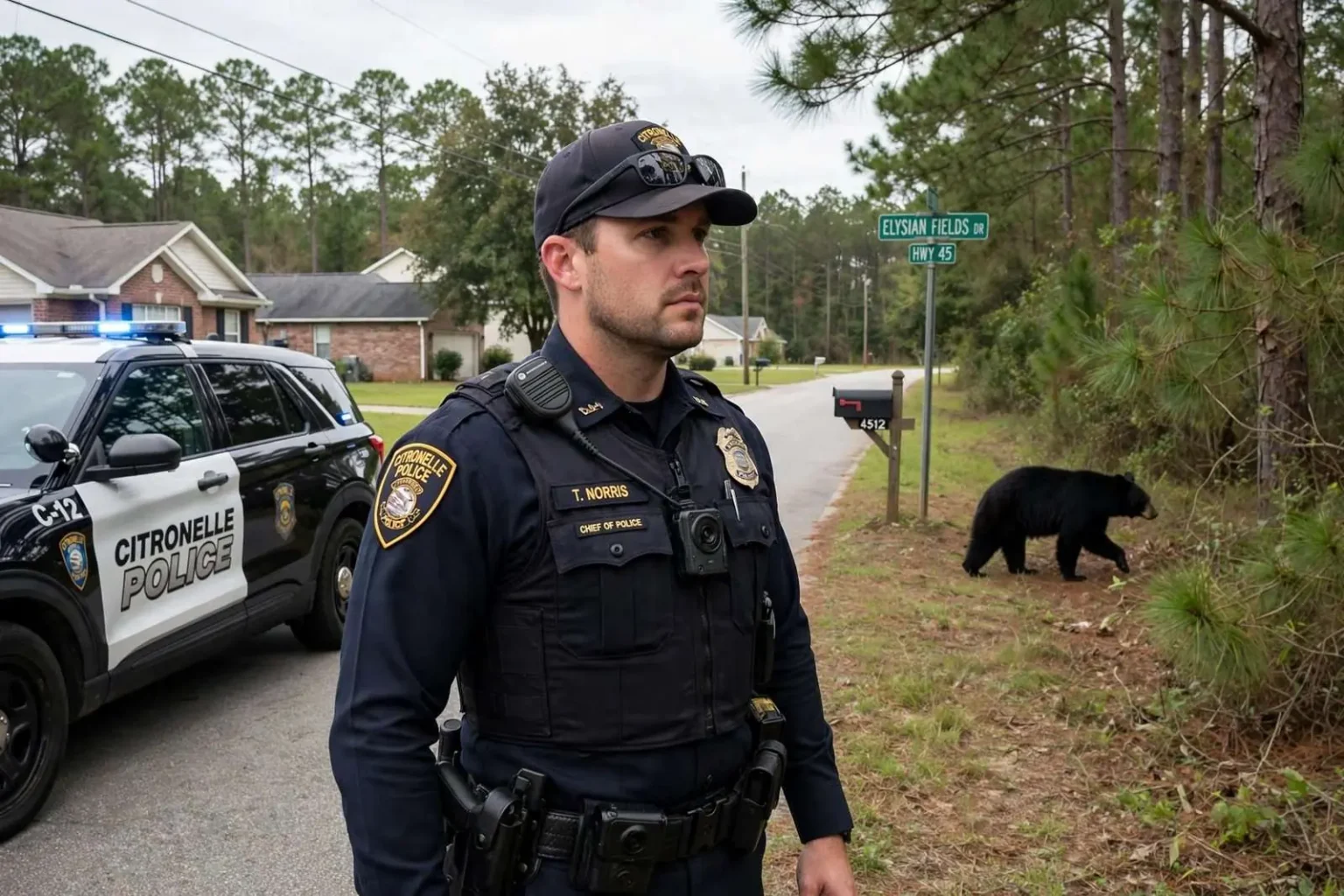
A black bear turned up in a north Mobile County neighborhood this week, and the person who ran into it was a local police chief. Citronelle Police Chief Tyler Norris crossed paths with the bear on Thursday, according to accounts of the sighting. The animal was seen in the Elysian Fields neighborhood along Highway 45, in the stretch of road between Chunchula and Saraland — a corridor where subdivisions increasingly press against the wooded country north of Mobile.
The encounter was unusual mostly for who it happened to. Black bears are native to southwest Alabama, but sightings along Highway 45’s developed stretches remain rare enough that a police chief meeting one on a routine pass through a residential neighborhood made for memorable news. No injuries were reported, and the bear did what bears usually do when people are around: it moved along.
The sighting comes as Alabama’s black bear population has been quietly expanding, with wildlife biologists documenting more confirmed sightings across the southern counties in recent years. Bears established in the Mobile-Tensaw Delta and the forested tracts of southwest Alabama have gradually extended their range, and young males in particular wander long distances — sometimes straight through or past human neighborhoods on the way to new territory.
Bears in the Woods North of Mobile
The area sits in a largely wooded part of Mobile County where pine stands and undeveloped land run up against subdivisions and highway frontage, giving bears and other large animals a natural corridor to travel through without much human contact. The landscape between Chunchula and Saraland is a patchwork — creek bottoms, timber tracts, farmland and newer residential streets — and that mix is exactly the kind of edge habitat bears use. Animals moving between the big forest blocks north of Mobile and the delta lowlands can pass through without being noticed until one crosses a road or wanders into a yard.
The Elysian Fields neighborhood along Highway 45 sits close enough to that wild country to fall inside a bear’s natural travel range. Wildlife biologists who track Alabama’s bears describe them as shy, reclusive animals that avoid humans whenever possible; most residents never see one even in areas where bears are present. A daytime pass through a neighborhood usually means a young bear in transit rather than one settling in.
Alabama’s black bears belong to two populations: the American black bears of north Alabama, linked to bears in Georgia and Tennessee, and the smaller Florida black bear subspecies that occupies the panhandle-influenced habitat of southwest Alabama. The Gulf Coast group — centered historically on the Mobile-Tensaw Delta and the vast timberlands toward Washington and Clarke counties — is the one capable of producing sightings in north Mobile County. Estimates of the southwest Alabama population have grown as biologists have documented reproduction in the region, though the numbers remain modest compared to bear strongholds in Florida and Georgia.
Wildlife officials have worked in recent years to document the population through sighting reports, trail cameras and genetic studies, and they ask the public to report bear encounters so the data builds. Every confirmed sighting — including ones like the Elysian Fields visit — helps biologists map how the range is shifting.
What Residents Should Do
Wildlife officials generally advise anyone who encounters a black bear to keep a wide distance, avoid cornering or approaching the animal, never attempt to feed it, and secure trash cans, pet food and grills that can draw bears toward homes. Bears that find an easy food source in a neighborhood tend to return to it — and a bear that learns to associate neighborhoods with meals becomes a repeat visitor, which is when encounters turn from novelty to problem.
The practical checklist is simple. Bring pet food indoors at night; keep garbage in secure containers or put it out the morning of collection; clean grills after use; and take down bird feeders in areas where a bear has been seen. Garden produce, unsecured compost and leftover deer corn in rural sheds can also pull a bear in. None of these steps are complicated, but they matter most in the weeks right after a sighting, while the animal is still learning whether the neighborhood offers anything worth returning for.
Contrary to instinct, experts say never run from a black bear and do not climb a tree — both are losing propositions against an animal that can sprint at highway speeds and climbs better than any human. Instead, stand tall, make yourself look large, speak in a firm voice and back away slowly, giving the bear an unobstructed exit. Black bears that encounter people almost always choose to leave, and attacks in the eastern United States are exceedingly rare.
Residents who spot a bear are encouraged to report it to the Alabama Department of Conservation and Natural Resources, which tracks sightings across the state. Reports from the public give biologists location data and dates that feed the population picture — and they help wildlife officials know when a particular bear has overstayed a welcome. In the rare case of an aggressive or repeatedly problem bear, the department’s wildlife and freshwater fisheries staff respond and handle the animal.
Living Alongside an Expanding Range
North Mobile County’s growth makes encounters like Thursday’s likelier over time. Subdivisions along Highway 45 and the rural roads north of Mobile keep pushing into habitat that bears, deer and other wildlife have used for generations, and the animals do not recognize the property lines. The result is an increasing number of shared landscapes — neighborhoods with woods at the back fence and wildlife corridors crossing cul-de-sacs. Communities across the Southeast that have lived with growing bear populations for decades have adapted through exactly the kind of household practices wildlife officials recommend for Mobile County: secured trash, managed attractants and a working knowledge of what a bear encounter does and does not require.
Sightings also tend to come in clusters that prompt a wave of calls, and officials emphasize perspective: a black bear passing through is not a crisis, and the appropriate response is patience rather than panic. Most neighborhood visits last minutes. The animal moves on, the yards empty, and the incident becomes a story — in this case, one a police chief can tell firsthand.
No injuries were reported in connection with the sighting, and there was no indication the bear caused property damage before moving on. That outcome is the norm for black bear encounters in Alabama, and wildlife officials would like to keep it that way — which is why the guidance they repeat after every sighting centers on giving the animal space and removing the food rewards that would encourage a return trip.
For the residents of Elysian Fields and the communities along Highway 45 between Chunchula and Saraland, the episode is a reminder of the wild country at their doorstep. The pine stands and creek bottoms north of Mobile connect to the Mobile-Tensaw Delta, one of the most biologically rich landscapes in North America, and the wildlife that lives there — black bears among them — occasionally tests the boundary. A police chief crossing paths with one on a Thursday is the visible edge of a larger story: Alabama’s bears are slowly reclaiming ground in the southern part of the state.
The state’s own conservation history supports that trend. decades of reforestation, improved habitat along the delta and protection under state law have given bears room to grow their numbers, and biologists expect sightings in south Alabama counties to continue increasing as young bears disperse. For now, the playbook for the neighborhoods they pass through remains the same as it was the morning Chief Norris met his unexpected constituent: keep your distance, secure your trash, report the sighting — and let the bear be on its way.
Bear biology explains the wandering. Young male black bears typically disperse from their mothers’ home ranges at around two years old, striking out across unfamiliar country in search of territory of their own. Those journeys can cover dozens of miles, following river systems, timber corridors and undeveloped land — and in southwest Alabama, that geography funnels travelers through the wooded expanses north of Mobile Bay. A bear in a subdivision is usually a dispersing animal mid-journey, not a resident looking for a new home.
The species’ recovery in Alabama also reflects broader Gulf Coast trends. Florida’s black bear population has expanded enough that the state manages it as a conservation success story, and Georgia’s bears have grown along with habitat protection in the southern part of that state. Alabama’s bears, sandwiched between those populations, have benefited from the same forces — maturing forests, protected delta lands and a public that increasingly reports sightings rather than shooting them, as was common in earlier generations when bears were treated as vermin.
Law enforcement officers are often the first officials on the scene when wildlife turns up in populated areas, and encounters like Chief Norris’s give police departments a chance to model the right response. The best practice, wildlife officials say, is to observe from a distance, keep others away, and let the animal leave — calling the state’s wildlife agency if the bear lingers, appears injured or shows unusual boldness. Officers who understand that script keep an ordinary sighting from becoming a dangerous one for either species.
State wildlife officials maintain guidance and reporting channels for bear encounters on the Alabama Department of Conservation and Natural Resources’ website, and they have produced materials for communities in bear country covering everything from garbage management to what to do on a hiking trail. As sightings increase across south Alabama, that public-education work will matter more — and the Thursday visit to Elysian Fields gave north Mobile County residents an early lesson in sharing the landscape with one of the state’s largest wild animals.