Citronelle Police Seize 40 Pounds of Marijuana Shipped From Washington State
Citronelle police seized 40 pounds of marijuana worth $120,000 after tracking a FedEx shipment from Washington state to a local home.
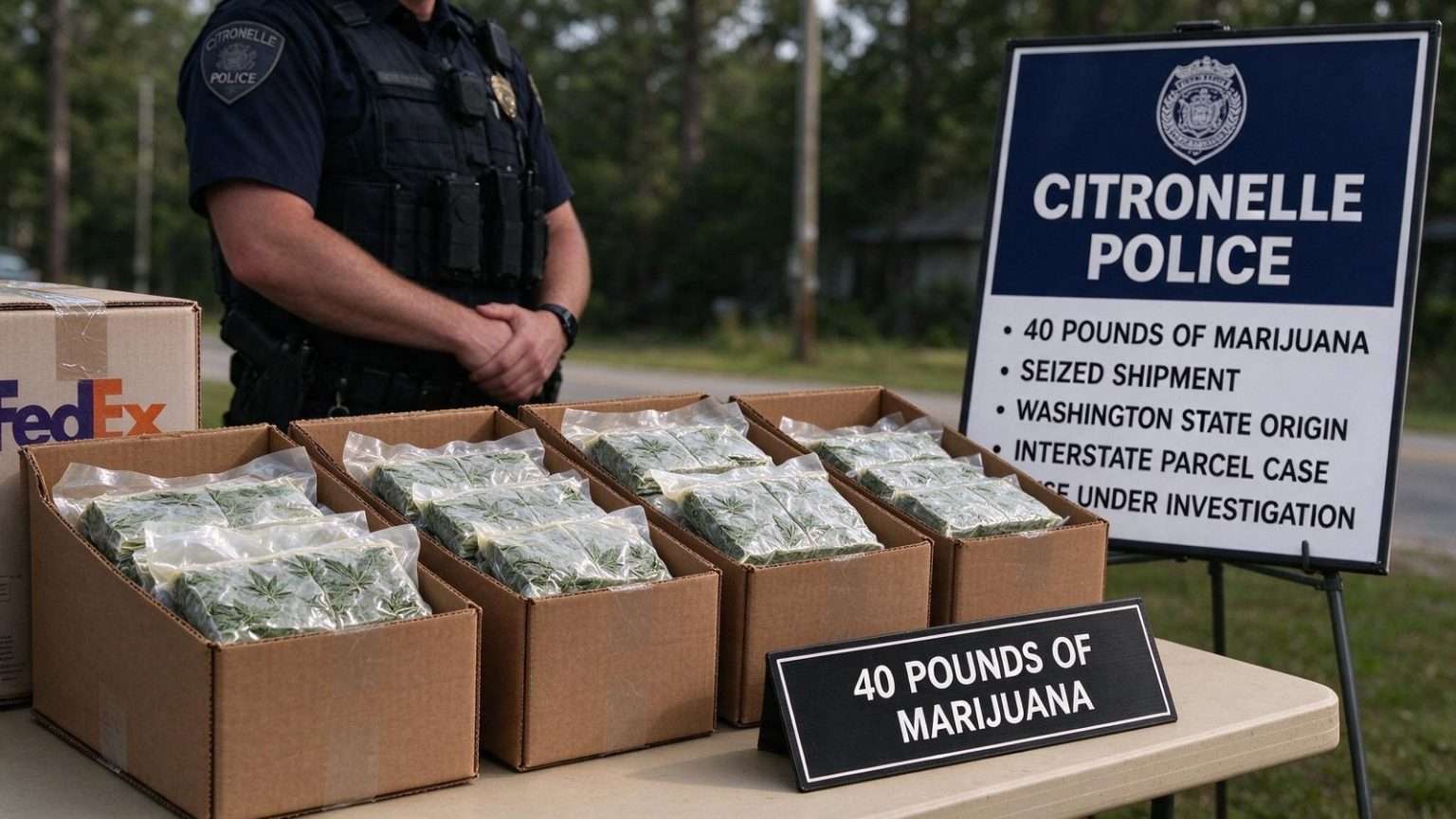
CITRONELLE, Ala. — Citronelle police intercepted a large drug shipment last week, seizing roughly 40 pounds of marijuana with an estimated street value of about $120,000, in an operation that unfolded quietly in the woods outside a residential address in the north Mobile County city. The seizure ranks among the larger single marijuana busts recorded in rural Mobile County in recent years and highlights how interstate shipping services have become a common pipeline for moving drugs into small Alabama communities.
Police Chief Tyler Norris said officers acted on confidential information indicating a large quantity of marijuana was headed to the city. Acting on that tip, investigators did not wait for the drugs to reach the street. Instead, they began planning surveillance around the anticipated delivery, a process that required coordinating schedules, positioning officers, and making sure the interception would not put residents in danger.
The package arrived by FedEx truck from Washington state. Washington is one of the states where recreational marijuana is legal under state law, and law enforcement agencies across the country have repeatedly noted that shipments originating in legal-market states are frequently intercepted far from their origin because transport across state lines remains a federal offense regardless of state legality. Marijuana remains a controlled substance under Alabama law, where possession of even small amounts can bring criminal charges and trafficking-weight quantities carry felony exposure.
Officers set up surveillance in woods near the home where the delivery was addressed, watching the approach to the property without revealing their presence. The stakeout position allowed investigators to observe the delivery driver and anyone who might come to collect the package, ensuring the interception happened at the right moment and with minimal risk to the surrounding neighborhood.
The arrest at the Citronelle residence
When the shipment arrived at a Citronelle residence, police took the recipient, identified as Shajuan French, into custody without incident. There were no injuries reported and no standoff, which authorities generally credit to careful planning during the surveillance phase. The package was recovered along with the marijuana inside, and evidence from the delivery was documented for use in the case.
The investigation and any resulting charges were not detailed in the release. It remains unclear whether the case will be presented to a Mobile County grand jury for felony indictment, whether federal prosecutors might take an interest given the interstate shipment, or whether additional suspects could be identified as the investigation continues. Cases involving packages shipped through commercial carriers frequently involve follow-up efforts, including examining the shipping labels, payment records and communication associated with the order.
Citronelle and the drug enforcement picture in north Mobile County
Citronelle is a city of roughly 3,900 residents in the far northern reaches of Mobile County, near the Washington County line, and its police department operates with a small force responsible for both city limits and mutual aid in the surrounding rural area. Departments of that size routinely partner with the Mobile County Sheriff’s Office and regional drug task forces when investigations grow beyond their own capacity, and interstate drug shipments routed to rural addresses have become a recurring enforcement challenge across south Alabama.
Large quantities of marijuana mailed from out-of-state — often vacuum-sealed and concealed inside legitimate packaging — have been seized in communities across Alabama in recent years, and agencies say the pattern reflects a shift away from bulk transport on highways toward parcel services, which officers say requires a different kind of surveillance work than traditional highway interdiction. In this case, the confidential tip gave Citronelle investigators the advance notice they needed to position themselves before the truck ever rolled into town.
Under Alabama law, the weight of the seized marijuana matters greatly to how a case is charged. Quantities above certain thresholds can support trafficking charges, which carry mandatory minimum prison sentences, while smaller amounts typically support possession or possession-with-intent charges. With roughly 40 pounds recovered, prosecutors would have substantial latitude in how they structure any charges, and the estimated street value of about $120,000 cited by police reflects the kind of pricing used in regional drug-market assessments.
How parcel-based drug cases unfold
Law enforcement officials describe parcel interdiction cases as a cooperative process between local police, shipping carriers and prosecutors. Carriers do not routinely open packages, but when a lawful investigation provides grounds to intercept a shipment, the delivery is allowed to proceed under surveillance so officers can identify who takes possession. That step — allowing the package to arrive rather than seizing it at a distribution hub — is a deliberate tactic that links the drugs directly to the person who accepts them, which prosecutors consider critical evidence at trial.
The use of a legitimate carrier address in a residential neighborhood also illustrates why police stage these operations away from main roads. Officers want to avoid a vehicle pursuit or a confrontation on a busy street, and the wooded surveillance positions around the Citronelle home gave them a clear view of the delivery while keeping their own presence invisible until the moment of the arrest.
Chief Norris’s office has emphasized community tips as a key source of drug cases in the city, and residents can report suspected drug activity directly to the department or, if they prefer anonymity, through regional tip lines. Confidential information like the tip in this case is vetted by investigators before an operation is launched, and multiple independent details are usually corroborated before officers commit resources to a stakeout.
What happens next in the case
The seized marijuana will be held as evidence and weighed with laboratory confirmation, which formally establishes the quantity that prosecutors will rely on. If charges are filed in state court, the case would move through the Mobile County system, beginning with a bond hearing and preliminary examination in district court before any grand jury review. If federal authorities take the case, penalties for marijuana distribution involving interstate shipment can be substantial, and federal prosecutors in the Southern District of Alabama have historically taken an interest in large multi-pound shipments.
For Citronelle residents, the outcome of last week’s operation was a quiet one: a large quantity of drugs intercepted before it could be distributed locally, a suspect in custody without any violence, and a small police department demonstrating the kind of patient, coordinated work that drug enforcement in rural communities increasingly requires. The department said further information would be released as the investigation allows, and anyone with additional information about the case is encouraged to contact Citronelle police.
The interstate dimension of the case underscores how enforcement priorities work across state lines. While Washington voters legalized recreational marijuana in 2012 through a statewide initiative, that legality stops at the border. The federal Controlled Substances Act continues to classify marijuana as a Schedule I substance, and transporting it across state lines — by private vehicle or by commercial carrier — constitutes federal drug trafficking regardless of the laws at either end. Police in Alabama and other prohibition states say the Pacific Northwest and the West Coast are common origins for mailed shipments, driven in part by the price differential between legal-market states and black-market prices elsewhere in the country.
That price gap is what gives a seizure like Citronelle’s its dollar value. Marijuana that sells at licensed dispensaries in legal states for a fraction of its street price elsewhere becomes a high-margin commodity when resold illicitly in the Southeast, which is why law enforcement agencies across the Gulf Coast region report seeing multi-pound shipments intercepted with regularity. The $120,000 estimated street value attached to the 40 pounds seized in Citronelle is consistent with the per-pound pricing that regional investigators cite for illicit wholesale distribution in south Alabama.
For the small Citronelle police force, the operation also demonstrates the value of patience in investigations. Rather than attempting to intercept the package at a shipping hub or pulling over the delivery truck on the highway, officers chose to let the shipment complete its journey under close watch. That approach carries risk — a package can be rerouted or picked up by someone other than the expected recipient — but it produces the strongest possible evidence tying the drugs to the person who accepted them.
A continuing conversation in small Alabama cities
Drug seizures of this size are unusual in a city of Citronelle’s size, but they are not without precedent in north Mobile County. The area’s mix of rural acreage, railroad lines, and highway connections to Mobile, Jackson and Hattiesburg has long made it a corridor for trafficking investigations, and the city’s department works regularly with county and federal partners on cases that cross jurisdictions.
Community members in small cities often serve as the eyes and ears for these investigations, and police leaders across the region encourage residents to report unusual activity — such as unfamiliar vehicles making brief stops at residences, repeated package deliveries to addresses with no visible business activity, or strong odors and unusual traffic patterns. Investigators say those observations, combined with confidential tips like the one that drove last week’s operation, frequently provide the first thread in cases that end with substantial seizures.
Anyone with information about drug trafficking in the Citronelle area can contact the police department directly, or leave an anonymous tip through regional crime stoppers programs. The department has not announced whether any additional arrests are expected in connection with the 40-pound shipment, and the case remains under investigation.