Citronelle Tag Office to Close for a Month as Mayor Faults County Decision
Citronelle's tag office shut down for a month due to county staffing shortages, and Mayor Jason Stringer says the city got no advance notice.
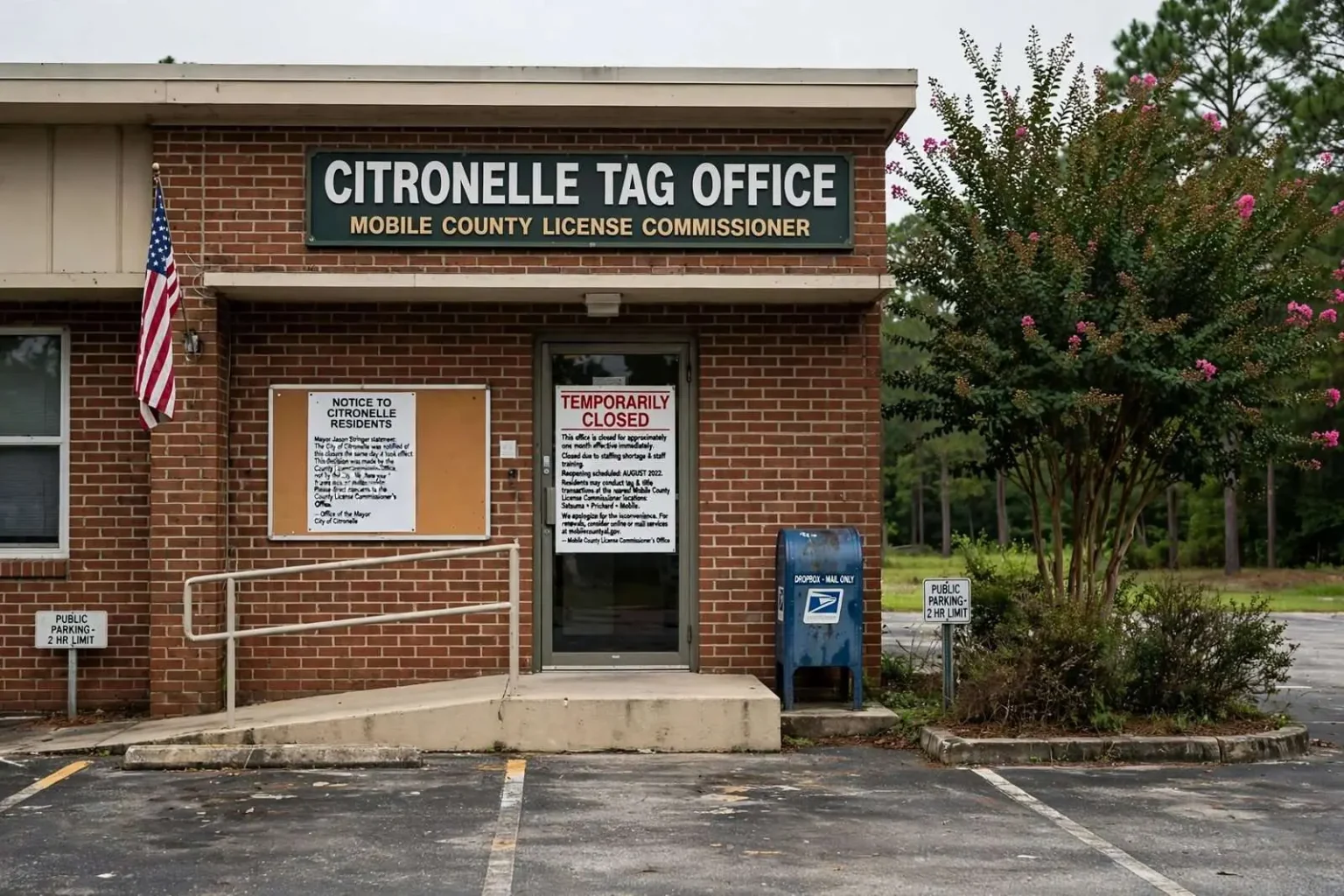
Residents of Citronelle will have to take their tag and title business elsewhere for about a month. Mayor Jason Stringer announced that the city’s tag office is shutting down temporarily while new staff are trained to run it, a decision made by the Mobile County License Commissioner’s office rather than City Hall. According to Stringer, the county closed the office because of staffing shortages. The facility is expected to reopen in August 2022 once a new crew has completed its training.
The closure removes one of north Mobile County’s most-used local government services from the city for roughly four weeks. For residents of Citronelle and the surrounding rural communities, the tag office has long been the place to renew vehicle registrations, transfer titles and handle the routine paperwork of car ownership without a long drive south toward the population centers of the county. Its absence means planning ahead — and, for many, driving significantly farther to conduct business that used to take a few minutes downtown.
Tag offices occupy a particular place in small-town Alabama life. They are where a teenager takes a driver’s license paperwork for a first car, where a family registers the truck that pulls the boat, where farm vehicles and trailers get their tags renewed each year. A town that loses its office, even temporarily, feels the loss in ways that a larger city with multiple locations does not.
The Mayor Objects to How It Was Handled
The mayor made clear he had no hand in the move — and did not approve of how it was handled. In a social media post, Stringer said the decision came from the License Commissioner and his team, not the city, and criticized the lack of notice given both to residents and to the city itself.
Stringer said he learned of the closure only that same day, adding that while he disagreed with the decision, he especially objected to the short warning citizens received before losing access to the service. His public statement drew a sharp line between the city and the county office that controls the facility’s operation — a distinction that matters to residents deciding whom to hold accountable, and that reflects the unusual arrangement by which a county office operates a service bearing the city’s name.
The complaint about notice is a familiar one in rural service delivery. When a closure is announced the same day it takes effect, residents who drove to the office that morning found it dark, and those with deadlines — registration renewals that lapse at month’s end, title transfers tied to a sale — had little time to rearrange. A month’s warning would have allowed people to take care of renewals before the shutdown; same-day notice left them to discover it on their own.
No interim arrangements for tag renewals or other license services in Citronelle were announced; residents needing those services during the closure will need to visit another Mobile County License Commissioner location.
How Mobile County’s License Offices Work
The Mobile County License Commissioner operates tag and title offices across the county, handling vehicle registrations, titles, decals and the related transactions that Alabama law routes through county license offices. The system is designed to bring those services closer to residents through branch locations rather than concentrating everything in downtown Mobile — an arrangement that matters enormously in a county as large and geographically spread out as Mobile, whose northern reaches sit the better part of an hour’s drive from the county seat.
Citronelle sits at the northern edge of Mobile County, a community of a few thousand residents surrounded by the forests and farmland of the county’s rural upper end. The nearest License Commissioner branches from there are in the southern population corridor — Satsuma, Prichard and Mobile itself — meaning the closure adds meaningful time and mileage to every transaction. For an elderly resident renewing a tag, a parent handling a teenage driver’s paperwork, or a small business registering vehicles, the trip is no longer an errand but a half-day.
Staffing shortages have strained government service offices across the country in recent years, and tag offices are no exception. The work requires trained personnel who can process title work, handle the state’s motor vehicle databases, collect the exact combination of state and local fees, and answer residents’ questions correctly. Training a new hire to that standard takes weeks — which is precisely why the county opted to close the Citronelle office during the transition rather than run it with untrained staff.
What Residents Should Do
With no interim service planned in Citronelle, residents have a few practical options during the closure window. Renewals that can wait until August can wait; many transactions can also be handled online or by mail through the county’s remote services, an option residents may want to confirm before making the drive south. Those who must conduct business in person should plan for travel to the nearest open branch and, where deadlines are involved, build in time before the month ends.
The mayor’s message urged residents to direct their concerns to the License Commissioner’s office rather than to City Hall, since the closure decision and the staffing behind it rest entirely with the county. Whether residents take that route or simply wait out the month, the episode has underlined a reality of rural government service: when a single office closes, an entire community loses its access point.
For Citronelle, the expectation is that the doors reopen in August 2022 with a fully trained crew behind the counter. For the month before that, the tag-and-title business of north Mobile County will be conducted somewhere else — to the frustration of a mayor who learned about it the same day his constituents did.
The dispute between the city and the county office also illustrates the layered arrangement of local government in Alabama. Cities frequently provide the buildings and the civic identity for services that counties actually staff and operate, and residents are often surprised to learn which level of government controls which counter in town. Stringer’s social media post served, in part, to draw that line plainly: the city of Citronelle did not choose to close the office, could not prevent the closure, and learned of it the day it happened.
Small-town officials across rural Alabama have voiced similar frustrations in recent years as agencies consolidate services or shutter branch operations in sparsely populated areas. The math that drives such decisions is straightforward — training, salaries and overhead cost the same whether the office serves four thousand people or forty — but the consequence falls unevenly on communities where a branch office may be the only government service within a short drive. Mayors like Stringer argue the calculus should weigh the burden placed on residents who must now travel, not just the cost saved by the county.
For now, the practical reality is a month without local tag service. Residents with August renewals should note the timeline, check what can be completed online or by mail, and otherwise plan for the drive to the nearest open Mobile County License Commissioner location. The city’s office is expected to be back in operation in August 2022, once its new staff complete their training, and the mayor has made clear that when it does, the service will return under the county’s management — with the city’s objection to how the closure was handled on the record.
Residents had questions the announcement did not answer: whether renewals due during the closure would be penalized, whether the office’s hours would change when it reopened, and whether the county intended to give the city more notice the next time staffing issues forced a shutdown. None of those details came with the initial announcement, and the mayor said his office was given no more information than the public received.
What is clear is the timeline. The Citronelle office closed immediately, new staff begin their training for the operation of the tag office, and the facility is expected to reopen in August 2022 with a crew capable of handling the full range of transactions — registration renewals, title transfers, decals and the other services the License Commissioner provides at branch offices across the county.
In the meantime, the nearest alternatives remain the county’s southern branches, and residents are advised to check locations, hours and available services before making the drive. Transactions that can be completed remotely are worth handling that way during the closure, and anyone with a deadline attached to a renewal or a sale should act early rather than assuming the local office will be open.
For a city that has watched other services drift south over the years, the episode struck a nerve. Citronelle has worked to hold on to the institutions that keep a small community self-sufficient — its schools, its downtown businesses, its local government offices — and a month-long closure of the tag office, announced without warning, touched precisely that nerve. Stringer’s message to the county was blunt on that point: disagree with the decision as he might, his chief objection was that the people most affected were the last to know.