City of Jackson takes over McVay Water System
The Jackson Waterworks and Sewer Board has acquired the McVay Water System, with the change taking effect June 15, the city of Jackson, Alabama, announced.
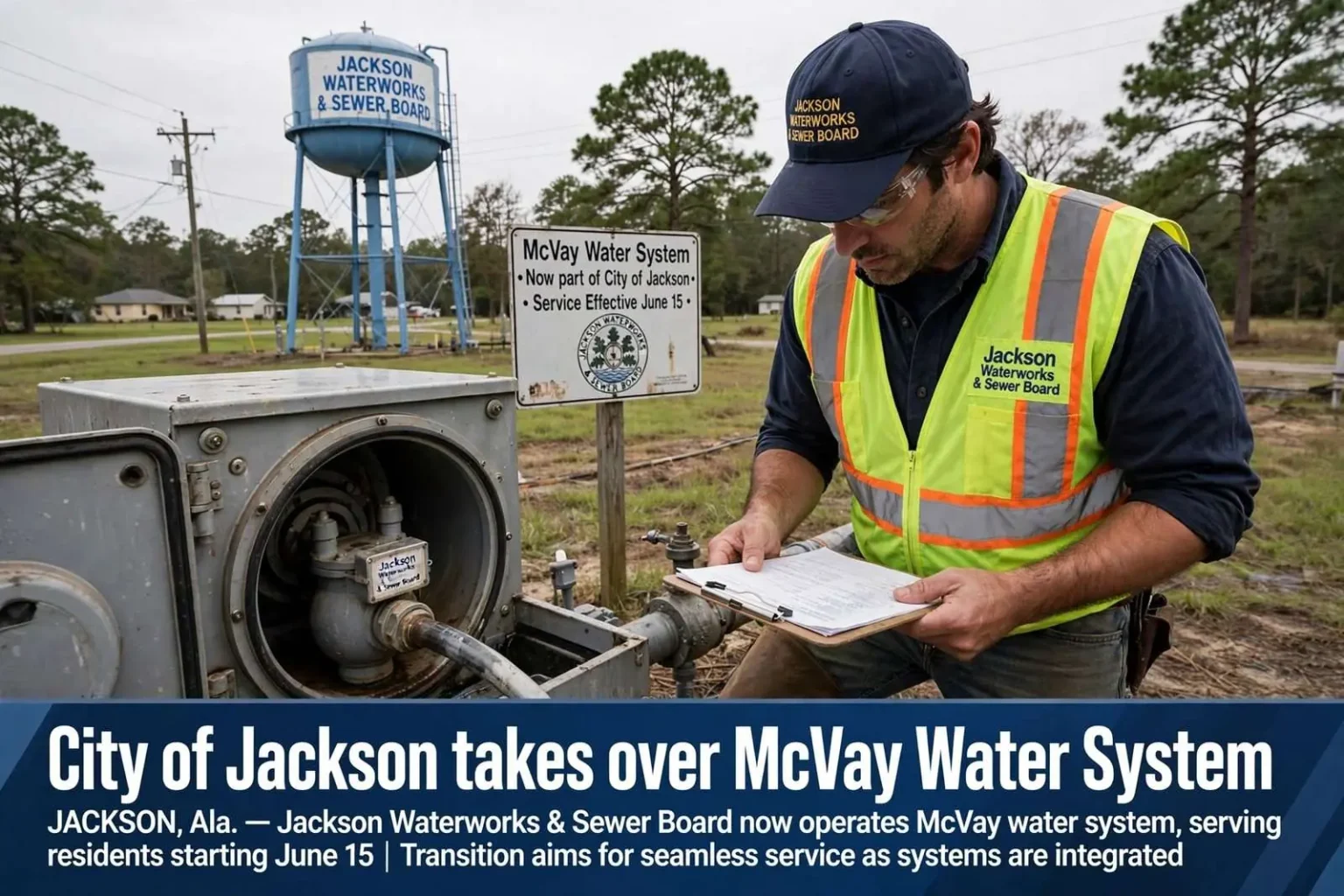
JACKSON, Ala. — The City of Jackson has taken a major step in expanding its public utilities, announcing that the Jackson Waterworks and Sewer Board has acquired the McVay Water System. The change took effect June 15, adding the McVay service area to the network operated by the city’s long-standing water and sewer utility.
The acquisition means that customers served by the McVay Water System are now customers of the Jackson Waterworks and Sewer Board, which will handle billing, maintenance, repairs, and customer service for the newly added territory. City officials emphasized that the transition is intended to be seamless for residents, but they acknowledged that any change of this scale can produce questions and short-term disruptions as systems are combined.
With that in mind, McVay residents are being urged to contact the city directly if they experience any issues with their service or any interruptions in water availability. Officials have stressed that reporting problems promptly allows utility crews to address them quickly, particularly during the early weeks of the transition when staff are still mapping lines, valves, and equipment that previously fell under a different operator.
What the Acquisition Means for McVay Customers
For residents of the McVay community, the most immediate change is the entity behind their tap water. The Jackson Waterworks and Sewer Board now owns and operates the system, which places McVay customers under the city’s established procedures for customer accounts, meter reading, rate structures, and service requests. Customers should expect communication from the city regarding billing arrangements as accounts are transferred.
Municipal acquisition of a small private or community water system is a familiar pattern across rural Alabama. Many small systems were built decades ago to serve scattered rural neighborhoods and were operated with limited staff and limited budgets. Over time, the cost of meeting modern water quality standards, replacing aging lines, and maintaining pumps and storage tanks can outpace what a very small system can generate through its rates. Consolidation under a larger municipal utility gives those customers access to a bigger operational base.
A larger utility brings several practical advantages. It has more personnel, meaning a line break or pump failure does not depend on a single operator being available. It has greater purchasing power for parts, chemicals, and equipment. It can spread the fixed costs of laboratories, testing, engineering, and regulatory compliance across a broader customer base. And it typically has a long-term capital planning process, which helps sequence pipe replacements and system upgrades in a deliberate way rather than reacting to failures one at a time.
City leaders pointed to those benefits when the acquisition was announced. Bringing the McVay system under the Jackson Waterworks and Sewer Board ties a neighboring community to a utility with decades of operational history, established relationships with engineering firms and regulators, and a track record of maintaining service through storms and other emergencies.
About the Jackson Waterworks and Sewer Board
The Jackson Waterworks and Sewer Board is the municipal utility responsible for water and sewer service in Jackson, the county seat of Clarke County. Like other municipal boards across Alabama, it operates under state law governing municipal utilities, with a board that oversees rates, budgets, and capital projects for the system. The board’s operations include wells or surface water sources, treatment processes, storage, and the distribution network of pipes that delivers water to homes and businesses.
Running a water utility in South Alabama comes with distinctive demands. The region’s climate produces heavy rain, which stresses drainage and can complicate sewer systems, while summer heat drives peak demand that the supply and pumping capacity must accommodate. Hurricanes and severe storms occasionally pass through the region, and utilities must be prepared with backup power, emergency supplies, and crews ready to restore service after outages. An experienced board and staff make those routine, which is precisely what an acquisition like this is meant to bring to a smaller system.
Regulatory oversight adds another layer. Public water systems in Alabama are regulated to meet federal and state drinking water standards, with required testing, monitoring, and reporting. Compliance obligations cover everything from bacterial sampling to disinfection byproducts, and systems must document their results. For a small operator, keeping up with the full weight of those requirements can be a genuine challenge; for an established municipal board, it is part of normal operations.
Background: Jackson and the McVay Community
Jackson is the largest city in Clarke County, a mostly rural county in Southwest Alabama between the Tombigbee and Alabama rivers. The city serves as the county’s commercial and industrial center, with a history rooted in the timber industry and other manufacturing. As the county seat, Jackson hosts the courthouse and much of the region’s public administration, and its utility infrastructure is among the most developed in the area.
The acquisition fits a wider trend across the state. Water systems in Alabama regularly merge, transfer, or interconnect, driven by aging infrastructure, the rising technical demands of regulation, and the difficulty small systems face in funding major repairs. When a municipal board acquires a neighboring system, the usual goal is to stabilize service for the acquired customers while creating a more rational footprint for planning future improvements.
What Residents Should Do During the Transition
The city’s message to McVay residents is straightforward: communicate early. Customers with questions about their accounts, their rates, or their billing schedule should contact City Hall or the waterworks office rather than waiting for problems to resolve themselves. Anyone who notices a change in water pressure, discoloration, an interruption in service, or a suspected leak should report it so crews can investigate.
During system transitions, some issues are administrative rather than physical. Meters may be re-registered, account numbers may change, and first bills under new ownership sometimes reflect partial billing periods or updated rate structures. Residents who understand that the Jackson Waterworks and Sewer Board is now their utility — and who reach out promptly with questions — generally find the transition far smoother than those who wait.
Physical issues matter just as much. When a utility inherits an unfamiliar network of lines, it takes time to learn where every valve and connection sits. Customer reports of low pressure or outages are often the fastest way for crews to locate and correct problems that the inherited system’s records never documented. That is why city officials have made a point of asking McVay residents to speak up about service issues and interruptions from day one.
Looking Ahead
The June 15 takeover marks the beginning of a longer process rather than its conclusion. In the months ahead, the board will be integrating records, assessing the condition of the McVay system’s lines and equipment, and folding the new territory into its maintenance schedules and capital planning. Customers may see crews working in the community as the utility maps and inspects its new assets.
For the City of Jackson, the acquisition extends the reach of its public infrastructure and reinforces the city’s role as the service hub of Clarke County. For McVay residents, it places their water service in the hands of an established utility with the staff, resources, and institutional experience to maintain and improve it. And for both, the immediate priority is the same: a clean transition, reliable service, and open communication as the McVay Water System becomes part of the Jackson Waterworks and Sewer Board’s network.
The transition also carries a customer-service dimension that city officials have highlighted. The Jackson Waterworks and Sewer Board’s office will be the single point of contact for McVay customers going forward, handling new account setup, billing questions, payment arrangements, and service requests. Residents who previously dealt with the McVay Water System’s own operator will now work with the city’s utility staff, and officials have encouraged customers to reach out with any uncertainty rather than assume how a procedure works.
Clear communication during a utility transition is more than courtesy; it is how a new operator learns its own system. Every report from a customer about pressure changes, outages, or meter questions gives utility staff information about the network they have inherited. Records for older rural systems are often incomplete, and the people who live on the lines are frequently the first to notice when something is not working as it should.
The Broader Context of Water System Consolidation
Those systems are now aging together. Lines installed sixty or seventy years ago are reaching the end of their practical lifespans, and the cost of replacement has grown far faster than the revenues of a small customer base. At the same time, treatment standards have tightened, testing requirements have multiplied, and the technical skills needed to operate a compliant system have expanded. A part-time operator with a handful of customers simply cannot carry all of that alone.
The result has been a steady movement toward larger operating entities. Municipal boards, county water authorities, and regional systems have absorbed smaller neighbors, either through purchase, merger, or management contracts. State agencies and engineering professionals generally view responsible consolidation as a positive development, because it places customers under operators with the resources to maintain service over the long term.
How a Municipal Takeover Typically Unfolds
An acquisition like the McVay transaction involves more than signing a document. Before the effective date, the acquiring utility and the seller conduct due diligence on the physical system: the condition of lines, the age of pumps and meters, the location of valves, and the state of any storage or treatment assets. Financial records, customer lists, and billing histories are reviewed so that accounts can be transferred cleanly.
For customers, the practical markers of the transition usually appear in sequence. First comes notification of the new utility contact and payment arrangements. Then billing begins under the new operator, sometimes with a prorated or adjusted first cycle. Over the following months, customers may see unfamiliar trucks and crews in the area as the new operator inspects and maps its inherited assets. None of this is unusual, and each step moves the system toward steady-state operation under the new owner.
What This Means for Jackson
For the City of Jackson, the acquisition is consistent with the city’s longstanding role as the anchor community of Clarke County. Jackson’s utility infrastructure serves not only the city itself but has historically supported growth and development in the surrounding area. Adding the McVay system expands that footprint and extends the city’s public-service capacity to more of the county’s residents.
Growth in utility territory also supports the city’s broader planning. Water and sewer capacity shapes where housing can be built and where businesses can locate, and utilities that plan their expansion deliberately are better positioned to support economic development. Bringing a neighboring system into a well-run municipal board reduces the risk that service quality in the area drifts downward as the old system ages.
The Bottom Line for Residents
The essentials for McVay customers are simple. The Jackson Waterworks and Sewer Board now owns and operates the water system serving the community, effective June 15. Billing and service questions go to the city’s utility office. Any interruption in service, drop in pressure, or other problem should be reported promptly so crews can respond.
Transitions of this kind tend to fade into normalcy within a few months, as accounts settle into a routine and the new operator becomes familiar with every mile of inherited line. Until then, the city has asked for exactly the kind of engagement that makes transitions work: patience, communication, and prompt reports from residents when something with their service does not look right.
The acquisition of the McVay Water System is, in the end, a quiet but consequential piece of public infrastructure news — the kind of change that rarely makes headlines beyond the community it affects, yet shapes daily life there every time a resident turns on the tap. With the June 15 takeover complete, the focus now shifts to the careful work of integration and the steady delivery of reliable water service to the McVay community under the City of Jackson.