Clarke County Schools Push for Bus and Safety Funding as High Schools Raise Grades
Clarke County school leaders want more state help replacing aging buses and funding school safety in 2027, while the district held its B on the state report card.
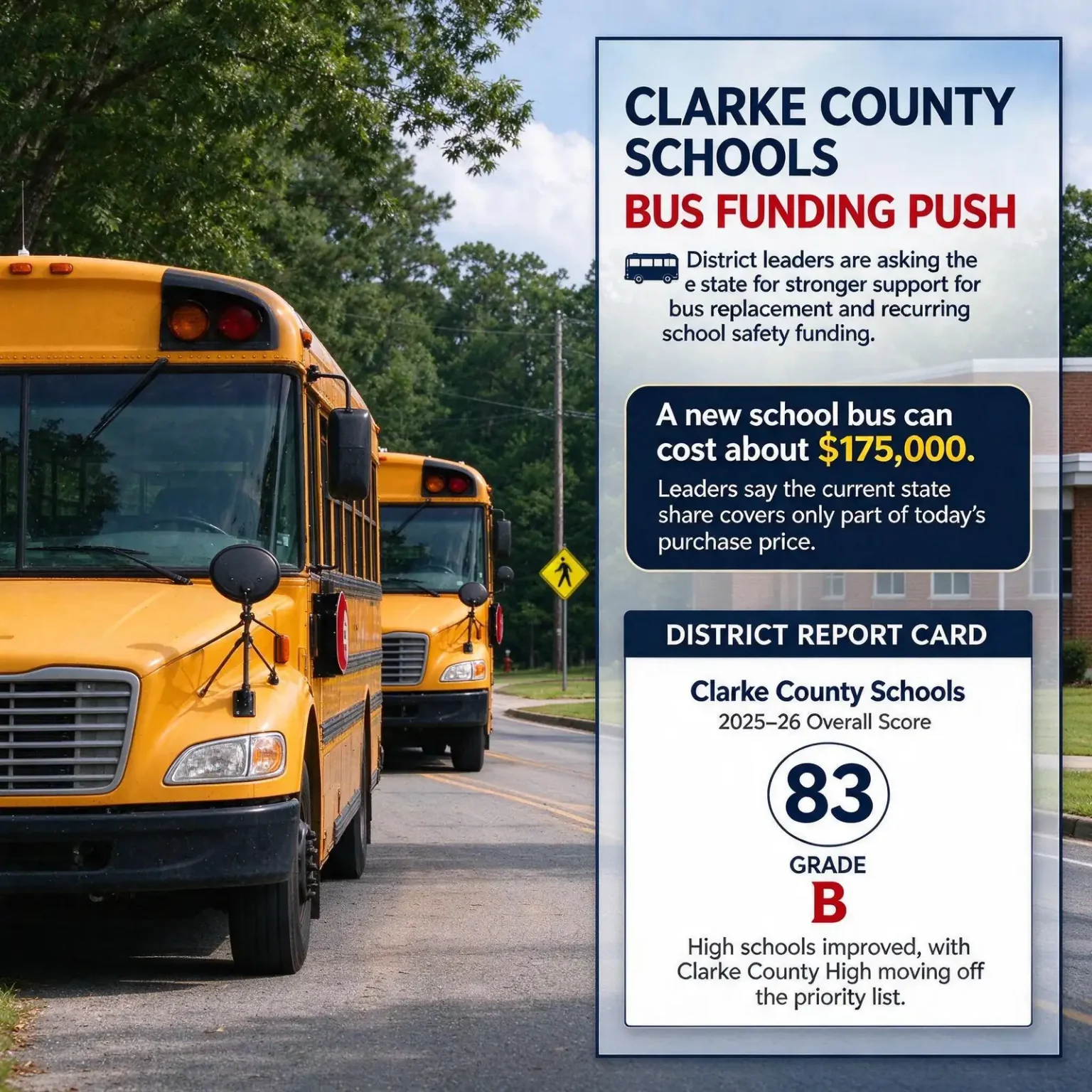
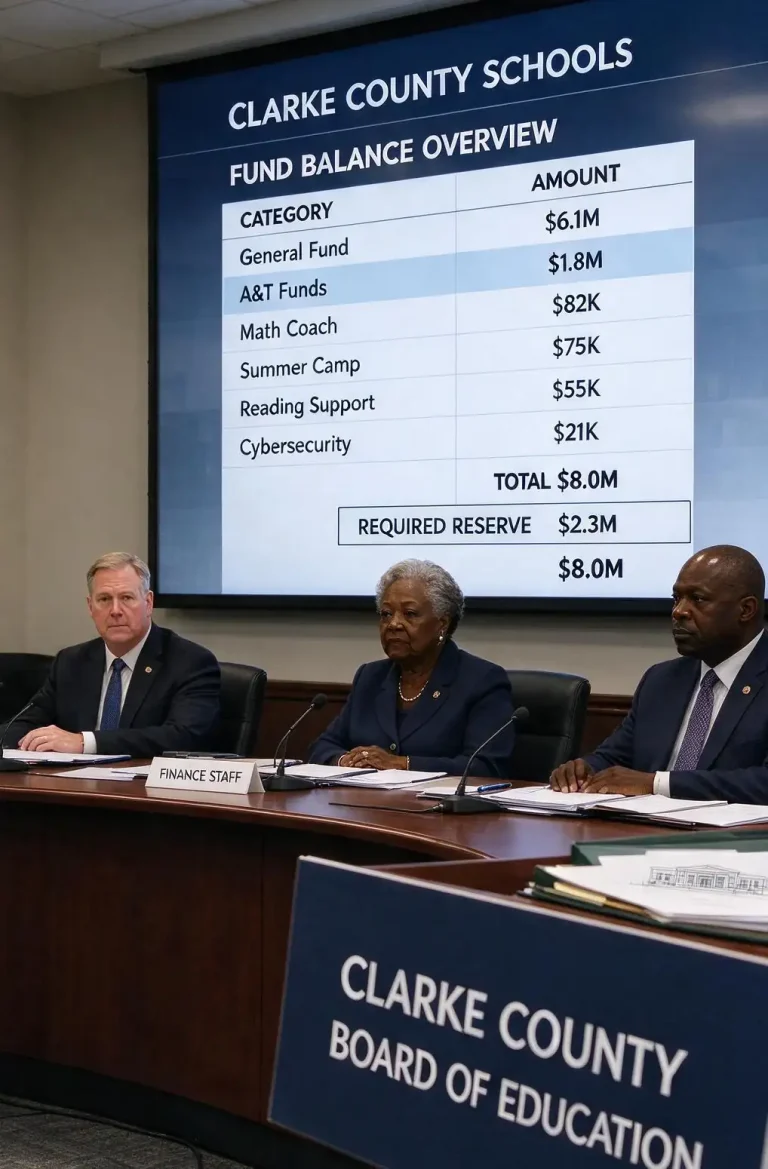
CLARKE COUNTY, Ala. — New school buses carry a steep price tag, and Clarke County school leaders say the state’s share of that cost has not kept pace. At the Clarke County Board of Education’s Nov. 19 meeting, district officials outlined a list of funding requests that Alabama superintendents intend to bring to state lawmakers in 2027, led by more money for bus replacement and a permanent stream of funding for school safety.
The same meeting brought good news on academics. The district’s 2025-26 state report card came in at 83, a B, matching the previous year’s grade, and both of the county’s high schools improved their scores, with one climbing out of the state’s list of priority schools.
The cost of keeping students rolling
Transportation is a major expense for a rural district like Clarke County, where many students ride long routes between home and school. District officials told the board the system is weighing the purchase of 18 or 19 new buses. Quotes have come in at roughly $175,000 per bus, which would put the total somewhere between about $3.15 million and $3.33 million.
The state does help. Alabama’s fleet renewal program sends school systems yearly payments for qualifying buses, calculated on a 10-year depreciation schedule. But district leaders estimated that the state’s support works out to only about $75,000 per bus across that 10-year cycle, well below today’s purchase price, and they said that amount needs to go up.
That gap leaves local systems to cover the difference or keep older buses on the road longer. Bus prices nationwide have climbed in recent years along with the cost of materials, engines and safety equipment, putting added pressure on district budgets.
Why bus age matters
School buses are built to be among the safest vehicles on the road. According to the National Highway Traffic Safety Administration, students are far safer riding a school bus to and from school than traveling by car, thanks to features such as compartmentalized seating, bright coloring, flashing lights and stop arms.
Even so, older buses tend to cost more to maintain as they age, and they can lack newer equipment found on recent models, such as improved emissions systems, updated camera systems and other safety technology. Replacing buses on a regular schedule helps districts limit breakdowns, control repair costs and keep routes running on time.
For families, a reliable fleet means fewer delays and missed pickups. For districts, the challenge is paying for replacements without pulling money away from classrooms, which is why state support through the fleet renewal program is so important to rural systems.
Safety, special education and class size
School safety ranks near the top of the list. Officials said superintendents across the state want legislators to make safety a regular, recurring line item in the Education Trust Fund budget, rather than depending on supplemental dollars that are now running out. Keeping schools safe will remain a top priority, the district stressed, and that requires a dependable source of money.
Recurring funding matters because many safety measures carry ongoing costs. Expenses for school resource officers, secure entry systems, cameras, communications equipment and staff training continue year after year, which makes one-time grants a difficult fit.
District leaders also asked for additional special education funding. Federal law requires public schools to provide a free appropriate public education to students with disabilities, and the cost of specialized staff, services and equipment often exceeds the funding schools receive for those students.
Another request focuses on teachers. Officials said they want the state to provide funding for additional teaching positions so the district can shrink class sizes in grades four through eight, the upper elementary and middle school years when students build skills that carry into high school.
A possible new revenue source
District leaders said they expect lawmakers to discuss sending a portion of the money raised through Alabama’s Simplified Sellers Use Tax program directly to local school systems.
Under that program, sellers that take part collect a flat 8% tax on qualifying sales made into Alabama, including purchases made online. The money is divided between the state and local governments, and part of the state’s portion is deposited in the Education Trust Fund. The program was created to simplify how remote sellers, such as online retailers without stores in Alabama, collect and send in tax on purchases shipped to Alabama customers.
When lawmakers return
The Alabama Legislature is set to convene Jan. 12 for an organizational session, the brief meeting held after a statewide election to swear in members and choose leadership. The regular session is scheduled to start Feb. 2.
Under the state constitution, regular sessions are limited to 30 legislative days within a period of 105 calendar days. Writing the Education Trust Fund budget, which pays for public schools, community colleges and universities, is one of the main tasks each year. The fund draws most of its money from state income and sales taxes, so its size rises and falls with the economy.
High schools post gains on report card
The brightest spot in the academic report came from Clarke County High School, which recorded the biggest improvement in the district. Its score jumped eight points, from 64 to 72, raising its grade from a D to a C. Officials said the gain moved the school off the state’s priority list, a designation reserved for qualifying schools graded D or F.
Jackson High School also improved, adding six points to go from 74 to 80. That moved the school up from a C to a B.
In the middle grades, Wilson Hall Middle School gained six points to finish at 77. Not every school moved up, however. Four schools saw their overall scores decline, including Jackson Middle School, which fell nine points to 72.
The district’s overall score of 83 earned a B for the second year in a row.
Growth scores stand out
District leaders highlighted academic growth, a measure of how much students improve from one year to the next, as a particular strength. Every one of the district’s seven schools scored higher than 71 in that category.
Two schools posted especially strong numbers, with Joe M. Gillmore Elementary School and Jackson Intermediate School both reaching 92.8 on the growth measure. Wilson Hall Middle School and Grove Hill Elementary School each came in at about 89.
Growth is often viewed by educators as a fairer measure than test scores alone because it focuses on progress. A school serving many students who start behind can still show strong growth if those students make significant gains during the year.
Attendance better than state average
The district also outperformed the state on chronic absenteeism. Across Clarke County’s schools, 9.26% of students were chronically absent, while the statewide figure stood at 10.54%.
Jackson Intermediate had the lowest rate in the system at 4%, with Jackson Middle close behind at 4.2%.
Chronic absenteeism describes students who miss a large share of the school year for any reason, including excused and unexcused absences. Nationally, it is commonly defined as missing about 10% or more of school days. Research has tied frequent absences to lower reading and math achievement and higher dropout risk, which is why it has become a standard part of school accountability systems.
How Alabama grades its schools
Alabama issues A-through-F report cards for each school and district through the Alabama State Department of Education. The grades are built from several indicators:
- Academic achievement, based on state test results.
- Academic growth, measuring year-over-year student progress.
- Chronic absenteeism.
- Progress in English language proficiency, for schools with English learners.
- For high schools, graduation rates and measures showing whether students are ready for college or a career.
Because the formula blends several measures, a school’s grade can move up or down even when its test scores hold steady, depending on changes in attendance, growth or graduation outcomes.
About the district
Clarke County Schools serves students across much of Clarke County in southwest Alabama, with schools in communities including Grove Hill, the county seat, and Jackson. The city of Thomasville, also in Clarke County, operates its own separate school system.
Like many rural districts, Clarke County covers a large geographic area, which makes bus service a central part of daily operations and explains why the cost of replacing buses is a pressing concern for school leaders.
What happens next
The funding priorities discussed at the meeting will be part of the conversation as superintendents and education groups meet with legislators ahead of the 2027 session. Decisions on bus funding, school safety money, special education and teacher units will largely be settled when lawmakers pass the Education Trust Fund budget during the regular session that begins in February.
Parents and residents who want to follow the district’s plans can attend Clarke County Board of Education meetings, which are open to the public, or contact their state legislators about education funding priorities.