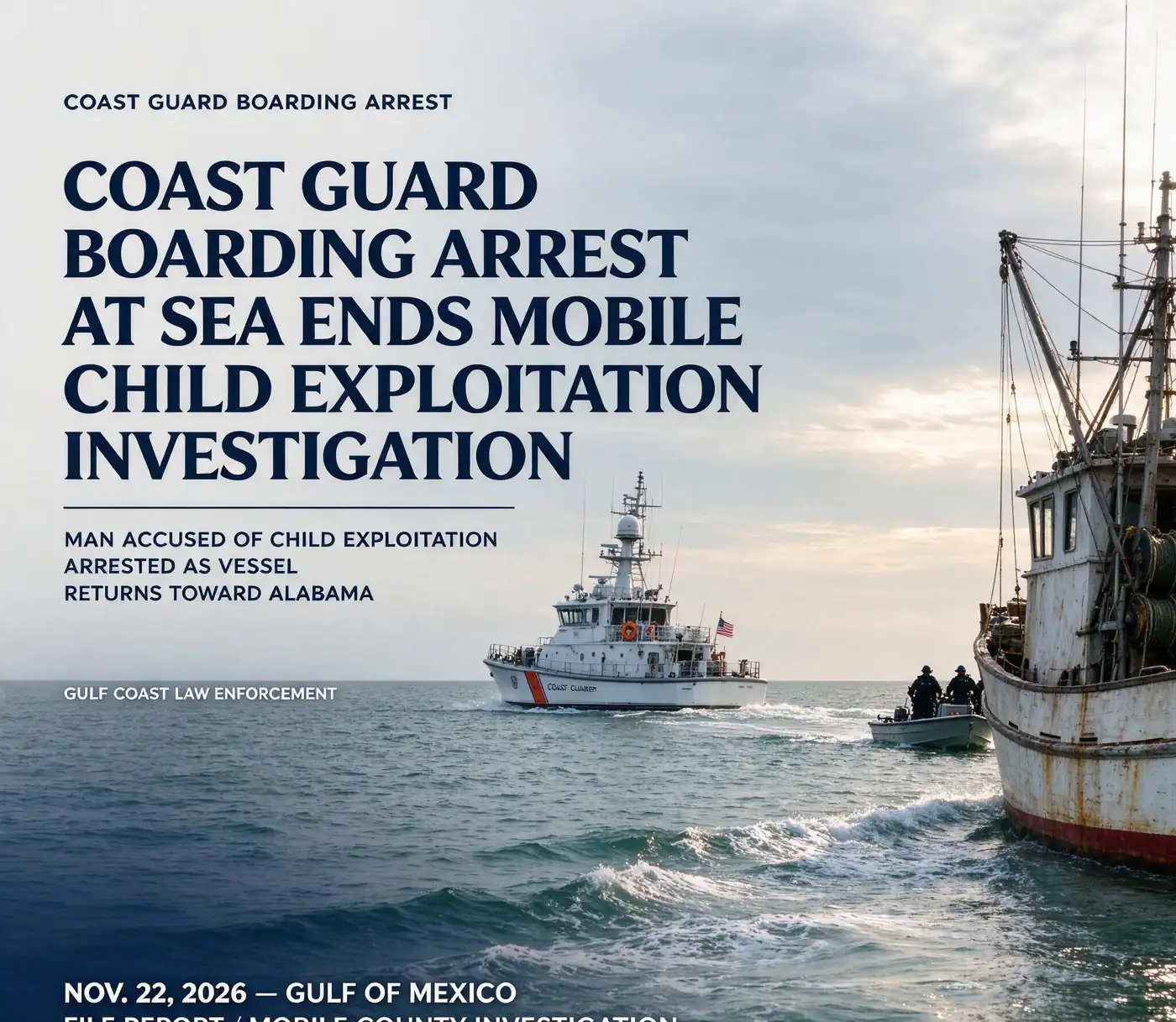
MOBILE, Ala. — A man accused of possessing child sexual abuse material is now in the Mobile County Metro Jail after a Coast Guard boarding arrest at sea, carried out when the commercial fishing boat he was on headed back toward Alabama on Sunday. The Mobile County Sheriff’s Office said its Internet Crimes Against Children Unit led the case, with the U.S. Coast Guard helping to stop and board the vessel.
He faces five counts of Unlawful Possession of Child Pornography, the charge name used under Alabama law. His arrest capped an investigation that started in October, moved through digital evidence and a search on land, and ended on the water.
What to know about the case
- Charges: Five counts of Unlawful Possession of Child Pornography.
- Investigating agency: The Mobile County Sheriff’s Office Internet Crimes Against Children (ICAC) Unit.
- Assisting agencies: The U.S. Coast Guard and the sheriff’s office Special Operations Unit.
- Investigation opened: October 2026.
- Search warrant served: Nov. 13, 2026, at a home in Mobile.
- Arrest: Sunday, Nov. 22, 2026, on a commercial fishing boat that was heading back toward Alabama waters.
- Status: Booked into the Mobile County Metro Jail. He is presumed innocent unless proven guilty in court.
From digital evidence to a Coast Guard boarding arrest
Sheriff’s investigators said they opened the case in October. Detectives obtained and served electronic search warrants, a step that allows law enforcement to collect digital records with a judge’s approval, and the information gathered gave them probable cause to seek arrest warrants on several possession counts.
On Nov. 13, ICAC detectives, backed by the sheriff’s office Special Operations Unit, served a search warrant at a home in Mobile. While working that part of the case, investigators found out that the man they were looking for was not on land at all; he was on board a commercial fishing boat out in the waters off Louisiana.
That presented a practical problem, since the vessel was operating offshore, beyond the reach of a routine traffic stop or a knock on the door. Investigators kept working the case, and on Sunday, Nov. 22, they determined that the boat was making its way back toward Alabama’s waterways.
The sheriff’s office then worked with the Coast Guard to meet the vessel, board it and locate the man. He was arrested without incident and later booked into the Mobile County Metro Jail on the five counts.
The sheriff’s office said the arrest shows how determined its ICAC investigators are and how much local agencies rely on close working relationships with federal partners. The agency added that it would use every resource available to bring people accused of exploiting children before the courts, whether those suspects are on land or far out at sea, and it thanked the Coast Guard for its help with the operation.
Why the Coast Guard can board vessels at sea
The Coast Guard is unique among the nation’s armed services because it is also a federal law enforcement agency. Operating under the Department of Homeland Security in peacetime, it has broad legal authority to stop, board and inspect vessels subject to U.S. jurisdiction, including commercial fishing boats.
That authority makes the Coast Guard a natural partner when local investigators need to reach someone on the water. Along the northern Gulf Coast, the service routinely works with sheriff’s offices, police departments and state agencies on search and rescue, safety enforcement and criminal cases.
Commercial fishing crews can spend days or weeks offshore, sometimes far from cellphone coverage. Coordinating a boarding as a vessel heads back to port allows officers to make an arrest safely in a controlled setting rather than waiting for a suspect to come ashore on an uncertain schedule.
What an ICAC unit does
Internet Crimes Against Children units are part of a national network created to investigate technology-facilitated crimes against children. The ICAC Task Force Program was launched in 1998 and is supported by the U.S. Department of Justice’s Office of Juvenile Justice and Delinquency Prevention.
Today the program includes 61 coordinated task forces across the country, made up of thousands of affiliated federal, state and local agencies. Local units, like the one in the Mobile County Sheriff’s Office, investigate cases involving the online exploitation of children, including the possession, distribution and production of child sexual abuse material and attempts to lure children online.
ICAC investigators receive specialized training in digital forensics, undercover online work and interviewing children in a trauma-informed way. Many cases begin with tips that flow from technology companies through the National Center for Missing & Exploited Children to law enforcement agencies, although the sheriff’s office has not said how this particular investigation started.
Why the term child sexual abuse material matters
Alabama’s criminal code and many older statutes still use the term child pornography for these charges, which is why it appears in the formal charge name. Child advocates, NCMEC and many law enforcement agencies now prefer the phrase child sexual abuse material, often shortened to CSAM.
The reason is straightforward: every image or video of this kind records the sexual abuse of a real child. Advocates say the word pornography can wrongly suggest consent or a legitimate product, while child sexual abuse material describes what the content actually is and the harm done to the victims depicted in it.
Possessing such material is a felony under Alabama law, and similar conduct can also be prosecuted under federal law. Prosecutors may bring separate counts for individual images or files, which is one reason these cases often involve multiple charges.
How the case will move through the courts
Being arrested and charged is not the same as being convicted. The man is presumed innocent, and the state must prove any charge beyond a reasonable doubt before he could be found guilty.
In Alabama, a person arrested on felony charges generally appears before a judge or magistrate soon after booking, when bond and release conditions are addressed. Felony cases typically start in district court, where a preliminary hearing may be held to determine whether there is probable cause to send the case to a grand jury.
If a grand jury returns an indictment, the case moves to circuit court for arraignment, where the defendant enters a plea. From there, the case may be resolved through a plea agreement, dismissed, or taken to trial before a jury.
How to report suspected child exploitation
Anyone who encounters child sexual abuse material online, or who suspects a child is being exploited, can make a report to the National Center for Missing & Exploited Children’s CyberTipline. Reports can be submitted online at report.cybertip.org or by phone at 1-800-843-5678, and the line is available around the clock.
Federal law requires electronic service providers, such as social media and email companies, to send reports of apparent child sexual abuse material to the CyberTipline. NCMEC analysts review those tips and make them available to the appropriate law enforcement agencies, including ICAC task forces.
If a child is in immediate danger, call 911 first. Residents can also contact their local police department or sheriff’s office directly, and the FBI accepts tips online at tips.fbi.gov.
A few simple precautions help protect both the person making a tip and the integrity of an investigation. When reporting, safety experts offer some general guidance:
- Do not download, copy, screenshot or forward suspected abuse material, even to share it with police; doing so can itself be a crime.
- Note where you saw the material, such as a website address, username or platform, and include that information in your tip.
- Preserve messages or other evidence on your own device without sharing them, and let investigators collect them.
- Talk with children about online safety, and let them know they can come to a trusted adult without fear of punishment.
NCMEC also offers a free service called Take It Down, which helps young people remove or stop the online spread of sexually explicit images taken of them before they turned 18. Families can find resources on online safety through NCMEC’s educational programs as well.
Signs parents and caregivers can watch for
Child safety organizations encourage adults to stay involved in children’s digital lives without relying on fear. Open, ongoing conversations about apps, games and online friends make it more likely that a child will speak up when something feels wrong.
General warning signs that a child may be facing online exploitation can include secrecy about devices, sudden withdrawal or anxiety after being online, new gifts or money from unknown sources, and contact with adults the family does not know. None of these signs proves that abuse is happening, but they are reasons to check in calmly and, when warranted, to seek help from law enforcement or the CyberTipline.
What happens next
The man now faces five possession counts, and his case will proceed through the Mobile County court system. The sheriff’s office has not said whether more charges are expected or whether federal authorities will become involved in the prosecution.
Court dates and any bond decisions will be set as the case moves forward. As with any criminal charge, the allegations must be proven in court, and he is entitled to a defense and a fair process.