
Coast Guard Boat Crew Rescues Swimmer Caught in Current Off Pelican Island
A swimmer attempting a nearly mile-long crossing to Pelican Island Sandbar was rescued by a Coast Guard boat crew after becoming trapped in a powerful.
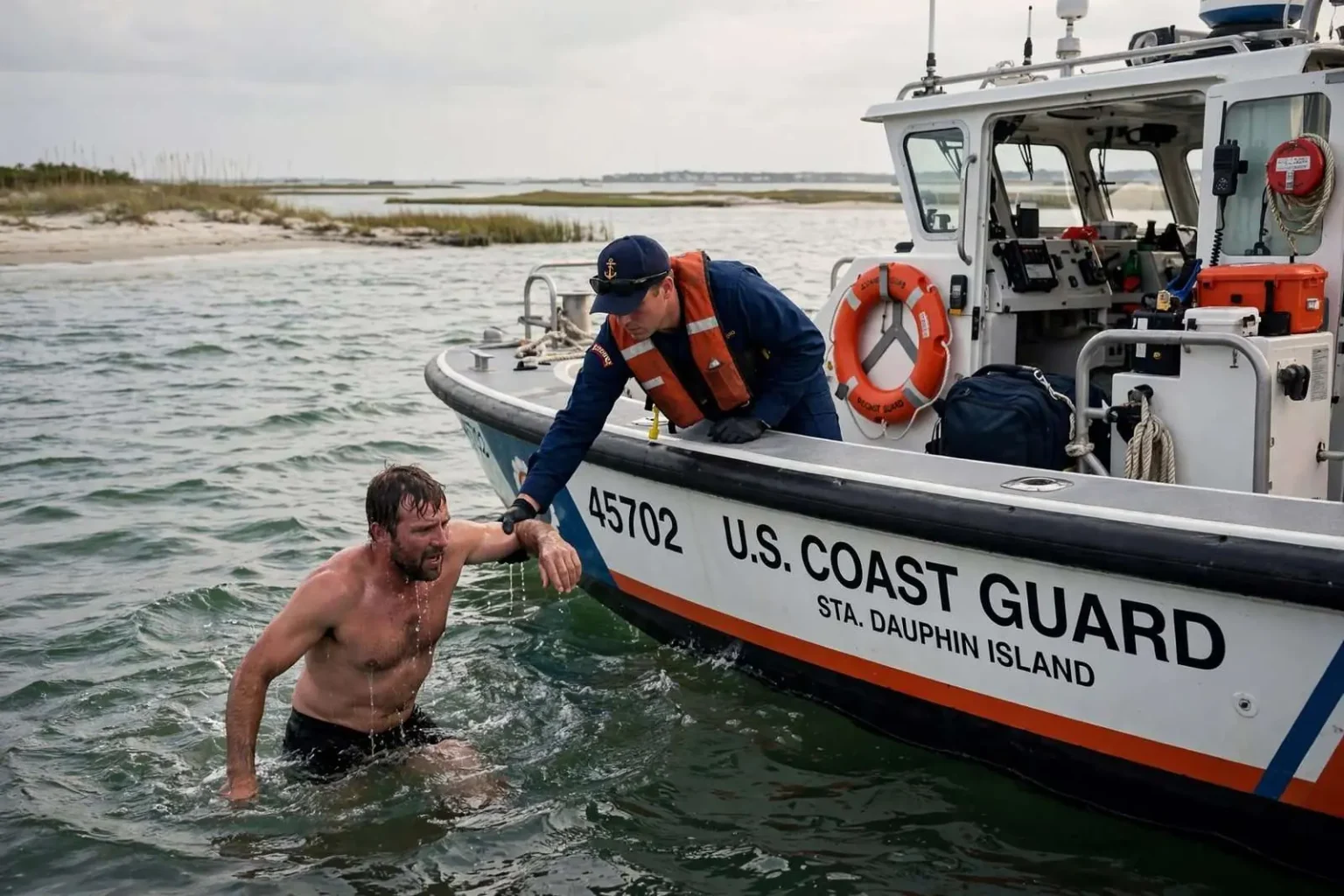
A man who attempted to swim from the southern tip of Pelican Island to a nearby sandbar was pulled from the water by a Coast Guard boat crew after powerful currents prevented him from making the crossing. The rescue ended what could have been a fatal afternoon in the open water between two of the barrier islands that shelter Alabama’s Gulf shoreline — and it came with a pointed warning from the rescuers about how quickly a recreational swim can go wrong.
Sector Mobile watchstanders received the report around 5 p.m. Thursday from a woman on the beach whose husband had set out for the Pelican Island Sandbar — a distance of nearly a mile — and had not returned after an hour and a half. The call set in motion a search over open water where the swimmer, fighting a current he could not escape, had drifted far from both his starting point and his destination.
A 45-foot Response Boat-Medium crew from Coast Guard Station Dauphin Island was directed to the area and located the man in the water. He told rescuers he had become caught in a current that he could not swim out of and was not wearing a life jacket at the time. The boat crew brought him to the station, where he was evaluated by EMS and found to be in stable condition — exhausted and fortunate, but alive.
A search between the islands
Dauphin Island Fire and Rescue assisted with a beach search during the operation, covering the shoreline while the Coast Guard boat crew worked the water. Coordinated searches like this one are standard when someone is reported missing in coastal waters: crews work both the last known position and the areas that wind and current are likely to have carried the swimmer, racing against fatigue, hypothermia and the growing distance between the victim and everyone looking for him.
The hour-and-a-half gap between the swimmer’s departure and the report to authorities was time the current used well. A person swimming against a tidal current can be carried hundreds of yards while making no progress at all, and the sandbar he was aiming for — like the sandbars that form and dissolve along the barrier islands — offered no shelter from the flow moving between it and the island.
“This swimmer is fortunate, and it was prudent he had a loved one on the beach who was familiar with his swim plan,” said Cmdr. Kara Lavin, search and rescue mission coordinator at Sector Mobile. “We advise that everyone tells a friend or family member their plans when open water swimming. The currents can catch people off-guard, and the absence of a life jacket put this swimmer at serious risk.”
The currents around the barrier islands
The waters between Pelican Island and the sandbar are subject to tidal flows that can move faster than a person can swim, particularly on an outgoing tide. What looks like a manageable distance from shore can quickly become a life-threatening situation when the water is moving. Swimmers who set out from the beach on a slack tide — the brief window when the current reverses — often find that conditions have changed entirely by the time they try to return.
Pelican Island sits just west of Dauphin Island as part of the same barrier chain, and its sandy shallows and exposed sandbars have made it a favorite destination for boaters and beachgoers. But the passes and channels between the islands concentrate tidal water moving in and out of Mississippi Sound and the Gulf, and the flow through those gaps on a falling tide can exceed two knots — a speed that even strong swimmers cannot match for long.
Currents around barrier islands can overwhelm even strong swimmers. The danger is compounded by a common miscalculation: a swimmer who fights the current directly exhausts himself within minutes, while the same swimmer floating with the current and signaling for help preserves the strength that makes a rescue possible. Safety experts’ standard advice — swim parallel to shore to escape a current rather than against it — applies with even more force in open water between islands, where the “shore” may be a mile away.
How the rescue worked
The Response Boat-Medium that found the swimmer is one of the workhorses of the Coast Guard’s coastal search and rescue fleet — fast enough to cover open water quickly, large enough to handle the seas between the barrier islands, and equipped to pull a person from the water and begin care on the spot. Crews from Station Dauphin Island train constantly for exactly this scenario, and their familiarity with the local waters, tides and sandbars factors heavily into how quickly a search converges on a drifting swimmer.
Once the man was aboard, the crew ran for the station, where EMS evaluated him. The stable condition he arrived in reflected both his own endurance and the speed of the response — a chain that started with a call from the beach and ended with a boat alongside a man who, without it, would likely have been swept toward the open Gulf as darkness fell.
Lavin’s two precautions
Cmdr. Lavin emphasized two precautions: always let someone on shore know exactly where you are swimming and when you expect to return, and wear a life jacket — or at minimum a personal flotation device designed for open-water swimming — any time you venture beyond the immediate shoreline. The first gives rescuers a search plan before they launch; the second buys the time that search requires.
The husband’s case illustrates both. His wife knew his swim plan, which meant Sector Mobile watchstanders could immediately direct a boat crew to the right stretch of water rather than searching blind. And while he was not wearing a flotation device, his ability to stay afloat and keep fighting until the boat arrived — nearly two hours after he entered the water — kept the incident in the category of rescues rather than recoveries.
Coast Guard officials across the Gulf Coast repeat the same statistics-heavy warning every summer: a large share of drowning victims were never wearing a life jacket, and many were engaged in exactly this kind of casual recreation — a swim between the boat and the beach, a wade out to a sandbar — that no one considers dangerous until it is. Open-water swimming without flotation, they stress, is the marine equivalent of driving without a seatbelt: the odds hold until, suddenly, they don’t.
A reminder for the sandbar season
The Pelican Island Sandbar and its counterparts along Dauphin Island draw crowds of boaters every warm weekend, with vessels anchoring in the shallows and swimmers wading and paddling between them. The scene feels safe — waist-deep water, other boaters nearby — but the channels between sandbars carry the same tidal currents as the deeper passes, and conditions shift with the tide tables in ways casual visitors rarely track.
Rescuers advise visitors to the sandbars to check tide predictions before heading out, to keep flotation devices aboard and within reach, to keep children within arm’s reach in any moving water, and to assume that the swim back will be harder than the swim out. A plan shared with someone on the beach, as this rescue showed, is the difference between a search that starts with a map and one that starts with a guess.
For the swimmer rescued Thursday, the lesson arrived without lasting cost: an evaluation at the station, a stable condition, and a story about the current that nearly carried him away. For everyone else headed to the barrier islands this season, Sector Mobile’s message is the one the commander put on the record — tell someone your plan, wear the flotation device, and respect water that moves faster than you do.
The watchstanders behind the rescue
Behind every open-water rescue is the watchroom that turns a phone call into a search plan. Sector Mobile, headquartered in Mobile, coordinates search and rescue across a stretch of the central Gulf Coast that includes Alabama’s entire shoreline and part of Mississippi, standing watch around the clock and deciding what assets to launch, where to send them and when to expand a search. Watchstanders take the information a caller provides — last known position, time in the water, swim plan, sea conditions — and convert it into drift projections that tell a boat crew where to look first.
In Thursday’s case, that calculation was relatively straightforward because the caller knew so much: her husband’s starting point, his destination, the distance involved and the time since he left. That is exactly the information Cmdr. Lavin’s precaution about sharing a swim plan is meant to provide. Search coordinators say the first hour of a missing-swimmer case is spent reconstructing what the caller could have supplied in the first five minutes of a call — a gap that grows deadlier with every knot of current.
The barrier islands’ hidden hazards
The chain of barrier islands and sandbars along Alabama’s coast is dynamic terrain, reshaped by every storm, tide and current. Sandbars appear and migrate; channels that were deep last summer may be shallow this year; and the water moving between the islands funnels through gaps that accelerate the flow, the way a river speeds up between narrow banks. Boaters who visit regularly learn to read the water’s surface — ripples and color changes marking where the current runs — but casual swimmers usually cannot.
Outgoing tides are the most dangerous window, because the water draining from Mississippi Sound and the back bays concentrates in those channels on its way to the Gulf. A swimmer caught in that outflow is being carried toward open water the entire time he fights it, which is why rescuers say the instinct to swim straight back to the beach is almost always the wrong move. Floating, signaling and conserving energy — while wearing flotation — is what turns a dangerous drift into a successful rescue.
Thursday’s outcome was the system working as designed: an informed caller, watchstanders who moved quickly, a well-drilled boat crew from Station Dauphin Island, and a helping hand from Dauphin Island Fire and Rescue on the beach. The swimmer who walked away owes that outcome to all of them — and to the warnings, repeated by the Coast Guard every season, that the Gulf’s inviting shallows hide currents that do not care how strong a swimmer is.


