
Coast Guard Helicopter Rescue Swimmer Pulls Unconscious Woman From Rip Current Off Dauphin Island
A Coast Guard helicopter crew deployed a rescue swimmer to save an unconscious woman caught in a rip current off Dauphin Island's public beach.
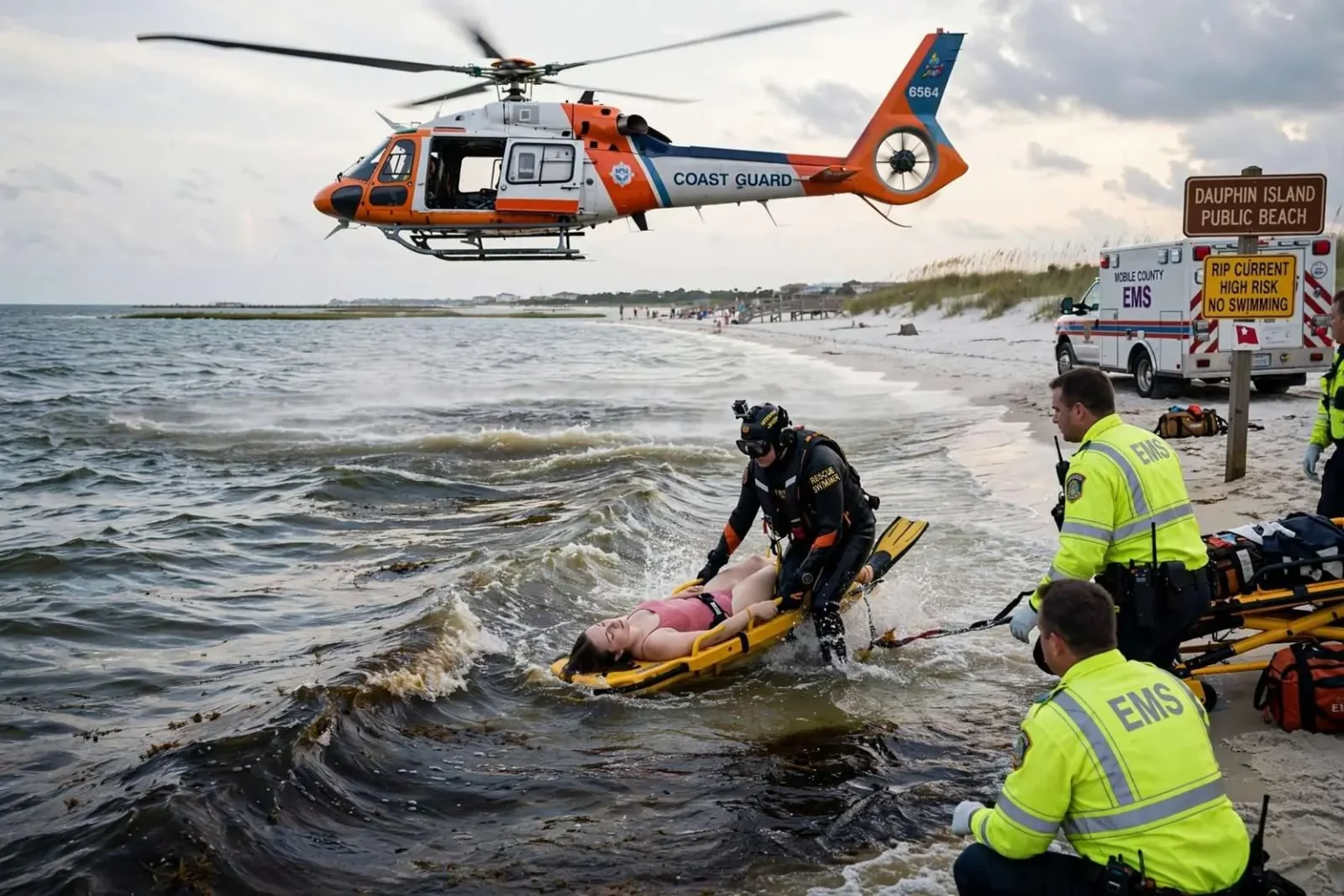
A Coast Guard rescue swimmer deployed from a helicopter pulled an unconscious woman to shore after she was caught in a rip current off Dauphin Island’s public beach Tuesday afternoon. The rescue unfolded quickly once the call came in, and it highlighted both the reach of the Coast Guard’s Gulf Coast air operations and the persistent danger that rip currents pose on the northern Gulf’s beaches.
Aviation Training Center Mobile received the report around 3 p.m. and launched an MH-65 Dolphin helicopter crew. The aircrew located the distressed swimmer and deployed a rescue swimmer, who swam the unconscious woman to the beach where EMS personnel were waiting. She was transported to USA Medical Hospital and listed in critical condition, according to the Coast Guard.
The response drew on one of the busiest Coast Guard aviation installations in the country. Aviation Training Center Mobile, based at the Mobile Regional Airport complex, is home to MH-65 Dolphin helicopter crews that stand watch over hundreds of miles of Gulf coastline, training rescue swimmers and aircrews for exactly the kind of short-fuse mission that played out over Dauphin Island. From launch to scene, a helicopter crew based in Mobile can be over the waters of Mobile Bay or the barrier islands in a matter of minutes, an advantage that matters enormously when a swimmer is fighting a current and the clock.
How a Helicopter Rescue Works
The mechanics of the rescue are standard for the Coast Guard but remarkable to witness. Once the aircrew located the person in the water, the helicopter positioned itself downwind and a rescue swimmer was deployed into the surf. Swimming with a rescue strobe, fins and a rescue litter, the swimmer reached the victim, secured her, and worked her back toward the beach, where emergency medical crews had staged to take over. In cases where a beach landing is impossible, hoists are used instead — but the swift passage to shore by the swimmer can save critical minutes when a victim is not breathing.
The Dauphin Island public beach sits at the western end of the island, where the white sand beaches meet the open Gulf just south of the Sand Island lighthouse channel. It is one of the most popular swimming spots in Mobile County, drawing families from Mobile, Baldwin County and beyond on summer afternoons — precisely the kind of crowded beach day when an unnoticed rip current can turn dangerous in seconds. The island’s beach-facing shoreline, like most of the northern Gulf, is regularly subject to rip current advisories issued by the National Weather Service office in Mobile, which flags elevated risk days with colored flag warnings posted at beach access points.
The incident prompted officials to reiterate the dangers of rip currents, which can pull even strong swimmers away from shore in a matter of seconds. The Coast Guard urges anyone heading to the beach to check local conditions before entering the water and, if caught in a rip current, to swim parallel to the shoreline until free of the current rather than fighting directly against it.
Rip Currents: The Gulf’s Quietest Killer
Rip currents are powerful, narrow channels of fast-moving water that can form at any beach with breaking waves. They account for the majority of surf-zone rescues and are a frequent cause of drowning along the Gulf Coast.
The physics are simple but unforgiving. When waves break over a sandbar or against a structure, the water they push shoreward has to find a way back out to sea, and it funnels through narrow channels — often gaps in the sandbar — at speeds that can exceed a swimmer’s ability to make headway. A person caught in the current instinctively tries to swim straight back to shore, grows exhausted, and goes under. The counterintuitive escape — swimming parallel to the beach until free of the current, then angling back in — is the single most important thing a Gulf Coast beachgoer can learn, and officials repeat it every summer because the lesson keeps failing to stick.
The National Weather Service and the Coast Guard point to the same warning signs again and again, because they work. A channel of churning, choppy water; a noticeable difference in water color, often darker or murkier where the current has stirred sand off the bottom; a line of foam, seaweed or debris moving steadily seaward; and a break in the incoming wave pattern — all are signatures of a rip. Anyone who spots one is advised to stay clear of that stretch of water and to keep children well away from it.
Staying Safe on Alabama’s Beaches
Officials recommend swimming at lifeguarded beaches when possible, never swimming alone, and learning to recognize the telltale signs of a rip current — a break in the wave pattern, discolored water, or a line of foam or debris moving steadily seaward.
Along the Alabama coast, the flag warning system is the first line of defense: green flags signal low hazard, yellow flags moderate surf and currents, red flags mean high hazard with strong currents expected, double red flags close the water entirely, and a purple flag warns of dangerous marine life. Dauphin Island and the beach communities of Gulf Shores and Orange Beach post these flags at public access points, and they are updated as conditions change through the day. Ignoring them is not only dangerous — double-red-flag days carry fines in Alabama’s beach cities — but each rescue conducted in heavy surf puts lifeguards, EMS crews and Coast Guard personnel at risk as well.
The risks do not end when a victim reaches the shore. Swimmers pulled from a rip current often have water in their lungs, and secondary drowning can develop hours later, which is why every rescue like Tuesday’s ends with a hospital evaluation rather than a simple return to the sand. First responders on the island practice for these events regularly, and the chain from the initial 911 call through the Coast Guard watch standers, the helicopter crew, the rescue swimmer and the waiting EMS unit worked as designed.
For residents and visitors along the northern Gulf Coast, the message from Tuesday’s rescue is a familiar one: the Gulf is inviting, but its currents do not discriminate between strong swimmers and weak ones. Check the flags, swim near a lifeguard where one is posted, keep an eye on the water’s texture and color, and if the sand beneath your feet suddenly disappears and the shore starts getting farther away, don’t fight the current — swim across it, and signal for help. The crew out of Mobile will come. The goal, every time, is to never need them.
Dauphin Island’s beach has been the scene of rescues before, and the town has invested in warnings and response infrastructure accordingly. Lifeguard coverage on the island is limited compared with the larger beach parks to the east, which makes personal awareness all the more important for the families who drive down the causeway from Mobile or across the bay from the Eastern Shore for a day on the sand. Town officials routinely use social media to flag high-risk days, and the Fire Department and EMS units that staged on the beach Tuesday are the same crews that answer the island’s water emergencies year-round.
Coast Guard officials emphasized that the response began with the report itself — a quick call from someone on the beach who recognized the emergency and relayed a location. Watch standers emphasize that early, specific reports make the difference in these cases: a fixed landmark, the color of the swimmer’s clothing, and the last known position all shorten the search. Boaters and beachgoers can reach the Coast Guard on VHF marine channel 16, and officials urge anyone who sees a swimmer in trouble to call 911 immediately rather than attempting an entry into the surf themselves, which too often doubles the number of victims.
A Warning That Repeats Every Season
The Coast Guard’s Gulf Coast rescue network is built for exactly these afternoons. Beyond Aviation Training Center Mobile, stations and air facilities from St. Petersburg to New Orleans coordinate coverage across the Gulf, and crews train constantly with the rescue swimmer curriculum that produced Tuesday’s deployer. For the towns along Alabama’s shoreline, the helicopters overhead are a reassuring sight — and the reminder that the most effective rescue is still the one that never has to happen.
Every summer along the Gulf Coast, the same pattern repeats: calm, clear conditions that look safe, a sandbar that has shifted with the latest tide, and a current that forms faster than anyone on the beach can see it. Safety agencies use every rescue as a teaching moment precisely because the danger is invisible until it has a hold on someone. Tuesday’s rescue ended with a woman in critical condition at USA Medical Hospital — the best possible outcome given how she was found, and one that families on the island credited to the speed of the aircrew and the swimmer who went into the water for her.


