
Coast Guard Searching for Owner of Unmanned Boat Found South of Dauphin Island
Coast Guard Sector Mobile is asking for help locating the owner of an unmanned 25-foot boat found roughly 16 nautical miles south of Dauphin Island.
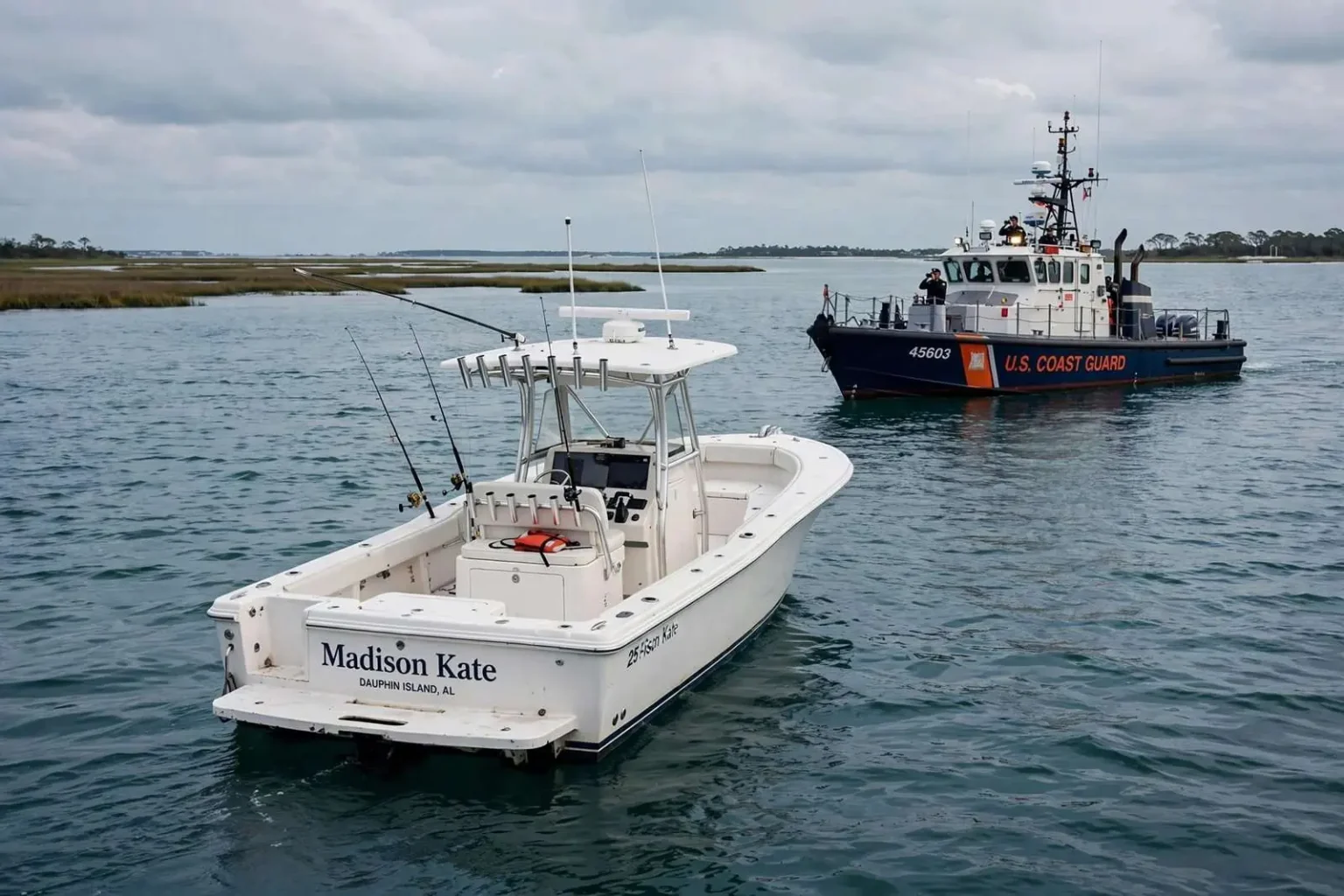
The U.S. Coast Guard Sector Mobile is asking for the public’s help locating the owner of an unmanned vessel found drifting south of Dauphin Island. The boat was discovered with no one aboard, and the agency turned to the community for information as it worked to determine who owned the vessel and whether anyone related to it was missing at sea.
In a Facebook post, the Coast Guard said it received a report of an unmanned, 25-foot white center-console boat approximately 16 nautical miles south of Dauphin Island, Alabama. The vessel is named Madison Kate. The description gave boaters in the region a clear picture of what to watch for as the case developed.
A center console of that size is a common sight in Gulf waters, favored by anglers for its open deck and helm positioned at the center of the boat. A 25-footer is large enough to run well offshore in decent weather, which places the vessel type squarely among the boats that regularly make the run from the Alabama Gulf Coast to fishing grounds south of the barrier islands.
The Coast Guard is asking anyone with information about the boat or its owner’s whereabouts to contact Coast Guard Sector Mobile. Calls from the public — a sighting of the vessel, knowledge of its registration, or word of an overdue boater — are the kind of leads that often resolve cases like this quickly.
How the Coast Guard Handles an Unmanned Vessel
When a boat is found drifting with no one aboard, Coast Guard crews treat it as a potential search-and-rescue case until they can prove otherwise. The first steps are standard: identify the vessel through its registration numbers or hull identification number, check the owner information on file with state and federal registries, and attempt to contact the owner directly by phone and through emergency contacts.
At the same time, watchstanders review radio traffic, float plans, weather forecasts, and any overdue-vessel reports that might match. If there is any indication that people were aboard and are unaccounted for, the Coast Guard launches search operations — aircraft, surface vessels, or both — covering the area where the boat was found and the waters upwind and upcurrent of it, since a drifting boat tells responders roughly where it has been, not necessarily where people went into the water.
When no evidence of distress turns up and the owner is reached safely, the case typically ends with the vessel recovered by its owner or a commercial salvage company. But until that happens, an unmanned adrift boat remains a serious concern: it is a navigation hazard to other vessels, and it may be the only visible sign of a boater in trouble.
Dauphin Island and the Waters to the South
Dauphin Island sits at the mouth of Mobile Bay, the barrier island that shelters the bay’s entrance and hosts one of the busiest commercial and recreational fleets on the northern Gulf Coast. Sixteen nautical miles south of the island puts the location well into open Gulf waters, beyond the sight of land, in the zone where recreational fishing boats routinely travel to reach reefs, rigs, and deep-water fishing grounds.
The waters south of the island see heavy traffic from ports on both sides of Mobile Bay. Recreational anglers run south from Dauphin Island and from ramps around the bay, charter fleets work the same grounds, and commercial vessels transit the area heading to and from the bay’s ship channel. With that much traffic, a drifting unmanned boat rarely goes unnoticed for long — which is exactly what happened in this case, with a good Samaritan reporting the vessel to the Coast Guard.
Good Samaritan reports are a cornerstone of Gulf Coast search and rescue. The Coast Guard repeatedly credits boaters who radio in what they see — a swamped skiff, a life ring, a boat circling under power with no one aboard — as the first link in rescues that would otherwise begin hours later or not at all.
Sector Mobile’s Area of Responsibility
Coast Guard Sector Mobile oversees search and rescue across a wide swath of the north-central Gulf, covering the Alabama coastline and adjoining waters of Mississippi and the Florida Panhandle. From its station at the mouth of Mobile Bay, the sector coordinates response boats, cutter patrols, and air assets from aviation units that cover the Gulf far offshore.
The sector’s personnel handle a full range of cases — medevacs from fishing vessels, grounded sailboats, missing kayakers, and unmanned vessels like the Madison Kate. During busy boating seasons, the volume of calls rises sharply, and watchstanders triage each report against weather, vessel information, and the possibility that lives are at risk.
Public communication is part of that work. Notices on social media and broadcasts over marine radio ask area boaters to keep watch for a specific vessel or person, multiplying the eyes on the water far beyond what any single agency could muster. In cases involving unmanned boats, that outreach is often what brings the answer: someone ashore recognizes the boat and calls in the owner’s name.
What Boaters Can Do to Help
The Coast Guard’s request in this case follows the standard playbook for getting the public’s assistance. Boaters transiting the waters south of Dauphin Island were effectively being asked to keep an eye out for the Madison Kate or anything unusual in the area — debris, life jackets, an emergency beacon — and to report it rather than assume someone else already has.
Mariners with information about the boat or its owner were asked to contact Coast Guard Sector Mobile directly. Even partial information helps: a marina that recognizes the hull, a bait shop customer who remembers the boat at the fuel dock, or a neighbor who knows the owner’s plans can all close the loop on a case that would otherwise demand hours of searching.
Officials also use cases like this to reinforce basic boating preparations. A float plan left with family, a working VHF radio, a registered and labeled vessel, and an emergency position-indicating beacon all shorten the time between something going wrong and help arriving. An unmanned drifting boat with no identifying information can delay a search by many hours; one with current registration can be traced in minutes.
The Hazards of an Adrift Vessel
Beyond the possible rescue dimension, an unmanned vessel poses real risks to other boaters. A 25-foot center console drifting without lights becomes a collision hazard after dark, and one taking on water can sink and leave a submerged obstruction in waters that boats run at speed. That is why the Coast Guard marks, monitors, and — when necessary — takes steps to secure or disable vessels found adrift in traffic lanes.
Currents and wind also carry unmanned boats considerable distances. Over a day or two of drifting, a vessel can move many miles from where it was first reported, which complicates both the search calculations and any recovery effort. Responders factor the drift into everything they do, projecting where the boat will be and adjusting search patterns accordingly.
For the owner, the discovery of a boat adrift offshore is often the first sign that something went badly wrong at sea — an engine failure, a swamping in a sea way, or a person overboard. The Coast Guard’s practice of seeking the owner quickly is designed to answer the most urgent question in the case: whether anyone who left shore on the Madison Kate has made it home.
As of the announcement, the vessel had been reported approximately 16 nautical miles south of Dauphin Island, and the agency had not released any further details about the boat’s condition or the circumstances in which it was found. Anyone with information was asked to contact Sector Mobile as the inquiry continued.
Recreational Boating on the Northern Gulf Coast
The waters off Dauphin Island are among the most active recreational boating grounds on the northern Gulf Coast. On fair-weather weekends, boats by the hundreds make the run south from Mobile Bay and from Perdido Pass to the east, heading for inshore reefs, artificial reef sites, and the deep water where snapper, amberjack, and other Gulf species draw anglers year-round. A 25-foot center console is one of the most common vessels making that trip, large enough to handle the bay’s chop and small enough for a private owner to operate.
That traffic is part of why an unmanned vessel in the area draws attention so quickly. Experienced boaters know what a drifting boat can mean, and the culture on the water — reinforced by Coast Guard outreach and generations of maritime tradition — holds that mariners look out for one another. A report like the one that brought the Madison Kate to the agency’s attention is a routine act of seamanship in the region.
The Coast Guard, for its part, urges boaters to take a few basic steps before heading offshore: file a float plan with someone ashore who knows the route and expected return, check the weather and tide forecasts rather than relying on the morning’s calm conditions, carry communication gear that works beyond cell range, and make sure the vessel’s registration is current so that a boat in trouble can be traced quickly.
When the Search Continues
Cases involving unmanned vessels end in different ways. Sometimes the owner turns up safely — the boat simply slipped its mooring or broke free on a tow line, and no one was ever in danger. Sometimes the owner is located and describes a mechanical failure that forced an abandon ship, and the Coast Guard recovers the crew or learns they were picked up by another vessel. And sometimes no answer comes quickly, and the case remains open while the agency follows every lead the public provides.
Until the Madison Kate’s owner is located, the boat itself remains evidence in that inquiry, and the agency’s public appeal stands: anyone who recognizes the vessel, knows of an overdue boater in the Dauphin Island area, or has information about the boat’s recent movements is asked to contact Coast Guard Sector Mobile. On the northern Gulf Coast, that call from a member of the public is frequently the one that brings a case like this to a safe ending.


