Cold Weather Shelter Opens in Milton as Temperatures Drop Across Northwest Florida
Ferris Hill Baptist Church in Milton opened its cold weather shelter for nights with below-40-degree temperatures in Northwest Florida.
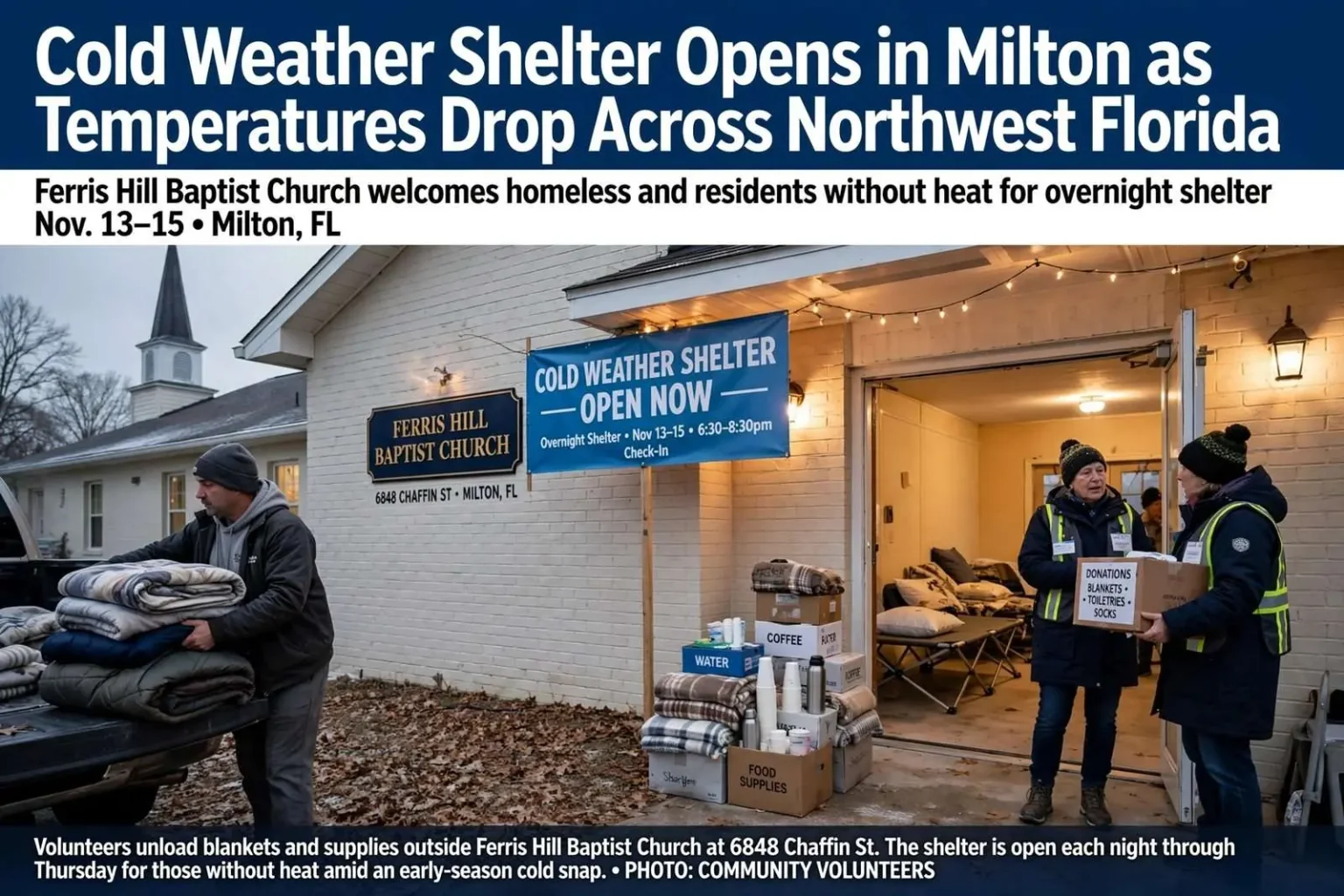
MILTON, Fla. — Ferris Hill Baptist Church at 6848 Chaffin St. opened its cold weather shelter for people who are homeless or without heat, with overnight stays planned for Tuesday, Nov. 13, through Thursday, Nov. 15. The activation came as an early-season cold snap pushed temperatures across northwest Florida toward levels dangerous for anyone sleeping outdoors or in homes without working heat, and church volunteers prepared cots, coffee and warm meals for the guests expected each evening.
The shelter operates on a firm schedule designed to keep the process orderly for both guests and volunteers. Guests must arrive between 6:30 and 8:30 p.m., and no one is admitted after 8:30 p.m. unless brought in by law enforcement. The shelter closes at 7 a.m. each morning, sending guests out with whatever warmth — literal and otherwise — a night indoors can provide as they return to the routines of survival that cold weather makes harder.
Santa Rosa County’s cold weather shelter is operated by Ferris Hill Baptist Church using volunteer resources and donations. The church takes on the work without a paid professional staff, relying instead on members and community volunteers who cook, register guests, monitor the building overnight and launder bedding between activations. Donations of blankets, toiletries and food from the community supply much of what the shelter distributes during a cold snap.
It opens on nights when temperatures are forecast to drop below 40 degrees, typically December through March. The threshold reflects the reality of the Gulf Coast’s winters, where sub-40 nights can arrive suddenly, catching unprepared residents off guard. An early November activation, like this week’s, signals a cold pattern arriving ahead of the season when shelters normally expect to open, and it gives the county a preview of the months ahead.
Who the Shelter Serves
The shelter serves people who are homeless or cannot keep heat in their homes and who can care for themselves. That last qualification matters in a volunteer-run facility without medical staff: the shelter is equipped to provide a warm, safe place to sleep for adults who can manage their own basic needs, not to deliver nursing care or supervision for acute medical conditions. Guests with serious medical needs are better served through emergency services, and shelter volunteers help direct people to the appropriate resources.
Anyone under the influence of drugs or alcohol, unable to walk without assistance, or disoriented is not admitted. The policy protects both guests and volunteers, keeping the shelter environment calm and safe for everyone inside. Volunteers say the rules are applied with compassion — the goal is to serve as many people as possible, safely — and the limitation on admissions after 8:30 p.m. exists for the same reason: once lights go down, the overnight volunteers need a predictable, secure environment.
The population the shelter serves in Milton mirrors the homeless and housing-insecure population across northwest Florida. Some guests sleep outdoors year-round; others are one broken heater or one overdue power bill away from a cold night, living in homes without adequate heat during a freeze. Cold weather shelters serve both groups, and church volunteers say the second group often grows the fastest during a hard cold snap, as families and older residents on fixed incomes struggle with heating costs.
Northwest Florida’s winters are short by national standards, but that brevity is part of the danger. The region’s housing stock is built for heat and humidity, not cold, and many homes lack central heating altogether. Residents accustomed to mild Decembers can be caught genuinely unprepared by a January front that drops temperatures below freezing, and hypothermia cases in the Panhandle tend to cluster in exactly those surprises — cold snaps that arrive early, stay late or plunge farther than forecast.
Health officials warn that cold exposure is more dangerous than most Gulf Coast residents assume. Hypothermia can develop in temperatures well above freezing when wind and wetness are factors, and older adults, people with chronic illness and anyone sleeping outdoors face the greatest risk. On nights when the forecast approaches the shelter’s threshold, county officials urge residents to check on elderly neighbors, bring pets indoors and take extra care with space heaters, which are a leading cause of house fires during regional cold snaps.
The shelter’s November activation also serves as an early test of the season’s readiness. Each opening exercises the volunteer call-down list, the supply inventory and the coordination with law enforcement, exposing gaps while the calendar still offers time to fix them before the heart of winter. Churches that operate shelters say the first activation of a season is often the roughest — and the most valuable — for exactly that reason.
How Cold Weather Shelters Work in Santa Rosa County
The trigger system is simple: when the forecast calls for temperatures below 40 degrees, the shelter opens, and word spreads through the county’s network of churches, social service agencies, law enforcement and local media. Deputies and police officers who encounter people outdoors on a cold night know they can bring them to Ferris Hill even after the regular admission window has closed, an exception written into the shelter’s rules precisely for encounters that happen late.
Volunteers describe a cold-weather activation as an all-hands effort compressed into a few hours’ notice. Before guests arrive, the church’s fellowship space must be arranged, cots or bedding laid out, dinner prepared and check-in stations staffed. Overnight, volunteer teams rotate through monitoring duties, and in the morning the space must be cleaned and reset for the possibility of another activation the following night. A multi-night run like this week’s Tuesday-through-Thursday stretch multiplies that work, which is why churches recruit extra volunteers each season.
The shelter model depends on donations as much as volunteers. Blankets, warm clothing, coffee, food and toiletries all come from community contributions, and churches that operate cold weather shelters in the Panhandle consistently report that public response spikes with each cold snap. Residents who want to help typically can donate supplies, contribute funds or sign up for volunteer shifts through the host church.
Ferris Hill Baptist Church’s role reflects a broader pattern across northwest Florida and south Alabama, where cold weather shelters are most often operated by churches rather than government agencies. Congregations have the buildings, the volunteer bases and the community trust, while counties have limited social services budgets. The partnership between church initiative and community donation fills a gap that neither could bridge alone, and it has become an institutional fixture of Panhandle winters.
What Guests and Neighbors Should Know
For anyone who needs the shelter, the essentials are straightforward: arrive at 6848 Chaffin St. in Milton between 6:30 and 8:30 p.m., plan to stay until the 7 a.m. closing, and expect a warm, supervised place to sleep. Guests should bring whatever personal belongings they can carry; donations cover the rest. Transportation challenges are common for the population the shelter serves, and word-of-mouth, outreach workers and law enforcement all help connect people to the church before the 8:30 p.m. cutoff.
Neighbors who encounter someone outdoors during a cold night — disoriented, unable to walk, or otherwise in medical distress — are encouraged to call 911 rather than attempt transport themselves, since those situations fall outside what the shelter can safely handle. The law enforcement exception exists so that officers can bring people in after hours when appropriate, bridging the gap between emergency response and charitable shelter.
As the cold snap passed through the region, church members said the shelter’s mission remained unchanged from year to year: no one should freeze in Santa Rosa County when a warm room and a meal are within reach. The Tuesday-through-Thursday activation was expected to conclude as temperatures moderated, with volunteers cleaning, restocking and standing ready for the next forecast that dips below 40 — the signal that sends Milton’s cold weather shelter back into action.
Residents who want to support the effort have several practical options during any activation. Donations of new blankets, coats, socks and toiletries meet the most consistent needs, while food contributions — particularly items that can be served hot — help cover evening meals. Financial donations give volunteers flexibility to buy exactly what runs short, and volunteering for an overnight shift or a morning cleanup makes the multi-night runs sustainable for the small core of members who carry them.
The shelter’s presence in Milton also connects to the county’s wider safety net. Social service organizations, food pantries and health clinics across Santa Rosa County refer people to the shelter during cold snaps, and the shelter in turn connects guests to those longer-term resources. For many guests, a night at Ferris Hill is a single warm room in a longer struggle; for some, it has been the first step toward housing, treatment or a job — a bridge built one cold night at a time.