Contrasting Tones Defined Mobile’s 2017 Mayoral Campaign as Voters Headed to the Polls
As Mobile's 2017 municipal election reached Election Day, the mayoral campaign between incumbent Sandy Stimpson and challenger Sam Jones closed out months of sharply contrasting messaging, from outreach-focused positivity to identity-driven rhetoric and a late-breaking IRS bond penalty disclosure.
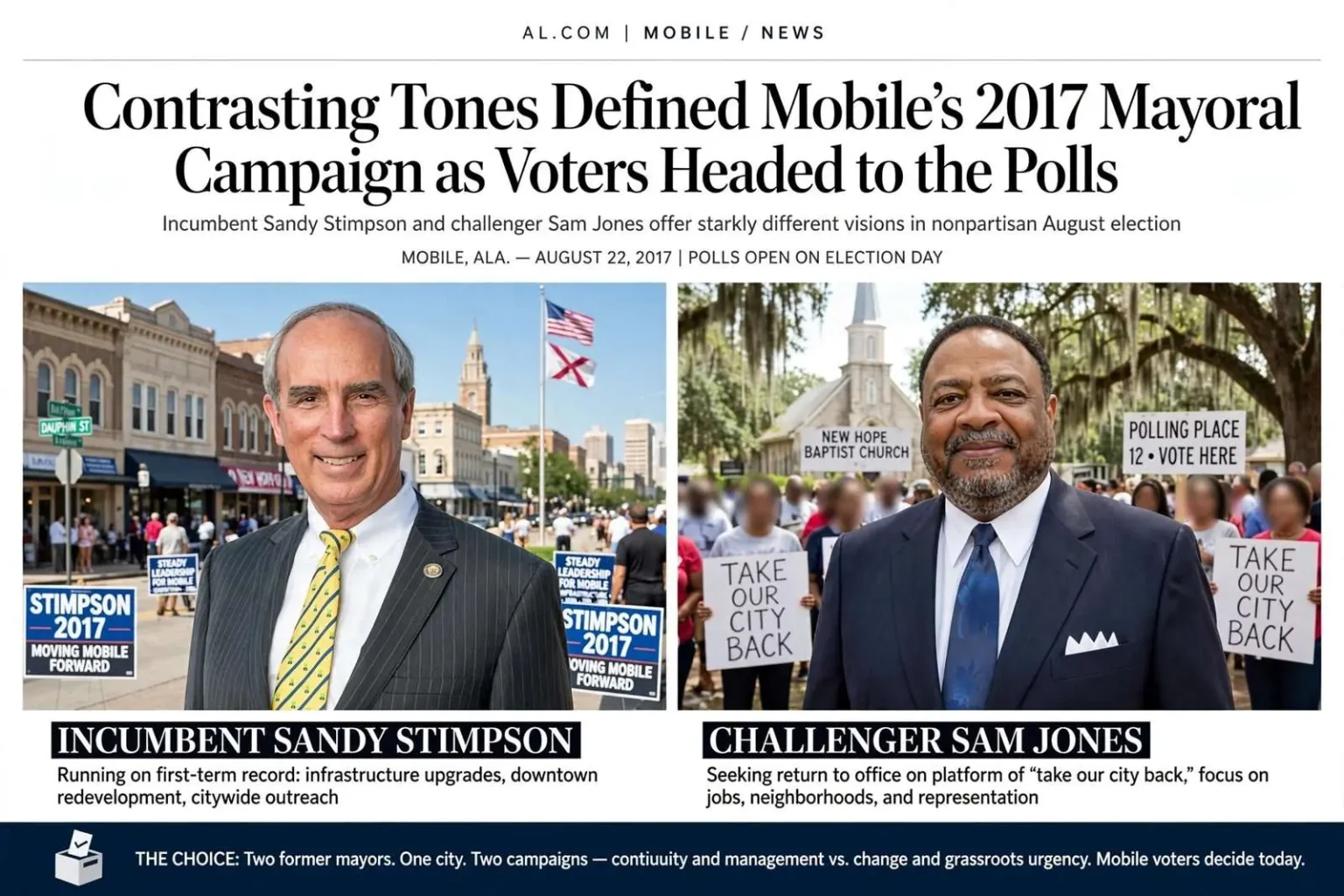
Mobile voters lined up at polling places across the city on Election Day in August 2017 to settle a mayoral contest that had produced two starkly different approaches to winning City Hall. Incumbent Mayor Sandy Stimpson and challenger Sam Jones, the former mayor whom Stimpson had unseated four years earlier, spent months courting voters with messages that diverged sharply in both substance and tone. The campaign gave residents a clear choice not just of candidates but of campaign styles, and it unfolded under Alabama’s nonpartisan municipal election rules, which put the race on an August ballot and left party labels out of the equation entirely.
Stimpson’s reelection bid leaned heavily on the record his administration had built over its first term, emphasizing infrastructure projects, downtown redevelopment and other tangible improvements the campaign said the city had seen since he took office in 2013. His team pointed to repaved streets, drainage work and a revived urban core as evidence that the city’s trajectory had changed. The message was aimed at a city that had spent years discussing its potential — the port, the aerospace cluster at Brookley Aeroplex, the walkable downtown grid — and the incumbent framed himself as the manager who was finally delivering on it.
Alongside the record, the Stimpson campaign made a visible push to court voters across all of Mobile’s neighborhoods, holding events and outreach efforts well beyond the incumbent’s natural base. That strategy drew criticism from the Jones campaign, which characterized it as insincere. Supporters of the incumbent countered that the citywide approach reflected an effort to represent all of the city’s residents rather than a narrower base — a meaningful distinction in a mayor-council city where the mayor answers to the entire municipality rather than a district.
Jones, seeking to reclaim the office he held from 2005 until 2013, built his campaign around a message aimed at consolidating a specific bloc of voters. Campaign rhetoric from Jones and his surrogates referenced “the 52 percent” and calls to “take our city back,” framing the race in terms of identity rather than policy specifics. The approach drew scrutiny from observers who noted that it left out any messaging directed at the remainder of the electorate — a notable posture in a general election, where a candidate must assemble a citywide majority rather than win a low-turnout primary.
The structure of Mobile’s government raised the stakes of the choice. The city operates under a strong-mayor form of government, in which the mayor controls the day-to-day administration of city departments, proposes the budget, and drives the agenda for economic development. The seven-member City Council writes ordinances and approves spending, but the mayor’s office sets the tone for how the city is run. Whoever won in August 2017 would hold the pen on contracts, department leadership and the city’s relationships with the port, the airport authority and the county.
For the candidates themselves, the rematch carried personal weight. Stimpson, a former executive at a local pipe manufacturing company, had entered politics late and defeated Jones in 2013 by campaigning on competence and management reform. Jones, a former city councilman who became the first African American to serve as Mobile’s mayor, had governed through the recession years and the early recovery from the Deepwater Horizon oil spill’s damage to the Gulf Coast seafood and tourism economy. Each man represented a different answer to the question of what Mobile needed next, and each spent the summer of 2017 making that case at fish fries, civic club meetings and church fellowship halls across the city.
The sharpest criticism aimed at the Jones campaign centered on remarks his surrogates made about black Mobilians who had supported Stimpson in the previous election. Those voters were described in some campaign rhetoric as having been swayed by free food and entertainment at Stimpson campaign events, comments that struck many as dismissive of voters’ independent judgment. Jones himself referenced the theme during his campaign announcement, joking about constituents eating at rallies while their votes remained unseen.
The remarks became a recurring point of contention throughout the race. Critics argued that any campaign confident in its message should not need to question its opponents’ supporters’ motives, and that suggesting black voters had been purchased with plates of barbecue treated a consequential civic decision as a transaction. The episode played out against the longer history of black political power in Mobile, where black voters had formed a decisive share of the winning coalition in every mayoral race since the 1980s and where candidates of both races had long competed for that support. Treating that support as casual or purchasable, critics said, misread both the electorate and the stakes.
For his part, Jones had a governing record he pointed to: he had led the city through the depths of the national recession, and his administration had pursued the early negotiations and groundwork that later carried Mobile’s industrial expansion. His argument in 2017 was essentially that he had done the job before and that the city’s prosperity had not been shared evenly — a message that resonated in neighborhoods where the downtown revival felt a world away. The tension in the campaign was that this substantive argument was often overshadowed by the identity-focused rhetoric coming from his surrogates.
Stimpson’s team, meanwhile, worked to keep the race on the ground of his first-term record. The campaign emphasized a culture of transparency at City Hall, the adoption of a strategic plan for city services, and measurable improvements in how quickly the city handled basic functions such as permitting and paving. Endorsements from business leaders and neighborhood associations gave the argument institutional weight, and the incumbent’s low-key personal style — a self-described numbers man more comfortable with spreadsheets than stump speeches — was presented as a feature rather than a flaw.
The contrast in tone was impossible to miss by the final weeks. One campaign was running as a satisfied report card, the other as a correction. Voters navigating the race had to weigh whether the incumbent’s steady management deserved another term or whether the challenger’s urgency about change — and his claim that the city’s leadership had grown complacent about who was benefiting from growth — warranted returning him to the office he had lost.
Underneath the tone war, the two camps also differed on how the city should measure its own success. Stimpson’s campaign cited bond ratings, budget reserves and the arrival of new employers as the metrics that mattered. Jones’s campaign pointed to unemployment in particular zip codes, the condition of streets and parks outside the downtown core, and the sense among some residents that city hall’s attention followed investment rather than leading it. The election was, in that sense, a referendum not only on a mayor but on which map of Mobile voters believed described the real city.
Policy substance also entered the campaign’s final stretch. The Stimpson camp raised questions about an Internal Revenue Service penalty tied to the alleged misuse of a tax-free municipal bond, an issue that traced back to the prior administration and that could have cost the city as much as $45 million before Stimpson’s team negotiated a smaller, undisclosed settlement. Stimpson said he opted not to publicize the resolved penalty when he first learned of it after taking office, preferring to move past it rather than dwell on the previous administration’s dealings.
The issue resurfaced late in the campaign after Jones began citing the city’s financial position as evidence of his own fiscal stewardship, prompting the Stimpson campaign to detail the bond penalty publicly. Municipal bonds carry tax-exempt status on the condition that proceeds serve a public purpose, and the Internal Revenue Service can claw back tax benefits — and impose substantial penalties on the issuing government — when that condition is breached. Because the underlying tax law issues were technical, the disclosure generated some news coverage but did not appear to reshape the race in its closing days. Most voters encountered it, if at all, as a one-line summary: an inherited problem, quietly settled for less than the worst-case figure.
By contrast, the City Council races playing out on the same ballot generated relatively little controversy, with most incumbents facing straightforward reelection bids and comparatively low-key campaigns. Mobile’s council districts each elect a single member, and in a year when the mayor’s race absorbed the community’s attention and most of its political spending, the district contests drew modest fundraising and little organized opposition. The muted council contests stood in sharp relief against the mayoral race’s more combative exchanges, and they meant that whoever occupied the mayor’s office would likely be dealing with a largely familiar council whose members had built their own neighborhood relationships independent of the citywide campaign.
Beyond the policy debates and pointed rhetoric, the campaign season also produced its share of lighter moments, including local social media buzz around a rescue dog that became an unofficial mascot amid the otherwise tense final weeks of campaigning. The episode offered Mobile voters a brief reminder that municipal politics, for all its edge, is also a civic ritual — yard signs, sample ballots and community forums that recur every four years regardless of who is running.
With polls open and ballots being cast, the 2017 municipal election marked the culmination of a campaign season that tested two very different visions for how a candidate should court Mobile’s electorate — one built on continuity, record and outreach, the other on consolidating a defined base of support around a message of reclaiming what had been lost. Whichever vision prevailed, the city that emerged from the election would be governed by a mayor chosen from two men who had each already held the job, in a municipality whose downtown was ascending and whose neighborhoods were still deciding whether they had been brought along.
A choice of eras on one ballot
In the end, the 2017 race functioned as a bridge election between two eras of Mobile politics. The campaigns disagreed about tone, about tactics and about who the city belonged to, but both asked the same underlying question: whether Mobile’s recent momentum belonged to everyone. The answer, delivered at polling places from Toulminville to Tillman’s Corner, would set the city’s direction for the next four years.